Businesses left behind in Australia’s rooftop solar and storage stampede
Commercial and industrial rooftops a vast, untapped resource
Key Takeaways:
There is significant untapped potential to expand renewable energy through encouraging greater uptake of solar and batteries in Australia’s business facilities in Australia. Australia leads the world in residential solar with 22GW installed but businesses have only installed 5.6GW, in spite of consuming more electricity than households.
Studies indicate the technical rooftop potential for solar across commercial and industrial areas could be close to 40GW, and once agricultural areas are included it could exceed 80GW. Some forecasts suggest we could fall a long way short of that potential with CSIRO suggesting slow growth to just 17GW by 2050.
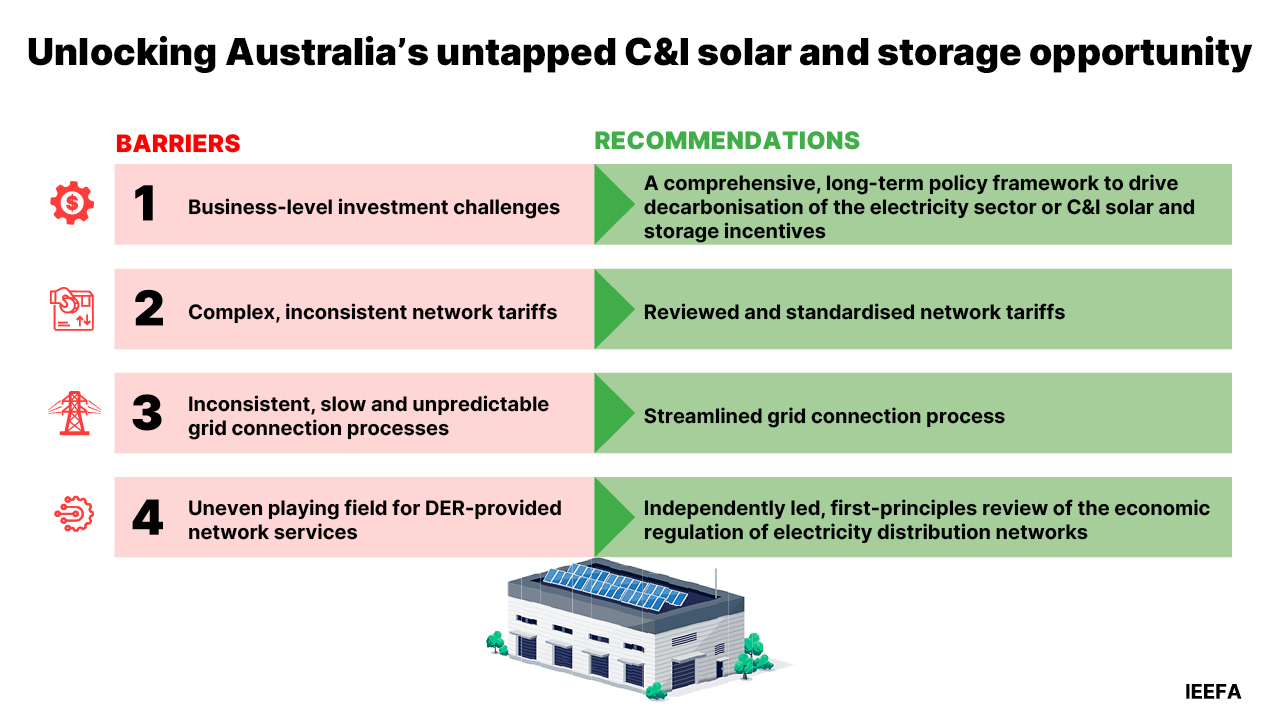
We could substantially accelerate the uptake of business solar and storage by addressing a range of barriers that are constraining uptake to levels well below what is economically optimal. These barriers include distorted investment frameworks, complex and inconsistent network tariffs and slow and unpredictable grid connection processes.
These barriers can be overcome through improved incentive schemes, reviewed and standardised network tariffs, a streamlined grid connection process, and a first-principles review of distribution network economic regulation.
Unlocking the business solar and storage segment could help serve energy demand as aging coal power stations coal close, reduce energy costs for businesses, and assist in decarbonising our electricity supplies.
Business rooftops are a huge potential source of clean energy yet the sector faces substantial barriers to uptake, according to a new report released today.
Australia is a world leader in household rooftop solar but business lag, with the sector the “missing middle” between residential and utility-scale solar in the nation’s transition to renewable energy, finds the report, Unlocking the clean energy potential of Australian business rooftops.
“The power-generating capacity installed on household roofs in Australia is roughly equal to that of the coal plants in our grids,” says co-author Johanna Bowyer, lead analyst, Australian electricity at IEEFA. “However, we have not seen the same scale of action within Australia’s commercial and industrial buildings even though they consume substantially more electricity than the household sector.”
To date, only 5.6 gigawatts (GW) of business rooftop solar capacity has been installed across Australia’s main grids, far behind households (~22GW). This includes capacity installed at sites such as factories, retail stores, supermarkets, farms, schools and hospitals. The forecast capacity of business solar in 2050 has been placed at 17–32GW, and the technical rooftop potential could be even higher. C&I storage installations are also well behind households, although demand is increasing quickly. The report identifies four key structural barriers to C&I rooftop solar and storage uptake:
- Distorted business-level investment barriers: Businesses often rent their premises, making investment in long-lived assets more complex, and businesses often have many competing priorities in terms of capital allocation. Solar and storage projects in businesses are often too big to qualify for residential incentives and too small to qualify for utility-scale incentives.
- Patchwork network tariffs: Complex and inconsistent network tariff structures make it difficult for businesses to model investment returns, develop software and control systems to manage batteries, and scale up business models.
- Grid connection issues and delays: A fragmented, slow and unpredictable grid connection process adds to costs and delays for solar and storage projects in businesses, which can take anywhere from a few months to a year or more with numerous studies and revisions.
- Uneven playing field for network services: Regulatory processes hinder business solar and storage providers from competing with networks to help address identified network needs.
“Left unaddressed, these barriers will continue to constrain investment, slow down uptake and leave the full potential of C&I solar and storage unrealised,” Ms Bowyer says.
The report recommends a set of solutions to help overcome these barriers and unlock the potential of C&I solar and storage.
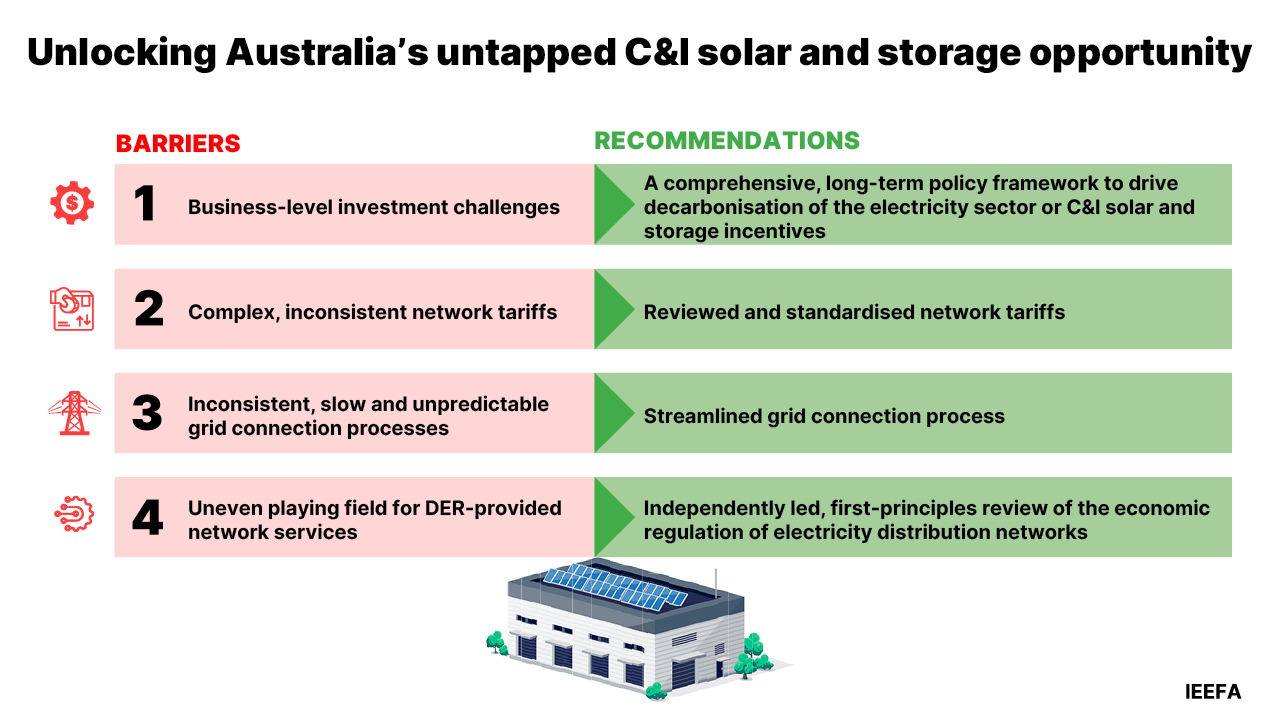
“Governments need to develop a more comprehensive, long-term policy framework to drive decarbonisation of the electricity sector,” co-author Tristan Edis says. “In absence of this or as an interim step, incentives for the business sector should be considered to help the ‘missing middle’ overcome sub-optimal levels of investment by businesses in non-core energy projects.”
Demand charges, which comprise up to 40% of business’s electricity bills, are complex and inconsistent across networks, depending on the timing, duration and definition of peak periods.
“This creates significant complexity and cost for C&I solar and storage providers and makes it difficult for C&I solar and storage providers to optimise battery control models,” Ms Bowyer says. “Network tariffs should be reviewed and standardised.”
The report recommends the grid connection process be streamlined.
“To streamline the grid connection process, technical requirements could be harmonised across Australia, and a fast-track pathway for C&I projects that fit within a standard architecture should be introduced – alongside other measures,” Ms Bowyer says.
“Finally, the network economic regulation regime was designed a long time ago, before it was clear that batteries, demand management and other such non-network solutions could support the network. A first-principles review of electricity network economic regulation should be undertaken, with explicit consideration of non-network solutions and their ability to deliver network services.
“These recommendations offer a set of solutions to enable the C&I sector to be scaled up at pace, helping serve demand as coal exits, and supporting Australia in attaining its emissions reduction goals while reducing energy costs for businesses.”
Read the report: Unlocking the clean energy potential of Australian business rooftops
Media and Author contact: Johanna Bowyer, ph: +61 466 041 121, e: [email protected]
About IEEFA: The Institute for Energy Economics and Financial Analysis (IEEFA) examines issues related to energy markets, trends and policies. The Institute’s mission is to accelerate the transition to a diverse, sustainable and profitable energy economy. (ieefa.org)