How a windfall LNG export tax can benefit all Australians
Pivotal moment for government to future-proof royalty regime
Key Takeaways:
A tax on LNG exports amid surging global prices and the prospect of windfall profits could help fund cost-relief and fuel-shifting measures to protect Australian consumers exposed to rising oil prices.
Surging LNG prices following Russia’s invasion of Ukraine delivered windfall profits for LNG exporters from FY2021-22 to FY2023-24, but PRRT revenues per gigajoule of gas extraction increased by only a small amount.
Several tax reform options could ensure a range of improved outcomes, particularly during windfall periods, with price-based royalties and a flat tax on revenues the most promising models.
9 April 2026 (IEEFA Australia): Gas exporters will be one of the only domestic industries to benefit from the global fuel crunch caused by the Middle East conflict, and all Australians should share in their windfall, according to a briefing note released today.
The crisis is a pivotal moment for the federal government as it weighs changes to Australia’s resources tax and royalty regimes, and the options available are wide-ranging and mostly positive, finds the note, Australians sharing in windfall LNG profits? A no-brainer.
Ensuring Australians receive a fair return from the nation’s gas resources could help fund cost-relief and fuel-shift measures, says the author, Josh Runciman, Lead Analyst, Australian Gas at the Institute for Energy Economics and Financial Analysis (IEEFA).
“Rising LNG prices are likely to massively boost Australian LNG export earnings, as happened after Russia’s expanded invasion of Ukraine, when oil and gas sector profits increased from AU$13 billion in FY2020-21 to a staggering AU$62bn in FY2022-23,” Mr Runciman says.
“However, Australia’s taxation of LNG exports suggests that higher international prices will not fully translate into higher tax receipts. Oil and gas royalties as a share of export earnings were lower in that period when LNG prices peaked, than in years of more normal pricing.”
The fuel crisis highlights a glaring disparity between the royalties imposed on gas and coal exports.
“In contrast, coal royalties as a share of revenue doubled in FY2022-23 compared with FY2020-21 as prices rose,” Mr Runciman says. “In total, coal royalties were four times higher than oil and gas royalties in times of elevated prices.
“The relatively low tax rate during a period of windfall profits partly reflects low payments under the Petroleum Resources Rent Tax (PRRT) framework.”
For example, from FY2018-19 to FY2023-24, PRRT payments per gigajoule (GJ) of sale gas ranged from AU$0.21-0.41 per gigajoule (GJ), well below Queensland’s royalties of AU$0.19-1.57/GJ over the same period.
“Queensland’s royalty revenues increased materially in years where LNG exporters earned windfall profits,” Mr Runciman says. “IEEFA estimates that, in absolute terms, Queensland’s royalty revenue was higher than PRRT revenues when prices spiked in in FY2022-23 and FY2023-24.
“This is despite gas production in Commonwealth waters (i.e. subject to the PRRT) being three times higher than Queensland’s production in FY2022-23, and 2.75 times higher in FY2023-24.”
Oil/gas and coal exports (AU$ billion, left) vs royalties as a share of revenue (right)
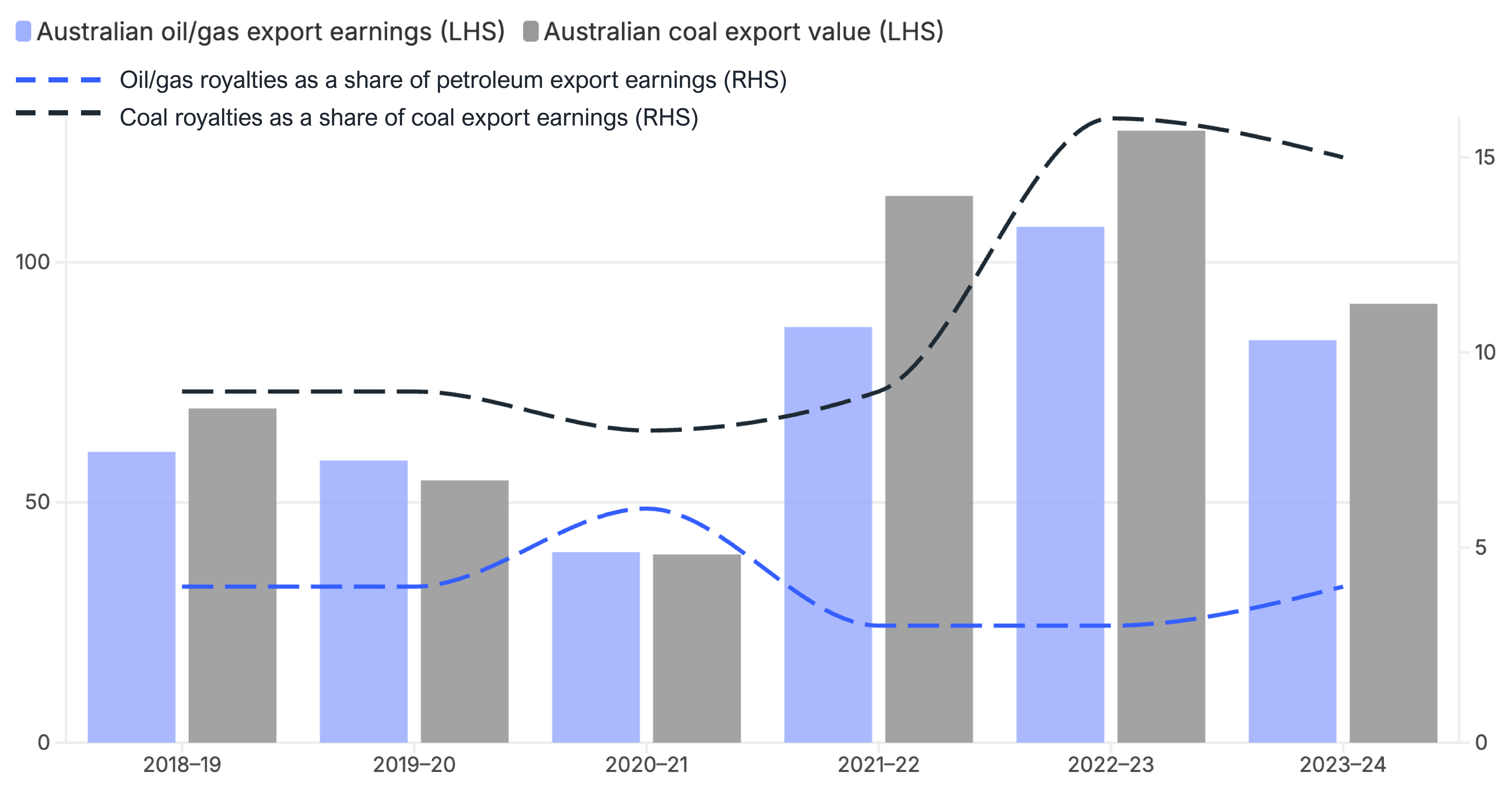
Sources: Australian Energy Producers, Queensland Government, NSW Government and Australian Government
As a profit-based tax, the PRRT allows LNG exporters to carry losses forward, which effectively minimises tax obligations in the early years of LNG projects, with payments increasing once exporters recover their costs.
“While this framework is intended to incentivise investment, effectively it partly transfers construction risk to the Australian public, who have no ability to manage this risk,” Mr Runciman says. “Most Australian LNG projects experienced construction delays and cost blowouts, which have delayed and decreased PRRT payments.”
The note compares the PRRT with a range of proposed reforms to Australia’s resources taxation framework, including:
- A flat tax on LNG exports
- Volume-based royalties
- Windfall profit taxes
- A fair share levy
- Price-based royalties
“This assessment shows the many drawbacks of the PRRT regime, with multiple proposed options representing an improvement,” Mr Runciman says. “Several models are promising, with a majority of positives against the selected criteria. In particular, the flat LNG tax and price-based royalty perform the best. However, we note that different criteria might support other options.”
Post-Ukraine, several European countries implemented windfall taxes, while other countries benefited from existing taxation arrangements.
“The conditions are right to reform royalties on Australian LNG exports,” Mr Runciman says. “The current system does not appear to be working, and prices are expected to be elevated for an extended period.
“With Australian LNG exporters set to earn windfall profits for the second time in five years, the broader public is increasingly questioning the value to them. Reforming taxation would allow some of these windfall benefits to flow to all Australians.”
Read the note: Australians sharing in windfall LNG profits? A no-brainer
Media contact: Amy Leiper, ph +61 414 643 446, [email protected]
Author contacts: Josh Runciman, [email protected]
About IEEFA: The Institute for Energy Economics and Financial Analysis (IEEFA) examines issues related to energy markets, trends, and policies. The Institute’s mission is to accelerate the transition to a diverse, sustainable and profitable energy economy. (ieefa.org)