India targets 60% non-fossil fuel energy in its overall mix by 2035, with financing its next big hurdle
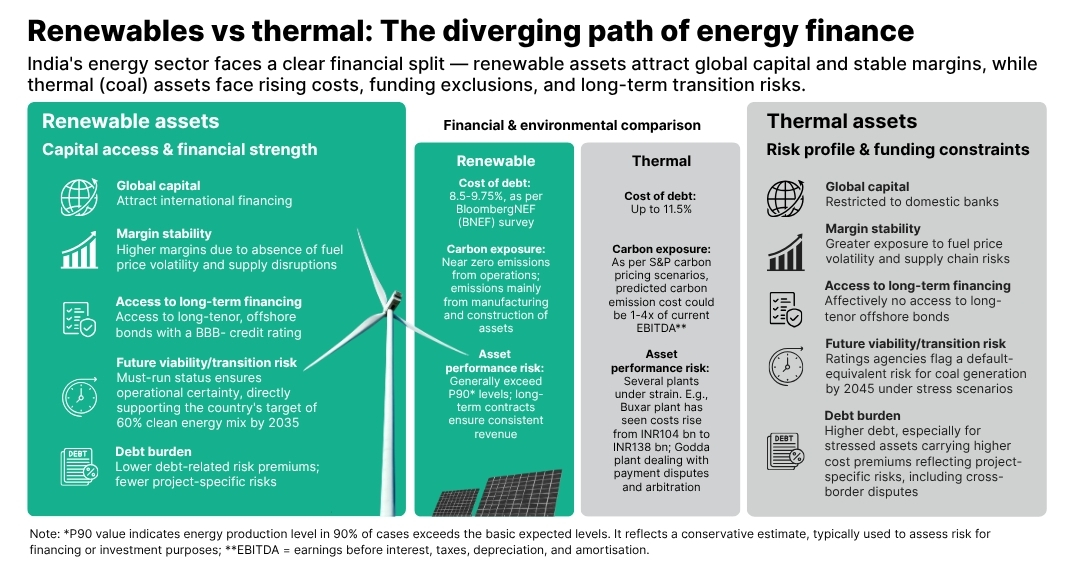
Financing needs are anticipated to rise to USD145 billion annually by 2035 for renewables, making debt markets and not just technology or policy central to the energy transition.
Key Takeaways:
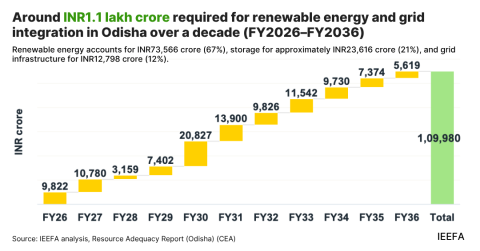
Annual investments in renewables, storage and transmission are estimated to surge from USD68 billion (INR6.18 trillion) by 2032 to as much as USD145 billion (INR13.19 trillion) by 2035. Given the capital-intensive, long-lived nature of renewable assets, transition planning is, at its core, a question of debt market planning. And in an era of heightened geopolitical instability, the shift to clean energy is equally a matter of national energy sovereignty.
Credit markets are already structurally differentiating between clean and thermal assets: Renewable platforms deliver stronger margins, lower variable costs, and broader access to capital than their thermal peers. New thermal investments risk crowding out balance sheet flexibility for renewable financing, compounding an already widening credit divergence.
With a sovereign-aligned credit rating and a planned capex of INR7 trillion (USD80 billion) through financial year (FY)2032, NTPC Limited, India's largest state-owned power utility, is uniquely placed to anchor large-scale, low-cost transition financing and catalyse broader capital flows across the sector.
India's corporate bond market remains structurally underdeveloped, with loans the dominant funding channel across the economy. Over-reliance on more mobile international capital flows also exposes the energy transition to sudden foreign capital repatriation, making a greater role for long-term domestic institutional investors a matter of financial resilience, not just market development.
7 April 2026 (IEEFA): India’s target to reach 500 gigawatts (GW) of renewable energy by 2030 and 60% non-fossil fuel in its energy mix by 2035, under the country’s revised Nationally Determined Contributions (NDC), will depend as much on structure of debt finance as on technology or policy. A new report by the Institute for Energy Economics and Financial Analysis (IEEFA) finds that India's credit markets are already differentiating between clean and thermal energy assets, with consequences for company balance sheets that are hard to ignore.
India's dependence on imported fossil fuels — for crude oil and liquefied natural gas (LNG) for power — leaves its economy acutely exposed to geopolitical shocks and supply disruptions, reinforcing the urgent need to accelerate transition.
‘Financing the energy transition: A credit perspective on India’s power sector’ examines financial indicators for eight key power generators —Adani Green Energy Limited (AGEL), Adani Power, JSW Energy Limited (JSWEL), ReNew Power, NLC India Limited (NLCIL), NTPC Limited, SJVN Limited, and Tata Power — together representing roughly one-third of India's installed capacity. Annual investments in renewables, storage and transmission are estimated to surge from ~USD68 billion (INR6.18 trillion) by 2032 to ~USD145 billion (INR13.19 trillion) by 2035. With renewable assets being capital-intensive with long operating lives, long-tenor amortising debt is the most efficient form of financing and will determine the pace of India's transition.
“The power sector is already among the largest borrowers in India’s domestic debt markets, and this role is likely to expand as investments accelerate. In this context, transition planning is, fundamentally, a question of debt market planning. The availability, tenor and cost of debt will decide how fast capacity can be added — and who gets left behind,” says Kevin Leung, Sustainable Finance Analyst, Debt Markets, IEEFA – Europe, and a contributing author of the report.
The credit divergence between renewable and thermal assets is already visible across key financial metrics. Renewable-focused utilities enjoy stronger margins, thanks to zero fuel costs, broader access to offshore and international financing, and stronger interest from global institutional lenders. Meanwhile, thermal-linked credits are being progressively shut out of international capital markets. All outstanding USD-denominated bonds from Indian power utilities are linked to renewable or hydro assets. Tata Power's 2021 offshore bond repayment marked a de facto exit for thermal credit from that channel.
“Adani Green Energy Limited consistently outperforms Adani Power on EBITDA margins within the same corporate group. Similarly, NTPC Green outperforms NTPC's legacy thermal operations. These are not cyclical differences. They reflect a structural shift in the economics of power generation that will compound over time as renewable portfolios mature and generate stable, contracted cash flows,” says co-author Soni Tiwari, Energy Finance Analyst, India, IEEFA.
The report finds that not all issuers will face transition risks equally. Financially constrained players will face a dual challenge: Limited balance sheet flexibility to adapt decarbonisation strategies, alongside increasingly restricted access to the funding sources that remain available to higher-quality credits. State-owned enterprises like NTPC and SJVN benefit from implicit government backing that provides refinancing flexibility unavailable to private issuers.
Meanwhile, India’s corporate bond market, despite annual issuances exceeding USD500 billion (INR47 lakh crore) in 2025, remains shallow, with growth driven by public sector issuers. Uneven issuances by utilities underscore the limited role of bond markets as a funding channel. The eight utilities studied rely on loans for nearly 80% of their debt, highlighting significant untapped potential for bond markets.
The composition of that capital base matters too. Over-reliance on international capital flows carries its own vulnerability: In periods of geopolitical stress, mobile forms of foreign capital can be prone to rapid reallocation, creating a transition investment flight risk. Hence, building a stable, domestically anchored funding base, led by long-term domestic institutional investors such as pension funds, insurers and provident funds, becomes a resilience imperative.
Among the utilities, NTPC is central to unlocking transition finance. It is India’s largest integrated power utility accounting for around 17% of installed capacity, with 51.1% government ownership and a credit rating aligned with sovereign debt.
“It is uniquely positioned to anchor large-scale, low-cost financing for the power sector’s shift to clean energy. NTPC’s INR7 trillion (USD80 billion) capex plan through FY2032 makes it the single most consequential capital allocator in the sector. If NTPC can demonstrate credible transition to a clean energy company, it would facilitate broader capital flows via a coherent transition finance agenda alongside other catalytic efforts,” says contributing author Saurabh Trivedi, Lead Specialist, Sustainable Finance & Carbon Markets, IEEFA - South Asia.
Scaling renewable capacity can help deepen India’s debt markets and reduce climate-related systemic risk. And with the right reforms, debt finance becomes not just an enabler, but a strategic lever for building a more resilient financial system and supporting sustainable growth.
Read the report: Financing the energy transition: A credit perspective on India’s power sector
Media contact: Prionka Jha ([email protected]); +91 9818884854
Author contacts: Kevin Leung ([email protected]); Saurabh Trivedi ([email protected]); Soni Tiwari ([email protected])
About IEEFA: The Institute for Energy Economics and Financial Analysis (IEEFA) examines issues related to energy markets, trends, and policies. The Institute’s mission is to accelerate the transition to a diverse, sustainable and profitable energy economy. (ieefa.org)