Energy efficiency gains save Bangladesh USD3.3 billion in one year
Bangladesh’s nearly decade-long effort to improve energy efficiency is paying off.
Key Takeaways:
In less than a decade, Bangladesh improved energy efficiency by 13.64%, an annual gain of 1.52%. In FY2023-24 alone, fossil fuel consumption of 7 million tonnes of oil equivalent (Mtoe) was avoided, slashing import bills by USD3.3 billion.
This sustained national effort created a framework for energy efficiency. However, after initial gains from FY2016-17, progress slowed until FY2020-21 when energy supply disruptions and higher tariffs made efficiency a priority.
Bangladesh is on course to achieve its energy efficiency targets a year early. With households and industry consuming two-thirds of the country’s energy, these sectors should be the focus for greater energy efficiency gains.
Proper standards and labels, and passive design features will ensure optimal energy efficiency in buildings. In industry, efficiency improvements in motors, motor drives and captive power generation, and switching to electric boilers, will cut energy consumption significantly.
17 December 2025 (IEEFA): Bangladesh’s nearly decade-long effort to improve energy efficiency is paying off. With targeted measures, the nation can build on this momentum and achieve its energy efficiency goals ahead of time, according to a new report by the Institute for Energy Economics and Financial Analysis (IEEFA).
Since 2016, energy efficiency gains have saved Bangladesh billions in fossil fuel imports, with great economic and environmental benefits for the nation, finds the report ‘Bangladesh’s energy efficiency goals within reach’ by Shafiqul Alam, Lead Energy Analyst, Bangladesh, IEEFA South Asia.
The report analyses Bangladesh’s primary energy consumption and gross domestic product (GDP) trends over the past decade to examine the country’s progress on energy efficiency.
“Between fiscal year (FY) 2014-15 and FY2023-24, energy efficiency increased by 13.64% against a target of 20% by 2030,” says Alam. “In FY2023-24 alone, energy efficiency gains helped Bangladesh cut fossil fuel consumption worth 7.02 million tonnes of oil equivalent, avoiding approximately USD3.34 billion in import bills.”
Initially, progress was encouraging but patchy until the global energy price shock and supply disruptions in FY2021-2022 made energy security and efficiency an urgent priority. Fortunately for Bangladesh, the Energy Efficiency and Conservation Master Plan developed in 2016 laid the groundwork to respond to such eventualities.
Subsequent regulations, low-cost financing and allied programmes have put Bangladesh on track to achieve, and even surpass, its energy efficiency goals.
“Bangladesh’s average annual energy efficiency improvement rate hovers around 1.52%, a trend that will likely help the country achieve its 2030 goal a year ahead of the deadline,” Alam adds.
While the updated Nationally Determined Contributions incorporated an energy efficiency target of 19.2% by 2035 from 2022 levels, the study finds Bangladesh is also on course to reach that target a year early.
Even greater gains are possible with measures targeting the household and industrial sectors, which are responsible for two-thirds of Bangladesh’s energy consumption, the study finds.
A notable shift to energy-efficient light-emitting diode (LED) lights from compact fluorescent lamps (CFLs) and incandescent lamps in the household, commercial, and industry sectors is an example of awareness-driven energy efficiency measures. Energy consumers are embracing efficient air conditioners, too.
“Energy efficiency labels will help drive greater adoption of efficient appliances amid information asymmetry on minimum energy performance standards in the market,” Alam says.
“Despite the significant adoption of low-hanging fruit, like LEDs, and technological shifts in some industries, the sector should prioritise efficiency enhancement in motors, motor-driven systems and captive generators, and a transition from gas to electric boilers. Similarly, energy efficiency labels and passive design are key to reducing energy consumption in the commercial sector, where cooling demand is high,” he adds.
With import duties hovering around 62% on imported components of LED lights, and compressors with inverters facing higher minimum import duty, the report calls on the government to reduce these duties to make efficient appliances affordable to the highly price-sensitive consumers.
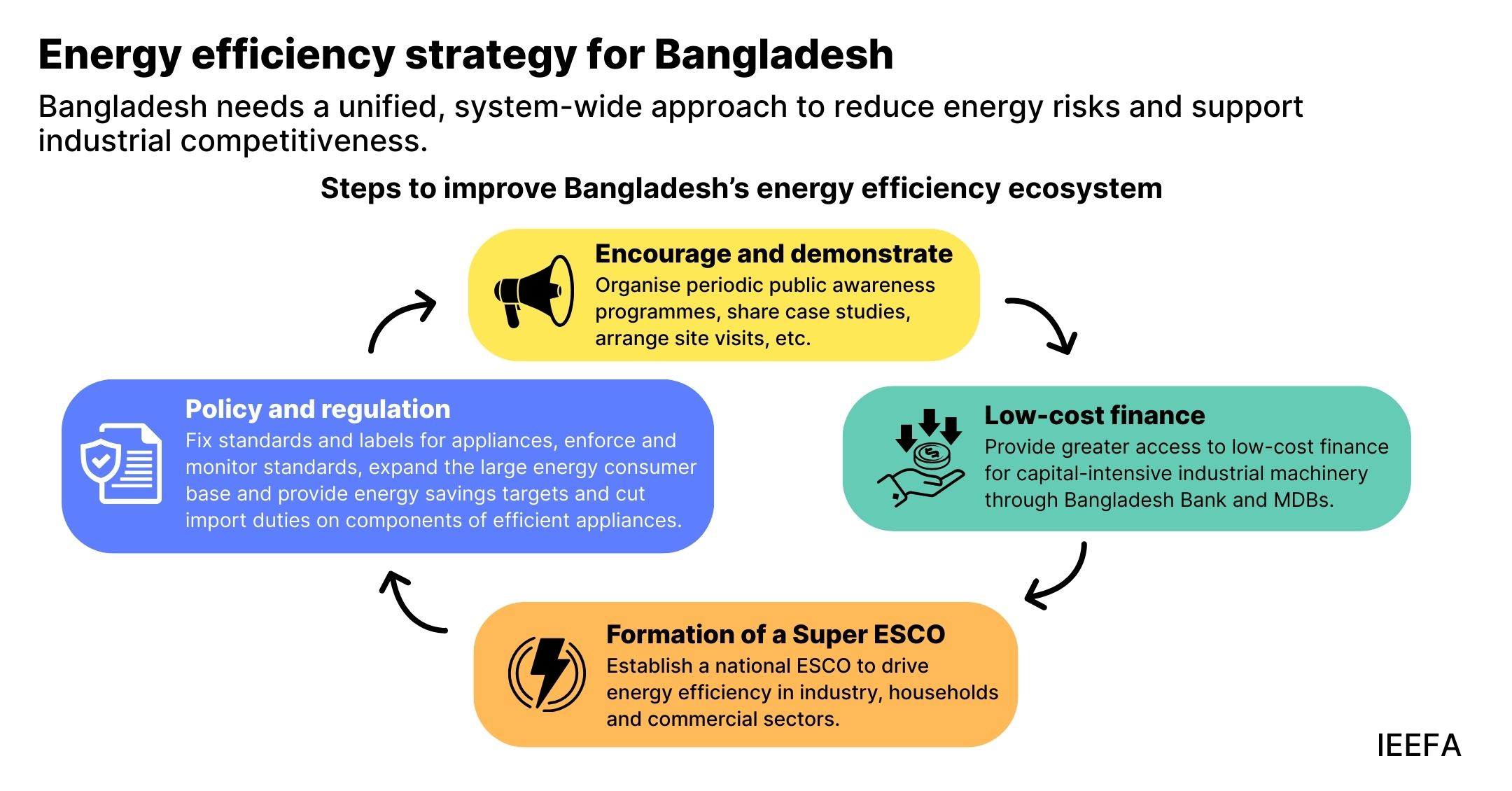
Building on the progress made over the past decade, the report offers several recommendations:
- Conduct periodic public energy efficiency awareness programmes.
- Expand the base of large energy consumers and set energy savings targets for them.
- Enforce the National Building Code 2020 to encourage passive design in new buildings, reducing the need for energy-intensive air conditioners.
- Establish a super energy service company (ESCO) to systematically address all challenges in energy efficiency projects—from opportunities assessment to designing business models, devising risk mitigation measures, ensuring the flow of finance, project implementation, and periodic monitoring to save costs.
- Ensure greater access to low-cost finance and explore new financing schemes for capital-intensive energy efficiency projects, supported by multilateral development banks (MDBs).
“Energy efficiency goes beyond reducing bills,” says Alam. “It can quickly transform the national energy system. However, Bangladesh must pursue a co-ordinated approach to establish synergy among regulatory authorities, energy consumers, financial institutions and technology providers.”
Read the report: Bangladesh’s energy efficiency goals within reach
Media contact: Prionka Jha (+91 9818884854), [email protected]
Author contacts: Shafiqul Alam, [email protected]
About IEEFA: The Institute for Energy Economics and Financial Analysis (IEEFA) examines issues related to energy markets, trends and policies. The Institute’s mission is to accelerate the transition to a diverse, sustainable and profitable energy economy. (ieefa.org)