Key Findings
In less than a decade, Bangladesh improved energy efficiency by 13.64%, an annual gain of 1.52%. In FY2023-24 alone, fossil fuel consumption of 7 million tonnes of oil equivalent (Mtoe) was avoided, slashing import bills by USD3.3 billion.
This sustained national effort created a framework for energy efficiency. However, after initial gains from FY2016-17, progress slowed until FY2020-21 when energy supply disruptions and higher tariffs made efficiency a priority.
Bangladesh is on course to achieve its energy efficiency targets a year early. With households and industry consuming two-thirds of the country’s energy, these sectors should be the focus for greater energy efficiency gains.
Proper standards and labels, and passive design features, will ensure optimal energy efficiency in buildings. In industry, efficiency improvements in motors, motor drives and captive power generation, and switching to electric boilers, will slash energy consumption.
Executive summary
In 2016, beset with energy security concerns and rising import bills, Bangladesh devised a master plan to improve national energy efficiency. Now, nine years later, these efforts are paying off. Between fiscal year (FY) 2014-15 and FY2023-24, energy efficiency increased by 13.64% against a target of 20% by 2030. In FY2023-24 alone, energy efficiency gains helped Bangladesh cut fossil fuel consumption worth 7 million tonnes of oil equivalent (Mtoe), avoiding approximately USD3.34 billion in import bills.
Initially, the country’s energy consumption and gross domestic product (GDP) trends showed signs of efficiency improvement from FY2016-17. However, progress slowed until FY2020-21, when it regained momentum as energy supply disruptions, led by global fossil fuel price volatility and subsequent energy tariff hikes, made energy efficiency a priority.
Bangladesh’s average annual energy efficiency improvement rate hovers around 1.52%, a trend that will likely help the country achieve its 2030 goal a year ahead of the deadline. While the updated Nationally Determined Contributions (NDC 3.0) incorporated an energy efficiency target of 19.2% by 2035 from 2022 levels, this study finds Bangladesh is also on course to reach that target a year early.
As households and industries are responsible for roughly two-thirds of Bangladesh’s energy consumption, this study highlights the critical importance of frontloading energy efficiency in these two sectors to achieve the country’s 2030 and 2035 targets. At the household level, energy efficiency labels will help drive greater adoption of efficient appliances amid information asymmetry (on minimum energy performance standards) in the market. In industry, significant gains can be made through efficiency enhancement in motors, motor-driven systems and captive generators, and a transition from gas to electric boilers. Similarly, energy efficiency labels and passive design are key to reducing energy consumption in the commercial sector, where cooling demand is high.
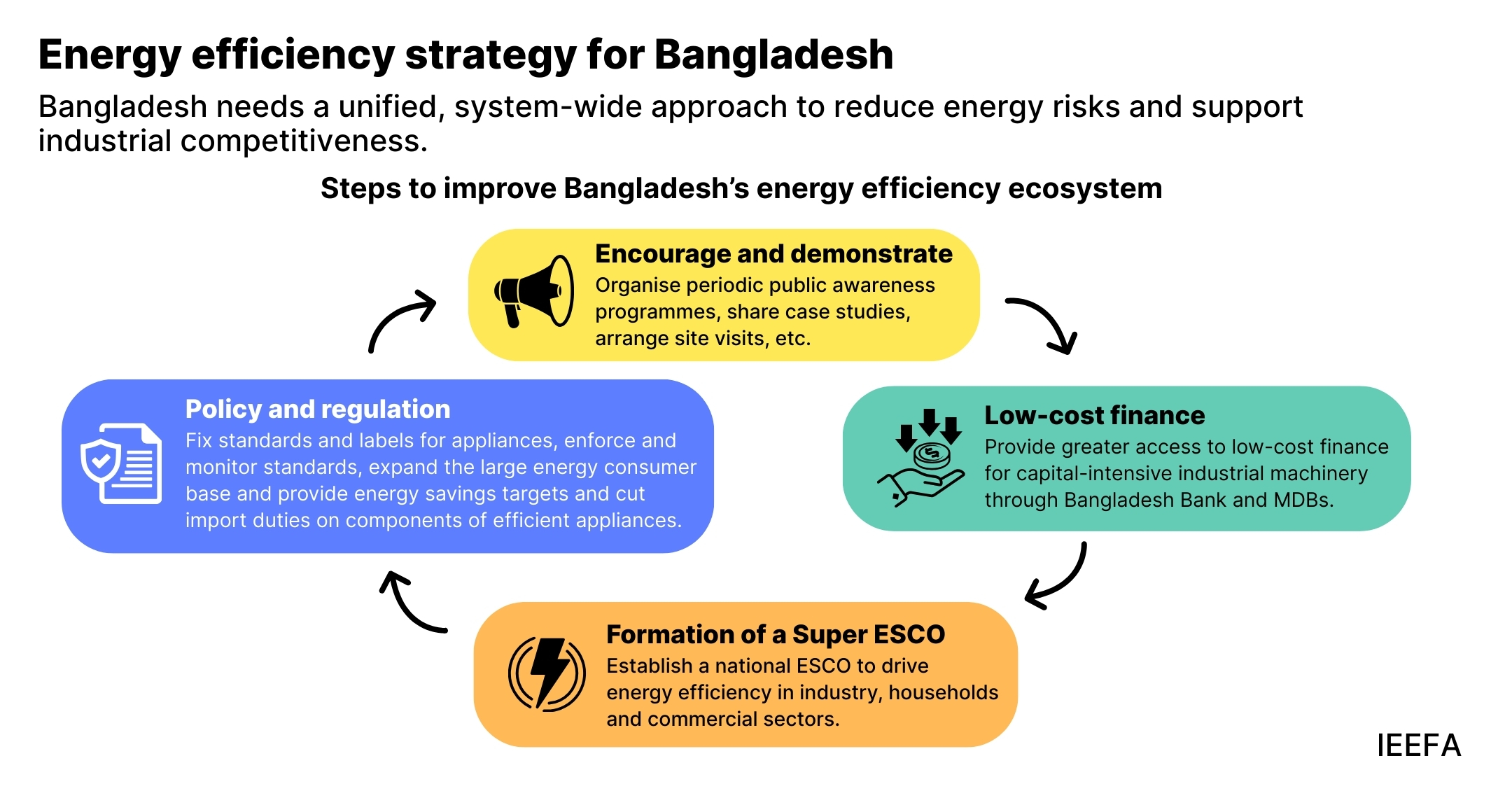
Bangladesh should build on its regulatory framework that laid a strong foundation for energy efficiency in less than a decade, contributed by the Sustainable and Renewable Energy Development Authority (SREDA). This study recommends measures to further improve the country’s energy efficiency ecosystem (Figure 1 below. See Table 4 for full details.):
- SREDA should organise events to raise awareness on energy efficiency, including technical and information sessions.
- SREDA should prioritise establishing standards and labels for appliances, widen the base of large energy consumers, and gradually provide energy savings targets to large consumers to ensure the desired level of efficiency.
- As cooling demand will surge owing to global mean temperature rises, Bangladesh should enforce the National Building Code 2020 to encourage passive design in new buildings, reducing the application of energy-intensive air conditioners.
- SREDA should engage with the National Board of Revenue (NBR) to rationalise high import duties on efficient appliance components to reduce upfront costs.
- The Bangladesh Bank should ensure the greater access of low-cost finance, and may explore designing new financing scheme for capital intensive energy efficiency projects, supported by multilateral development banks (MDBs).
- Bangladesh may establish a super Energy Service Company (ESCO) to drive energy efficiency in households, industry and commercial sectors.
- SREDA should also craft a monitoring framework to track progress, assess loopholes in existing policies and regulations, and undertake corrective measures as needed.
Energy efficiency goes beyond reducing bills. It offers a buffer against global price shocks and supply chain disruptions that stifle industrial production and business. For Bangladesh, energy efficiency is a strategic imperative to limit unabated energy consumption and enhance energy system resilience. While efficiency can quickly transform the national energy system, Bangladesh must pursue a co-ordinated approach to establish synergy among regulatory authorities, energy consumers (e.g., industries), financial institutions and technology providers.

Related Content