Is our next energy plan already out of date?
Key Findings
Residential battery uptake is an important input to AEMO’s Integrated System Plan (ISP).
The draft ISP’s household battery forecasts are far too low in the short term. In fact, we’re on track to exceed AEMO’s 2030 forecast by the middle of 2026.
AEMO has several better forecasts at its disposal and should adopt them, with necessary updates, for the final ISP.
The Australian Energy Market Operator (AEMO) is expected to release its next biannual Integrated System Plan (ISP) in June. While the ISP’s core purpose is to help guide decisions on electricity transmission projects, it has arguably taken on a broader role over the years – both through formal expansions to its scope, but also in an informal sense. Many now look to the ISP as a guide on how to stage a least-cost energy transition in the National Electricity Market (NEM).
The ISP involves lengthy modelling, and AEMO typically locks in the final inputs and assumptions many months before the final release. Consequently, the ISP’s forecasts can be somewhat out of date by the time it’s released.
This isn’t a criticism of AEMO but an inevitable feature of complex modelling projects – and something that is usually manageable. But this year’s forecasts feature a particularly large problem that is likely causing headaches for AEMO – and the culprit is residential batteries.
The Cheaper Home Batteries Program introduced generous rebates on the installed cost of household batteries in July 2025 – leading to an explosion in both the number of installations, and typical size of batteries, far beyond expert forecasts.
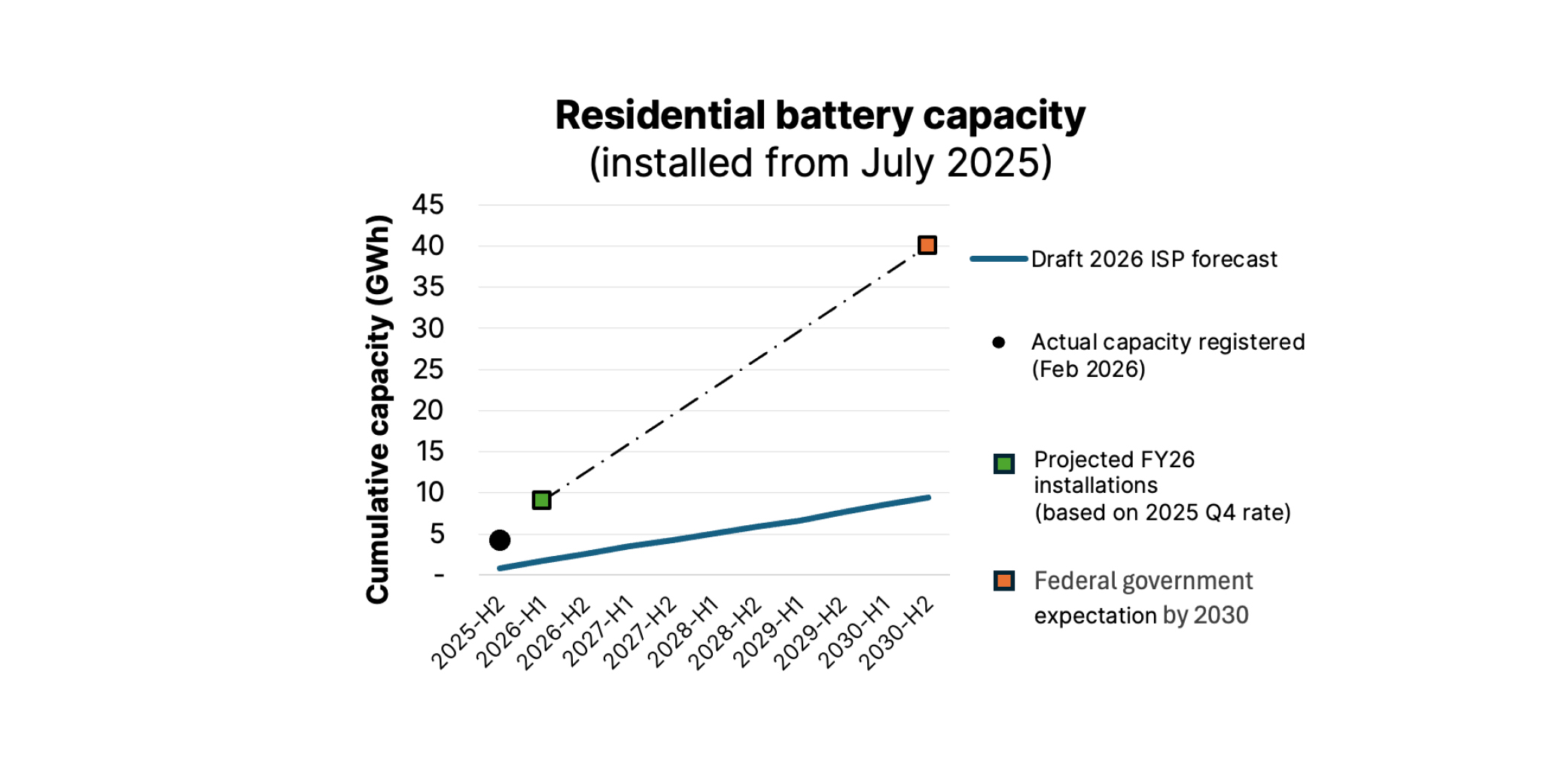
The federal government has already announced adjustments to ensure the funding pool (now $7.2 billion) can reach as many households as possible. However, it still expects the program to deliver 2 million batteries over the next five years – or 40 gigawatt-hours (GWh) of storage capacity. For comparison, that’s more than three times the total large-scale battery storage capacity currently in the NEM.
Rapid uptake of residential batteries could have profound impacts. IEEFA’s modelling found a 10 kilowatt-hour (kWh) battery could drastically reduce many households’ reliance on the grid throughout the year – including during the evening peak. However, with average battery sizes now exceeding 20kWh, it’s likely the contribution could be far greater than we estimated, particularly if batteries can export energy to the grid when it’s most needed.
Residential battery forecasts are important due to their flow-on effects across the NEM. More batteries could mean we have less need for expensive forms of electricity generation like gas during the evening peak period, and could allow us to put more solar generation to work, reducing emissions.
As the draft version of AEMO’s ISP was released in December 2025, it’s not surprising that the abrupt boom in household battery adoption wasn’t captured. But just how far off are the forecasts?
AEMO’s draft ISP assumes we will install around 1.5GWh of household batteries by the end of this financial year. The problem is, we already hit that milestone less than four months into the Cheaper Home Batteries Scheme. In fact the Clean Energy Regulator (CER)’s records up to January (which always lag behind actual installations due to the grace period for certificate creation) indicate we’ve already exceeded 4.2GWh of residential batteries in the NEM.
When your forecasts rest on shaky foundations, the issues tend to compound over time. By 2030, AEMO forecasts that total residential battery capacity will reach 9.5GWh; well below the 40GWh that the federal government hopes to achieve. In fact, if we were to sustain the average rate of installations seen in the final quarter of 2025 (and ignore the fact that the rate is increasing), we would be close to AEMO’s 2030 forecast by June this year.
IEEFA’s submission to the draft ISP urged AEMO to update these forecasts ahead of the Final ISP in June. However, AEMO hasn’t yet indicated a plan to do so – and these types of input assumptions would normally be locked in at this stage.
The good news is that AEMO has a range of alternative forecasts at its disposal, which were developed after the explosion in household battery uptake commenced. So how do these options compare?
Firstly, AEMO has developed a “rebased” version of its 2025 forecast – and while it hasn’t proposed using this in the ISP, it’s the forecast of choice for its next publication – the 2026 Electricity Statement of Opportunities. AEMO has updated the base year (2025-26) to try and reflect actual uptake. But unfortunately, the forecast hasn’t been raised nearly enough. And by updating only the first year, this forecast fails to fully factor in the likely continued response to the Cheaper Home Batteries Scheme.
Secondly, the two consultants who informed AEMO’s original forecast – CSIRO and Green Energy Markets (GEM) – have updated their own projections. GEM is historically more optimistic than CSIRO on solar and battery adoption. As a result, GEM is likely much closer to the mark on actual battery uptake for this financial year, while CSIRO has succumbed to the same pitfall as AEMO in not raising its baseline high enough. CSIRO also appears to assume a severe crash in the battery market after the federal rebates end, with close to zero sales in 2031-32.
Finally, and for the first time, AEMO has undertaken its own in-house modelling of rooftop solar and batteries, leading to the creation of an alternative version of its Step Change forecast.
This alternative forecast still appears on the low side in the 2025-26 baseline year. However, it is far closer than either the draft ISP forecasts, or the “rebased” forecast. It also hits the government’s expected 40GWh of capacity by 2030. And under the hood, AEMO has applied a reasonably sophisticated method in developing it. This includes considering not only the raw economics of household batteries, but also social factors that we know play a large role in driving uptake.
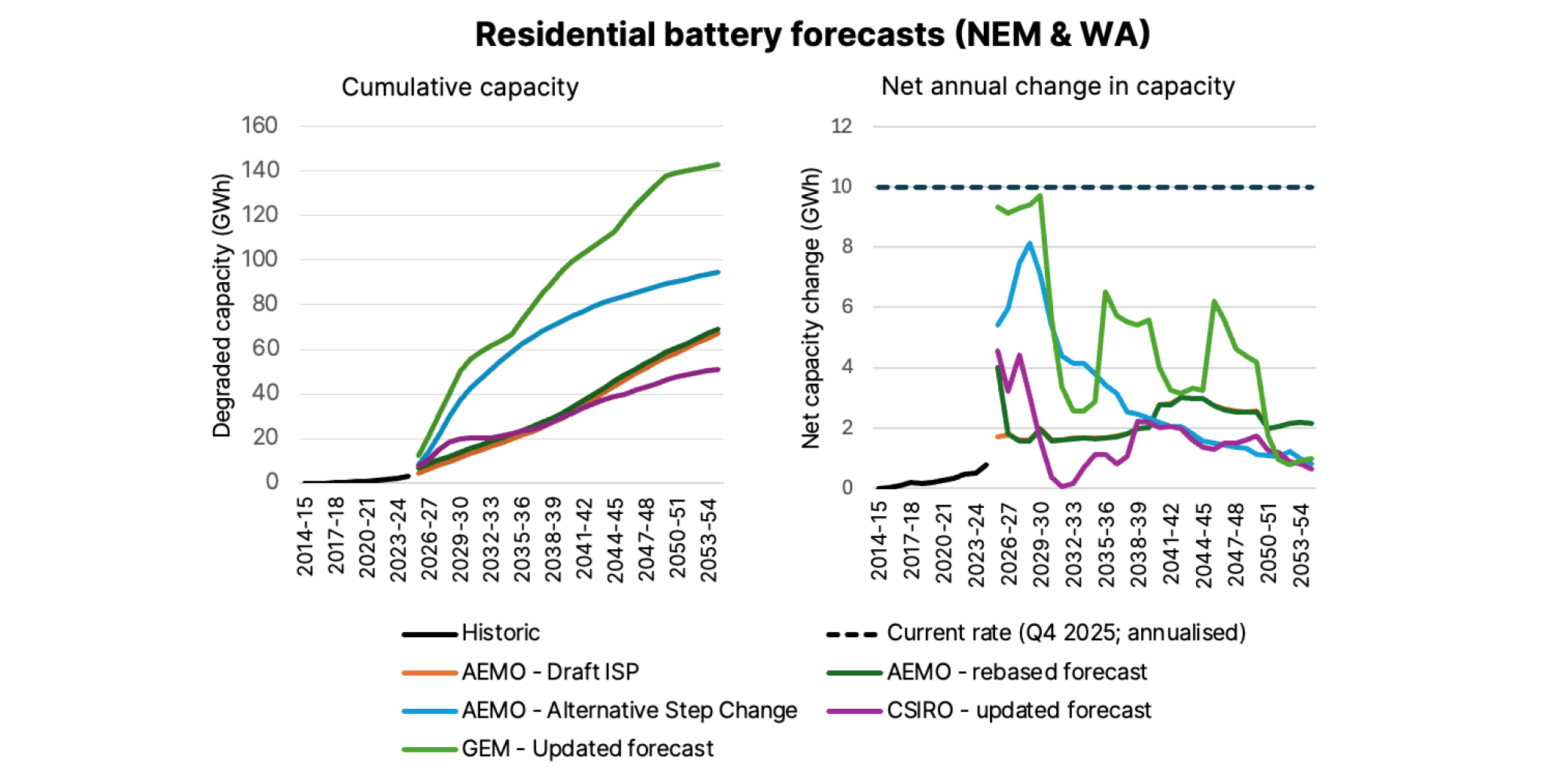
Source: AEMO, GEM, CSIRO, CER. Net annual change is derived from the cumulative capacity forecasts. Results include NEM and WA, as not all forecasts are available at a NEM level only.
None of these forecasts are perfect. They likely all need some tweaks to the base year, and they were all produced before recent updates to the Cheaper Home Batteries Scheme were announced that could alter expectations for the remaining years of the program. This is something AEMO will need to address no matter what option is chosen.
At this point we should be clear that our focus is squarely on the short term – particularly up to 2030, when the Cheaper Home Batteries Scheme is slated to end. There are legitimate grounds for uncertainty surrounding what battery uptake could look like in the late 2030s, ’40s and ’50s. But having a realistic view of short-term uptake is crucial.
AEMO’s next ISP needs to guide the NEM from a renewable energy share of 43% (2025) to 82% in 2030, in line with federal targets, and beyond. Material decisions will need to be made in the short term about the necessary investments in our energy system to track towards that target at lowest cost. That requires a robust understanding of our current starting point, which cannot wait another two years for the next ISP.
Outdated residential battery forecasts in the draft ISP are a problem that could impact the usefulness of the final plan. However, AEMO has several alternative forecasts it could turn to, including its in-house forecast, with only small updates needed to correct the baseline year and adjust for recent Cheaper Home Batteries Program changes. Taking these forecasts on board for the Final ISP would help ensure the plan is based on a firm baseline, and help us understand how this rapid trajectory of residential battery uptake might affect the future of the NEM.
This article was first published in Renew Economy.

Related Content