Getting off gas while cutting electricity demand? NSW could have it both ways
Download PDF
Key Findings
The NSW government is increasing its focus on residential electrification while seeking to manage electricity system reliability.
Residential electrification is unlikely to reduce electricity system reliability if flexible electrification of hot water, and upgrades of inefficient electric appliances in parallel with gas appliance electrification are prioritised.
NSW policy reforms should be expanded to include minimum energy efficiency standards for renters, phasing out inefficient electric and gas appliances, and introducing targeted programmes for hard-to-upgrade households.
Electrification of gas appliances is gaining increasing attention in New South Wales (NSW). The state government looks set to deliver a Gas Decarbonisation Roadmap this year, and the NSW Consumer Energy Strategy lays out a vision to electrify households and small businesses in the state. Most recently, the state government has consulted on updates to its Energy Savings Scheme that could focus more on electrification.
There are good reasons for this: efficient electric appliances have far lower running costs than gas appliances, largely due to their very high efficiency and the fact gas prices have risen faster than electricity prices.
Additionally, the Australian Energy Market Operator (AEMO) has forecast possible peak day gas supply shortfalls in southern states – including NSW – as early as 2028. Residential electrification is a key measure that can mitigate these risks.
And finally, combustion of fossil fuels – primarily gas – is the primary source of Scope 1 (direct) greenhouse gas emissions in residential buildings. As cost-effective alternatives to gas in buildings are readily available, most decarbonisation trajectories, including those produced by the federal government and for AEMO, include significant reductions in residential gas consumption.
However, the NSW government’s consultation on updating the Energy Savings Scheme has raised a valid question: How do we ensure efforts to electrify gas appliances do not inadvertently undo efforts to improve electricity reliability?
After all, there are already looming upward pressures on statewide electricity demand from factors including electric vehicles and data centres. It would be unfortunate if efforts to get off gas inadvertently placed more demand on the grid, especially at peak times.
Thankfully, this doesn’t need to be the case. IEEFA’s submission to the Energy Savings Scheme policy reform highlighted two sensible strategies that would allow NSW to reduce residential gas consumption and achieve a net reduction in electricity demand.
Flexible electrification of hot water
Hot water accounts for half of all residential gas demand in NSW, and is the single largest residential electrification opportunity.
The most efficient electric hot water system is a heat pump, which typically consumes less than a third of the energy of a continuous-flow gas water heater.
However, the maximum benefits occur when we ensure that electrification occurs flexibly. Because heat pump hot water systems use a storage tank, heating times can be shifted without affecting the household’s access to hot water on demand.
The profiles below compare a heat pump hot water system operating on a default “uncontrolled” basis versus one predominantly operated during the midday solar period. The latter consumes more than 85% less electricity during the peak demand window defined in NSW’s Peak Demand Reduction Scheme.
Figure 1: Electric hot water load profiles
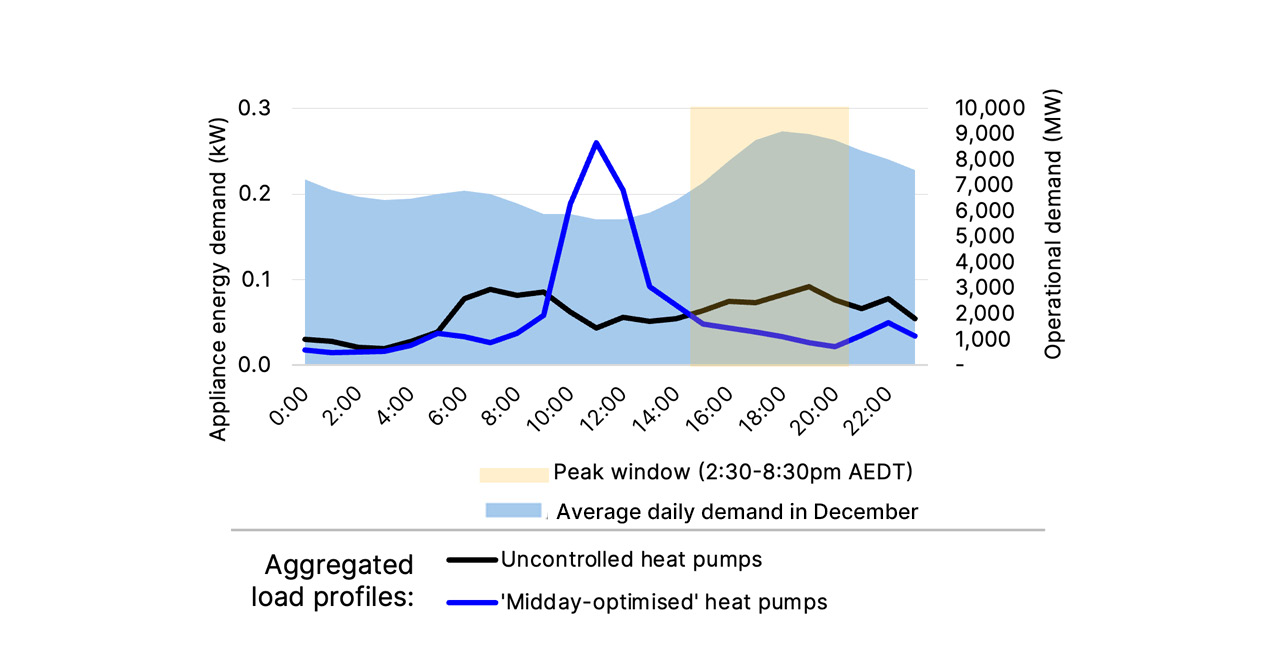
Sources: Uncontrolled heat pump profile based on Mohseni et al (2023). “Midday-optimised” profile based on analysis of data from Solar Analytics. Average daily demand profile from AEMO.
This data is based on average observed behaviour from hot water systems that are predominantly operated at midday. However, systems could be fine-tuned further to ensure heat pumps do not operate at all in the peak period. Several control methods exist. Timer controls are generally built into heat pump hot water systems, and most units available have some form of Wi-Fi connectivity that could enable dynamic control – which has significant benefits.
Upgrade inefficient electric appliances in parallel with electrification
Gas appliances are not the only appliances driving high energy bills in NSW. The state is also home to an estimated 1.8 million resistive electric hot water systems, 3.6 million resistive electric heaters and 1.2 million resistive electric cooktops. These all use far more energy than alternatives such as heat pump hot water systems, reverse-cycle air conditioners and induction cooktops.
IEEFA’s analysis shows that if NSW households electrified their gas appliances at a similar pace to upgrading their inefficient electric appliances (for instance, when the old appliance reaches its end of life), this would result in a net saving in annual electricity consumption. This is a win-win; it would enable more households to reduce their energy bills through efficient, electric appliances while avoiding negative impacts on electricity reliability.
Figure 2: Electric hot water load profiles
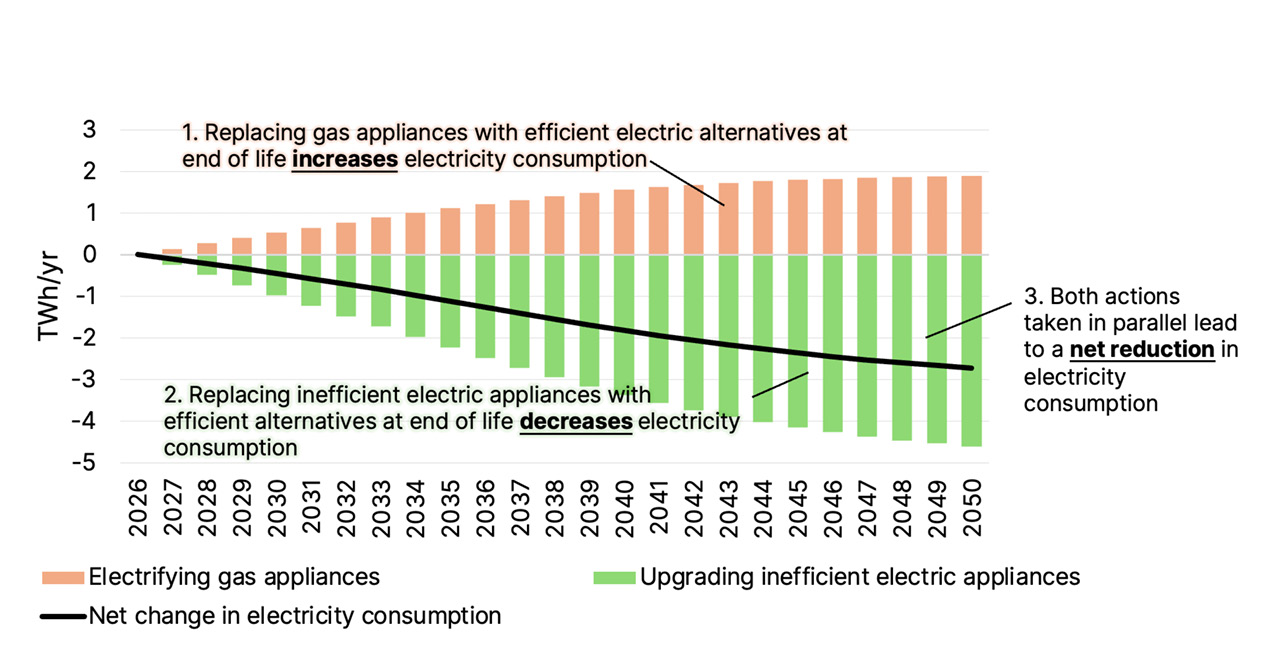
Source: IEEFA modelling assuming gas and resistive electric appliances are replaced with efficient electric alternatives at end of life. (Approach based on that in Appliance standards are key to driving the transition to efficient electric homes.)
Of course, it’s important not to focus on annual electricity consumption impacts alone – but also on impacts at different times of the day or year when reliability is a concern. And focusing on appliance upgrades can help ensure complementary effects at this time scale, too.
For example, by upgrading both gas and inefficient electric heating systems to reverse-cycle air conditioners, NSW could achieve a net reduction in electricity consumption in winter. And if the flexibility opportunity is fully explored – for instance, by ensuring new hot water systems are configured to avoid peak times – hot water electrification should have a negligible impact on peak demand.
NSW primed to increase energy efficiency action
Australia’s most populous state is particularly well primed to deliver on energy security, energy reliability and energy affordability through sensible household energy efficiency policy.
The Consumer Energy Strategy has already laid out several initial policy actions to focus on achieving an affordable, reliable, low-emissions energy system, with forthcoming measures including the potential to set targets that would boost energy efficiency and electrification.
The development of a Gas Decarbonisation Roadmap and ongoing reforms to the Energy Security Safeguard also present a particularly timely opportunity to design policies and incentives to support a balanced uptake of electrification and energy efficiency.
Experience from Victoria has shown significant consumer interest in electrification incentives. Since the addition of residential electrification activities in the Victorian Energy Upgrades (VEU) scheme in 2023, they have rapidly become some of the most popular measures in the scheme, and residential gas consumption in Victoria appears to be in clear decline.
To have the largest impact on reducing consumer energy costs and managing reliability, NSW should broaden its view towards other key policy reforms, such as:
Minimum efficiency standards for rentals
The "split incentive" issue renters face is a structural barrier to energy efficiency and electrification uptake that cannot be addressed via incentives alone. Phasing in minimum energy efficiency standards for rental properties is one of the only levers that would ensure inefficient gas or electric appliances in these properties are upgraded over time. This could complement targeted financial rebates for landlords to ensure their properties meet the standard.
Phasing out inefficient appliance installations
Due to a combination of cost of living concerns and the risk of gas supply shortfalls, Victoria has implemented strong regulations to require certain gas appliances to be replaced with efficient electric alternatives once they break down. This prevents the significant cost lock-in associated with installing inefficient appliances – a problem shared by NSW.
Support for hard-to-upgrade households
Some households face greater challenges in accessing energy efficiency upgrades, particularly apartment dwellers and households without adequate access to capital. There is a risk these homes could bear disproportionate gas network costs as other homes electrify, and they are likely to require support beyond existing incentive schemes. For example, Victoria’s Solar Homes and Solar for Apartments programmes provide targeted rebates and zero-interest loans that are means-tested and/or focused on these households.
Conclusion
Accelerating residential electrification in NSW would improve energy affordability and security. The NSW government is right to consider how to manage electrification in a way that avoids negative impacts on electricity system reliability. However, upgrading inefficient electric appliances in parallel with electrification presents an opportunity to achieve this while delivering significant consumer benefits. Additionally, the state’s largest residential gas load – hot water – could be electrified flexibly, ensuring no negative peak demand impacts. To gain the greatest benefits, NSW should broaden its policies to target electrification for renters and hard-to-upgrade dwellings while phasing out inefficient electric and gas appliances from the wider market.
First published in Renew Economy.

Related Content