West Virginia costs for transmission infrastructure to power data centers soar
Key Findings
The projected capital cost of part of a mid-Atlantic transmission line has more than doubled, according to one of its builders.
NextEra Energy has updated its cost estimate of the Mid-Atlantic Resiliency Link, from $441 million to $960 million.
The transmission line would cross parts of Pennsylvania, West Virginia, Maryland, and Virginia en route to data centers in Northern Virginia.
IEEFA now estimates that the cost to West Virginia ratepayers—who will receive no benefits from the line—could top $570 million.
The projected capital cost of NextEra Energy’s portion of the Mid-Atlantic Resiliency Link (MARL) has more than doubled.
The line was approved in December 2023 by regional transmission operator PJM. At the time, it was expected to cost $441 million. NextEra, however, now estimates that the projected cost will soar to $960 million. The line still needs regulatory approvals from the state public utility commissions in the states that it would traverse. The majority of the proposed route goes through West Virginia to bring power to a massive cluster of data centers in northern Virginia.
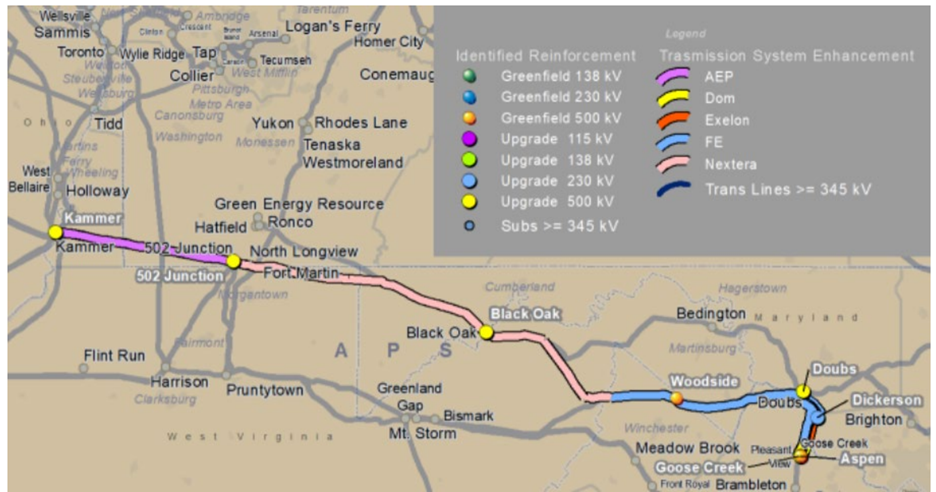
PJM’s planning documents make clear that rapidly growing data center energy demands in northern Virginia are the key driver for this line.
A 2025 IEEFA report used MARL as a case study to emphasize the need for reform in PJM’s transmission cost allocation methodology, so that data centers—and not ratepayers—across its 13-state region pay for the new infrastructure costs needed to serve them.
NextEra applied to the West Virginia Public Service Commission in January for a certificate to build its portion of the MARL line through the state (another segment of the project in West Virginia is to be built by FirstEnergy, which has not yet filed its application).
The total cost of the MARL line will be borne by ratepayers across the PJM region. In light of the new information provided by NextEra (as well as new projections of electricity demand recently filed by the West Virginia utilities in their integrated resource plans), IEEFA revised its estimate of the total cost burden to West Virginia electricity customers over the 40-year life of the project (including capital and operational costs). The IEEFA analysis was also updated to include construction work in progress, in other words costs charged to ratepayers during project construction.
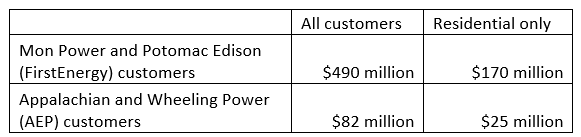
The latest information indicates that West Virginia customers will be charged $572 million—more than three times the 2025 IEEFA initial estimate of $185 million—for a project that will provide no benefits for them. NextEra is building the line through West Virginia, but has no customers in the state.
The following table shows the breakdown of IEEFA’s revised cost estimate for residential, commercial, and industrial customers, as well as for residential customers only:
Given the long lead-time for building new high-voltage transmission infrastructure, PJM is planning today for expected data center loads into the early 2030s. That means ratepayers can expect to see even more proposals for new transmission lines into data center hotspots like Northern Virginia as forecasted electricity demand continues to rise rapidly. Even if some of that demand fails to materialize, as IEEFA believes is likely, ratepayers are expected to bear much of the costs of these new transmission projects.
Related Research