South Korean offshore wind success requires a public-private approach to project realization
Key Findings
South Korea has set highly ambitious targets to make offshore wind a core part of the national energy mix over the next 10 to 15 years, with annual capacity allocations of approximately 4 gigawatts (GW) — an unprecedented pace globally.
Legacy project development challenges, changing policy parameters, extensive localization requirements, and ambitious realization targets could undermine developer and investor confidence in South Korea’s offshore wind sector.
South Korean government agencies should partner with the private sector to reduce offshore wind project development risks and costs. Government-led site identification, preliminary environmental studies, single window permitting, and stakeholder dispute resolution could increase project certainty and accelerate delivery.
A gradual approach to supply chain localization and flexible tariff formulas could help South Korea adapt to changing economic, financing, and project development conditions, while providing the time and flexibility needed for industries to invest in a strong domestic offshore wind industry.
Read the Korean translation: 한국 해상풍력의 성공 조건, 사업 실현을 위한 민관 협력
South Korea is turning to offshore wind to diversify and secure its energy supply, develop new domestic industries, and support its decarbonization goals. On 30 June 2026, the South Korean government issued a medium-term offshore wind development program (Medium-term Plan), targeting 55 gigawatts (GW) of auctioned capacity through 2035. The program bids for approximately 4GW of capacity annually from 2026, reaching 10.5GW under construction by 2030 and 25GW by 2035.
However, just seven weeks later, on 26 August 2026, the Ministry of Climate, Energy and Environment issued a summary of the upcoming 12th Basic Plan for Long-term Electricity Supply and Demand (BPLE). This plan targets 45GW of offshore wind realized by 2040, with currently contracted capacity to be deployed by 2030, and new capacity procured at 4GW to 4.4GW annually from 2029. Figure 1 compares the two plans.
Both plans follow the March 2026 Offshore Wind Special Act, passed in 2025, which aims to streamline offshore wind site management and the approvals process, establishing a centralized permitting framework.
Taken together, these measures signal a significant acceleration in offshore wind development, positioning it as a core contributor to South Korea’s energy mix. The scale of these plans aligns with President Lee Jae-myung’s call to strengthen energy security following price spikes and supply disruptions resulting from the Middle East conflict by rapidly expanding renewable energy and energy storage. The question is how government and private industry can work together to achieve South Korea’s ambitious goals.
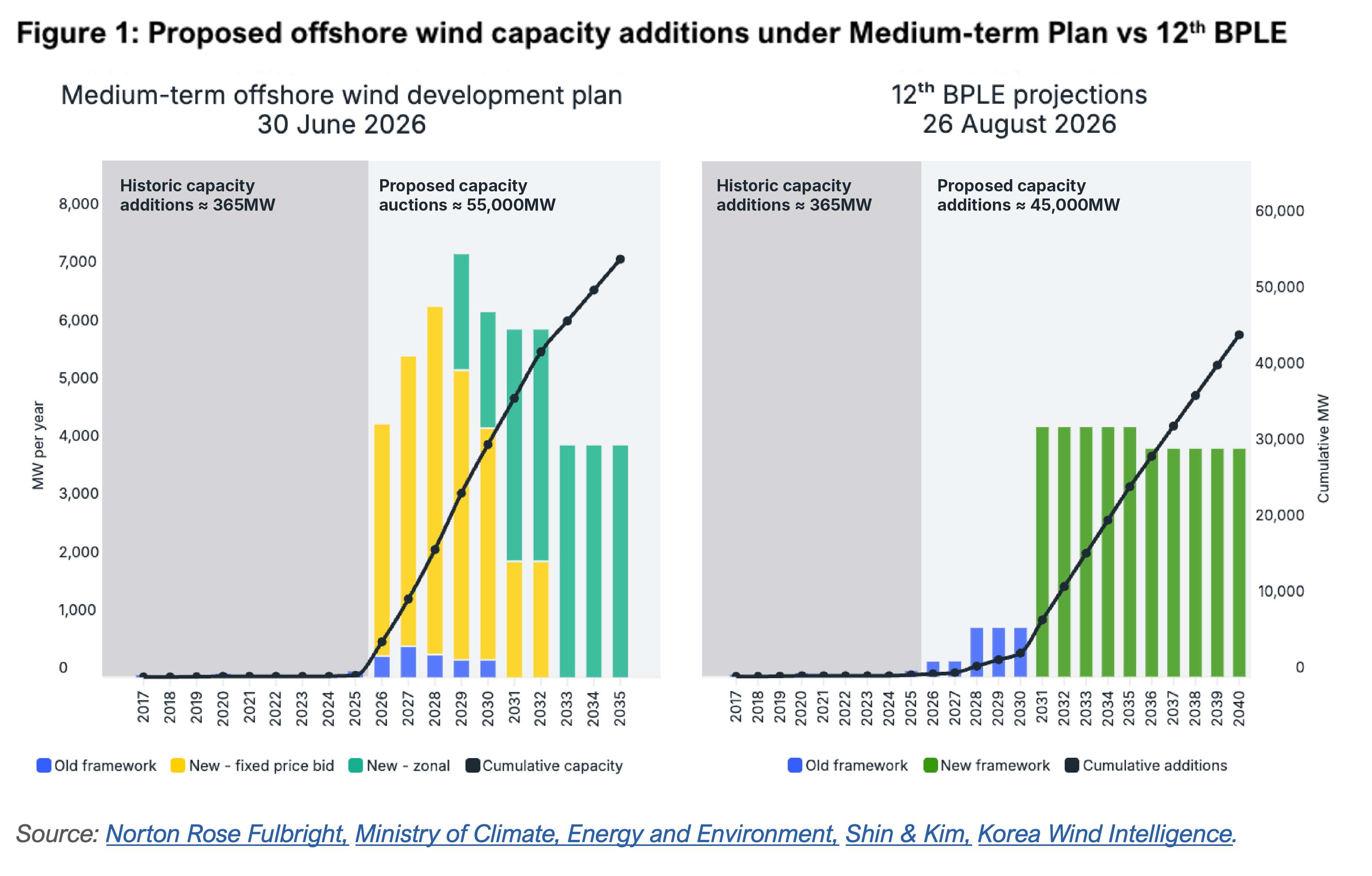
To date, offshore wind project development has remained constrained, with only about 365 megawatts (MW) of capacity realized over the past decade. This limited implementation reflects a challenging project identification and approval framework. Under the original offshore wind development regime, private developers were responsible for identifying and defining their own offshore project sites. They had to negotiate individually with fishing communities over compensation for project-related disruptions, while navigating 42 separate approvals across several government bodies. Despite significant time and investment required to develop project proposals, developers had no guarantee that projects would pass technical, environmental, or financial scrutiny.
Government implements a new approach
To achieve the scale and compressed project delivery timelines it is targeting, the government introduced the Offshore Wind Special Act, which seeks to address critical implementation challenges by:
- Streamlining the site selection process by shifting from developer-led site identification to government-approved development zones
- Consolidating approvals from multiple agencies under a “single window” process
- Creating a stakeholder reconciliation body, comprised of at least 50% project-affected parties, including fishing communities, to negotiate and resolve disputes
- Providing projects with long-term, fixed-price contracts awarded through competitive bidding, while eliminating renewable energy certificate-driven revenues
These measures address many of the challenges and uncertainties that project developers have historically faced. Their effectiveness, however, will depend on how quickly and efficiently the new coordination and approval mechanisms can move projects toward realization.
South Korea has set highly ambitious offshore wind targets
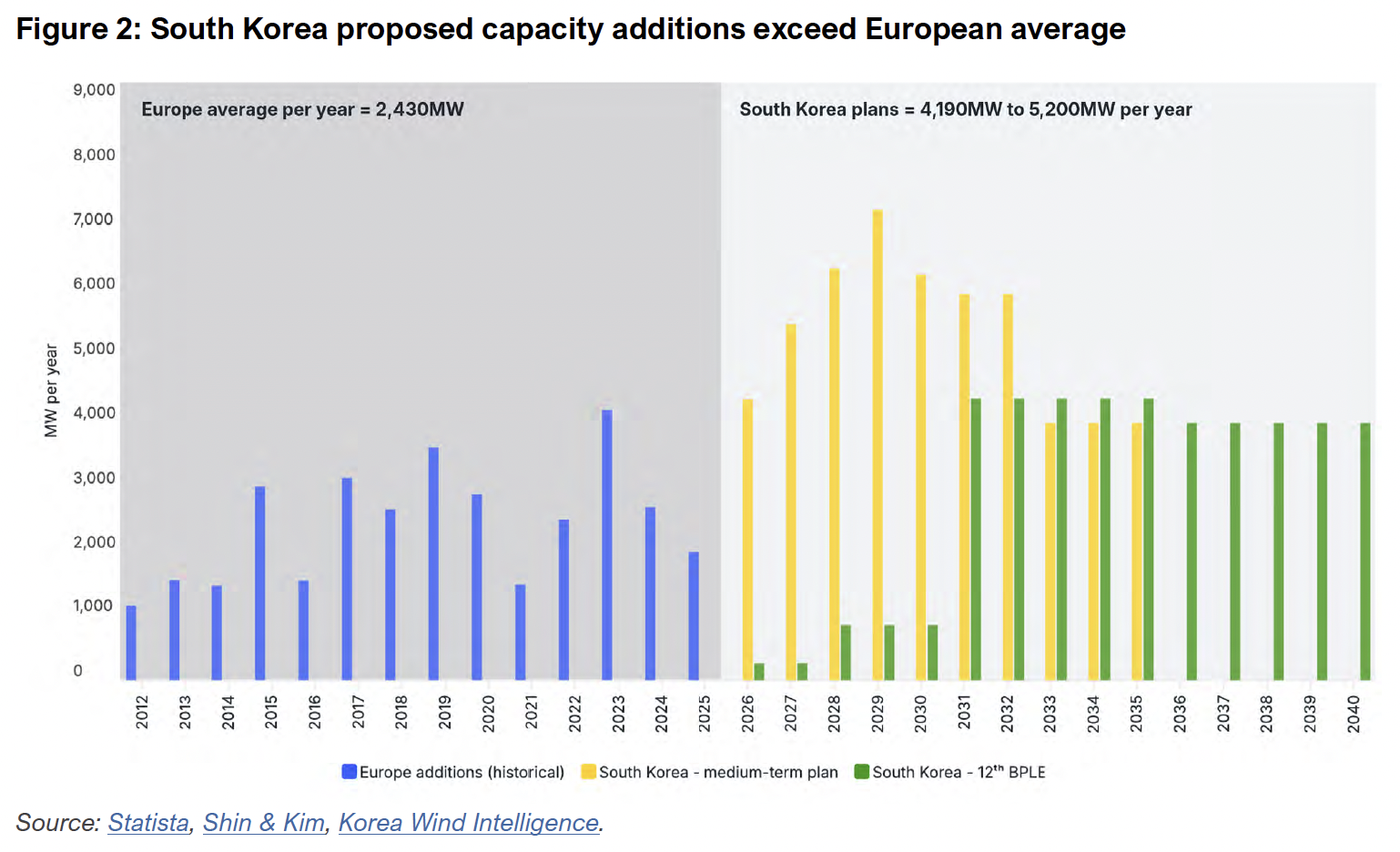
Over the next 10 to 15 years, under both the Medium-term Plan and the 12th BPLE, South Korea aims to achieve four goals simultaneously: rapidly increase offshore wind capacity, maximize content localization, increase domestic industry participation, and deliver tariffs half their current levels.
South Korea is starting from a nascent base of smaller, individual projects. However, it can leverage the knowledge and experience from the large offshore wind capacity buildouts in Europe. Europe had 39GW of operating offshore wind capacity at the end of 2025, following nearly two decades of learning across project development, finance, and supply chains.
In contrast, South Korea is targeting an offshore wind buildout at an annual capacity rate nearly double that of all European countries combined and achieved in under half the time. While these ambitions are commendable, delivering projects at this pace is likely to be challenging given the time-critical, resource-dependent demands of physical project development and construction. If South Korea intends to overtake more experienced markets, then its offshore wind development program could benefit from actively engaging global project development expertise and partnering with established supply chains, particularly in the initial years.
Government can target support by recognizing developers’ challenges
For South Korea’s offshore wind development plans to succeed, policymakers should take a more developer-focused perspective. While the new Offshore Wind Special Act appears designed to address critical project realization challenges, its effectiveness will depend on the government’s ability to streamline approvals and help resolve disputes. Developers will need the government to provide this support and act as a partner in successful project delivery.
Before submitting a bid, developers undertake extensive preliminary work at considerable cost and risk. This includes collecting meteorological data to assess wind resources and ocean conditions; conducting bathymetric, spatial, and geotechnical surveys to inform foundation designs; and undertaking preliminary engineering to assess wind turbine and construction requirements. Developers must also formulate procurement plans, assess local fabrication capabilities and ports, and plan logistics to estimate costs for construction, fabrication, yard storage, personnel, and marine and onshore equipment.
Developers must then secure financing, convincing bank credit committees to provide project debt and their own corporate investment committees that the project can be completed and generate a reasonable profit. Taken together, these pre-bid activities can require tens of millions of dollars in upfront expenditure and years of work, all at the developer’s risk and without guarantee of recovery.
For companies to undertake this process, they need confidence that there is a reasonable chance of winning a bid and successfully delivering a project. Government policies and supporting processes have a key role to play in building that confidence. South Korea’s offshore wind program would benefit from regulators taking a developer’s perspective on designing, financing, and implementing projects.
Government leadership in pre-determining project sites, with preliminary approvals secured before bidding, would significantly reduce project time and cost risk. This could include government determinations concluded on sensitive issues such as project boundaries, marine navigation limits, and fishing rights. The government’s convening power could also help mediate and resolve stakeholder disputes. This would allow developers to focus on the already complex challenges of wind farm design, procurement, construction, and financing.
Understanding a developer’s perspective would also help the government recognize that material changes to award criteria between bidding rounds, or revisions to key approval parameters after awards are granted, can lead to delays, cost overruns, or even cancellations. The change in offshore wind development plans between June and August 2026 risks undermining confidence in national policies as publishing two substantially different visions sends mixed signals to developers and supply chain companies.
These plans provide the basis on which developers and investors must make decisions about the scope and scale of wind farms on which they might bid and the need to develop supporting supply chains. There appears to be some level of disconnect between the government's two recently announced plans, which may concern developers. While June's Medium-term Plan may refer to auctioned capacity and August's 12th BPLE draft may refer to realized capacity, both set aggressive expectations unprecedented in the offshore industry. The effective yield of projects in definitive implementation - meaning beyond award but rather financially closed, in construction, and proceeding to commissioning - will need to be on the order of 4GW per year to achieve stated goals.
The overarching plans need to be considered alongside the Offshore Wind Special Act, which provides greater certainty and objectivity in the project development process. However, these changes also highlight the need for clear, reliable, and durable regulatory direction. Policy consistency will be essential for South Korea to attract investment in supply chains and deliver a renewable energy transition in a timely and cost-effective manner.
Adopting an evolutionary approach to supply chain development
The offshore wind sector involves an entire industrial ecosystem of equipment and services that can deliver high-value economic and employment opportunities. South Korean industry has demonstrated its ability to develop state-of-the-art technology while incorporating global expertise to localize and improve it.
Offshore wind requires a wide range of highly specialized technical inputs, including generation equipment, logistics, vessels, and installation methods. Wind turbines incorporate critical components from scores of suppliers to produce the final nacelle, while offshore foundations require specialty steels, specialized fabrication, and heavy-lift services. Advanced high-voltage substations, switchgear, control systems, and cabling are also needed to collect generated electricity and transmit it efficiently onshore.
At sea, installation and servicing require numerous types of specialized vessels, many equipped with positioning, stabilization, lifting, and other systems supplied by niche providers worldwide. Meanwhile, ports need berthing, fueling, crewing, and maintenance services that extend over the life of these wind farms.
Despite the government’s clear preferences for maximizing local content as quickly as possible, developing a national supply chain may take time. Domestic companies considering investment in offshore wind research and development need confidence that a long-term market will exist for their products. Similarly, international technology providers considering localized manufacturing need a clear path to repeated project opportunities at a growing scale. Attempting to accelerate localization too quickly could drive key market participants out of the sector, increase costs, reduce initial reliability, and ultimately jeopardize implementation targets.
Taiwan provides an example of how sudden changes to local content rules can delay project development or discourage participation. Ahead of its third round of offshore wind bids in 2021, the government significantly increased localization requirements, moving from specific project components in the first two rounds, to a blanket requirement of 60%–70% of investment value in Round 3. This policy change prompted participant complaints, with some developers withdrawing from bidding rounds and manufacturers declining to participate. The rule changes led to the European Union (EU) lodging a trade dispute at the World Trade Organization. The disagreements delayed the bidding round, and Taiwan subsequently adjusted its local content requirements.
A key way to foster supply chain investment is through successive bidding rounds that lead to successful deployment. Consistent project delivery, year after year and at a growing scale, can naturally encourage localization. If South Korea achieves 4GW of annual project deployment, the global offshore wind supply chain would need to expand production capacity to meet the country’s demand. Consequently, logistical factors would increasingly favor placing manufacturing in proximity to this growing market. Therefore, a well-designed offshore wind program that consistently delivers new projects could become the catalyst for investment in new domestic manufacturing and services.
Tariff targets should be formulated with flexibility
Offshore wind project development in South Korea has remained constrained in recent years. Yet, the government has stated its intention to seek lower costs on bidder-proposed wind tariffs, despite limited data on the cost of developing domestic offshore wind projects at scale. A tariff cap was introduced in 2024 at KRW176.565 per kilowatt-hour (kWh) (USD134 per megawatt-hour [MWh]), kept at that level in 2025 (effective price USD126 per MWh due to exchange rate movement), and reduced in the first half 2026 to KRW171.2/kWh (USD115/MWh). Under the medium-term offshore wind development plan, the government targets a further 50% reduction in realized costs by 2035. Without demonstrated project deliveries in the near term, it is unclear how such an expense reduction trajectory will be achieved.
Globally, offshore wind has experienced significant cost volatility. Between 2022 and 2024, offshore wind costs increased by 30%-50%. Steel and equipment prices were impacted by inflation, and the cost of capital rose sharply. While costs have partially decreased, this volatility suggests that rigid tariff caps may not be suitable when adverse global market events arise.
Despite ongoing challenges, the results of the most recent offshore wind bids in South Korea are encouraging. In June 2026, nearly 1.8GW of capacity was awarded by the Ministry of Climate, Energy and Environment across five developer groups, including the country’s first large-scale floating wind proposal. Together with the recently commenced and public enterprise-backed Shinan-Ui 390MW project — South Korea’s first truly large-scale offshore wind project and its first to use domestic capital — these projects could provide developers and the government with valuable insights on project costs, potential economies of scale, and ways to mitigate challenges.
Recommendations for advancing offshore wind development in South Korea
South Korea’s offshore wind program signals a serious commitment to transitioning to a more secure, affordable, and sustainable energy future. The government’s announced targets for offshore wind — 55GW auctioned by 2035 or 45GW realized by 2040 — are among the world’s most ambitious and will require extraordinary and sustained efforts to achieve. Comprehensive government support across project development, approvals, bidding, financing, and implementation can help deliver the required scale. To realize these goals, policymakers should consider the challenges faced by developers and the industry. The following recommendations for government action could encourage offshore wind deployment:
- Take action to reduce project uncertainties and risks. Government-approved project zones should be defined, and preliminary environmental studies and navigation clearances for commercial and military passage should be completed and shared with developers. Industry-standard data collection on wind resources, bathymetry, and ocean conditions should be undertaken and disseminated to prospective bidders. The govern ment could elect to recover part or all of the costs of this work from the winning bidder as part of the bidding process.
- Take an incremental approach to localization. Inflexible local content targets for specific components should be avoided. Instead, higher local content requirements should be phased in over time. Bid evaluations could provide non-tariff weighting to localization proposals, allowing bidders to balance cost, reliability, and localization when developing a competitive bid.
- Facilitate the development of wind logistics ports through public-private partnerships. Offshore wind farms require an optimized combination of land and ocean access. Port facilities will be needed for fabricating and loading major components onto vessels, along with access to appropriate materials, storage, and fabrication space, as well as landside and oceanside lifting services. Berthing, fueling, crewing, and maintenance services will also be required for the wide range of vessels supporting construction and operations. The costs and lead-time to develop such facilities are substantial, and their timely development can benefit from upfront government clearance and support.
- Consider extending the duration of fixed-price power purchase contracts. Extending power purchase contracts to 25 or even 30 years would provide a longer, more predictable period over which to spread financing costs. This could support longer debt tenors and, at the bidders’ discretion, allow equity returns to be deferred until later in the project’s life. Overall, longer contracts can lead to lower tariff rates.
- Keep tariff formulas flexible. While reducing electricity costs is in the national interest, tariff caps should reflect market realities. Material costs can fluctuate with market prices and inflation, while interest rates affect financing for both public and private borrowers. Strict adherence to lowering tariff limits, particularly during periods of adverse market conditions, could reduce participation and/or delay the offshore wind program.
For South Korea to realize its offshore wind development ambitions, the government and private industry will need to work in partnership. Gathering prerequisite data, completing preliminary studies, and addressing project identification and approval challenges proactively can accelerate project realization and reduce costs. Establishing predictable and durable policy frameworks would help project developers and supply chain participants set reasonable long-term expectations for their business and invest with greater confidence. Working together, the public and private sectors can make South Korea’s offshore wind program a platform for technology, investment, and innovation — and potentially create another globally competitive industry built on the country’s strengths.

Related Content