Why July’s inflation relief may be short-lived

Key Findings
Inflation dropped by 0.3 percentage points in July, but higher transport fuel costs are likely to push it up again in August as the end of the fuel excise cuts flows through.
While Australia’s oil use as a share of GDP has declined steadily, oil price increases mean that wholesale oil costs as a share of GDP have stayed at 1970s levels.
A low demand elasticity to oil prices, and a rapidly growing dependence on diesel, are other factors that increase Australia’s exposure to oil shocks.
Accelerating transport electrification and grid modernisation are key to cutting the link between oil price shocks and inflation.
The latest drop in inflation may be short lived as the Australian economy absorbs the delayed impact of higher fuel costs from the Iran crisis.
In July, inflation reduced by 0.3 percentage points to 3.5%, largely reflecting a reduction in the contribution from housing compared with June. Meanwhile, the renewed impact of higher transport fuel costs contributed 0.2 percentage points to the Consumer Price Index (CPI) increase (Figure 1).
Figure 1: Oil costs made a significant contribution to recent inflation spikes
Source: Australian Bureau of Statistics (ABS), Consumer Price Index, Australia.
Transport fuel costs first spiked in March due to the Iran conflict, but materially dropped due to lower international oil prices and fuel excise cuts of 26.3 cents per litre (¢/L) from April to June. In July, the fuel excise cut dropped to 16¢/L, before being removed in August.
The July increase foreshadows larger increases in the months to come as retail fuel prices have been about 21¢/L above average July prices since the start of August for petrol and about 34¢/L for diesel (Figure 2). These price levels are within the range experienced in April and May, when transport fuels contributed 0.4–0.7 percentage points to the CPI.
Figure 2: August fuel prices are materially higher than July’s
Source: Australia Competition & Consumer Commission, Weekly fuel price monitoring update.
Note: Based on mid-week daily average prices. *Partial month.
Oil prices have had a material impact on inflation before. Previous IEEFA analysis found that since 2000, oil price shocks were a key contributor to each of the six inflation spikes experienced by Australia. In addition to the direct impact on CPI, oil prices also affect inflation by increasing the cost of goods and services and influencing inflation expectations. The Reserve Bank of Australia (RBA) estimated that oil accounts for 2–2.5% of domestic production and distribution costs, and that oil has an outsized impact on expectations due to its visibility at the pump and in the media.
The RBA is too optimistic — Australia’s oil dependence has not improved
In a recent speech, RBA governor Michele Bullock highlighted that Australia is less dependent on oil today than it was in the 1970s, which reduces the impact of oil price increases on the economy (Figure 3, left). However, her analysis focused on oil use in petajoules (PJ) per unit of gross domestic product (GDP), and ignores a very important factor: that oil prices have increased much faster than inflation.
For example, oil price increases have more than doubled CPI rises since 2000. As a result, IEEFA found that estimated wholesale oil costs as a share of GDP (both nominal) have not reduced since the 1970s on average (Figure 3, right). Compared with the 1960s, wholesale oil costs as a share of GDP have more than tripled despite the consumption of oil per $ GDP halving.
Figure 3: Oil use per $ GDP has been decreasing, but oil costs haven’t
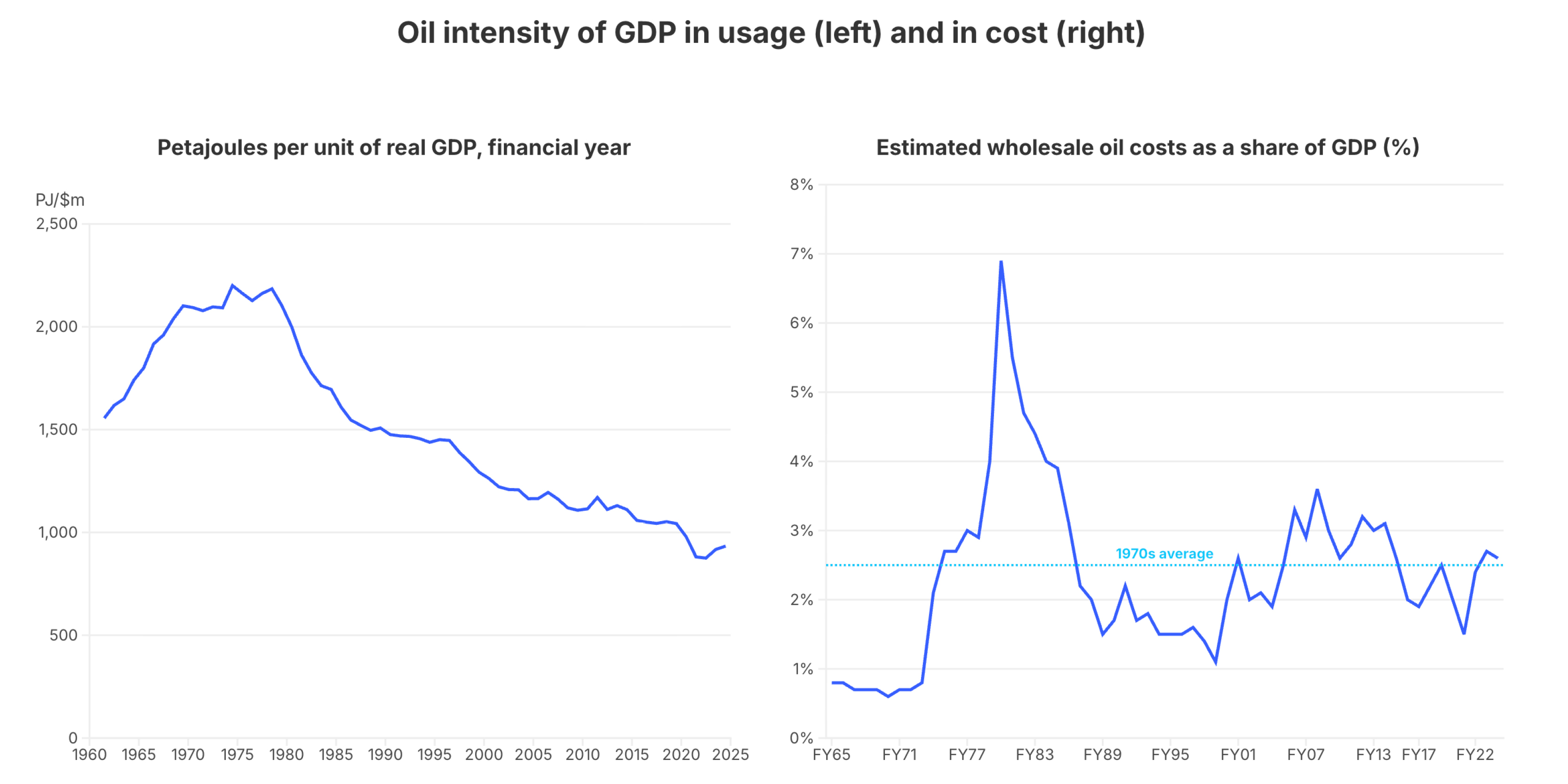
Sources: ABS; Australian Energy Statistics (AES); Energy institute (EI); Australian Petroleum Statistics (APS); World Bank Commodity prices; RBA exchange rates; RBA speech. Note: Estimated wholesale oil costs are calculated based on refined oil product use excluding lubricants and greases and bitumen. AES data used from FY74, EI data prior. APS data used for wholesale price of fuels from FY11, extrapolated based on Brent crude oil prices prior.
While the peak impact of the 1970s crisis on oil prices was higher than recent price increases, it is worth noting that oil use was a lot more elastic to price at the time than it is today. Economists found that a 10% increase in oil prices resulted in a 5–15% reduction in oil demand in the 1970s and early 1980s, but that it has been driving only 1–2% reduction since the mid-1980s. This both increases the likelihood of shocks as demand cannot adapt to changes in supply, and increases the impact of shocks as users cannot readily reduce their consumption when prices increase.
Another worrying factor is Australia’s growing reliance on diesel. Indeed, since 2000, Australia’s diesel intensity has outpaced other countries. Using a comparable metric of diesel use per unit of GDP in 2015 constant USD, IEEFA found that Australia’s diesel intensity increased by 33% between 2000 and 2024 while it decreased globally by 31% on average. This included a similar decrease in the European Union, and steeper falls of 48–59% in the United States, Japan and China (Figure 4).
Figure 4: Australia’s increasing diesel intensity is at odds with other countries
Source: Energy Institute; World Bank open data.
This is particularly concerning given that diesel prices have been experiencing much higher price spikes than other fuels. For example, international diesel prices were 82% higher in the week of 19 August than pre-crisis levels, while they were 53% higher for petrol and 29% higher for crude oil (in AUD).
Transport electrification and grid modernisation can cut the dependence
Fuel efficiency can help reduce business costs in the short term when a shock occurs. For example, IEEFA identified that short-term process and technology improvements could cut road freight’s diesel use by 10–20%.
However, much more drastic oil demand reductions are required to sever the link between oil shocks and inflation. Thankfully, road transport oil use, which has the largest direct and indirect impact on inflation, also presents the most immediate opportunity for electrification.
Modelling by the Australian Energy Market Operator (AEMO) shows that all road transport could be near fully electrified by 2050 (Figure 5). However, the government’s emissions projections show Australia is well off track to capture this potential, particularly in the heavy transport sector, which is expected to increase its oil use to 2040.
Figure 5: Nearly all road transport could be electric by 2050, but it’s not on track
Sources: AEMO; Department of Climate Change, Energy, the Environment and Water.
Government intervention is needed to accelerate progress, such as:
- Financial support for early heavy electric vehicle (EV) charging network and deployment.
- Removing regulatory blockages and introducing new requirements for heavy EVs.
- Modernising the grid to meet the additional electricity demand.
This modernisation involves accelerating transmission grid expansions, which are key to enabling renewable generation growth, as well as distribution grid planning, management and upgrades to deploy and integrate EV charging.
Australia has the tools to sever the link between oil price shocks and inflation, it just needs to use them.

Related Content