The coal-fired carbon credit market
Download Briefing Note
Key Findings
Australia’s federal government is undertaking a review of the Safeguard Mechanism, its main instrument for reducing industrial greenhouse gas emissions – including methane from coal mining.
While the coal industry’s net covered emissions are falling, there are questions over how this is being achieved. Gross or on-site emissions should be falling, but they are not.
Coal is the biggest user of carbon credits under the Safeguard Mechanism, and the industry is rapidly approaching the point where it consumes all available sources of methane-related carbon credits.
This analysis is for information and educational purposes only and is not intended to be read as investment advice. Please click here to read our full disclaimer.
The federal government’s upcoming review of the Safeguard Mechanism (SGM) is shaping up as a battle between competing sets of priorities.
Some are pushing for detailed design changes aimed at strengthening Australia's emissions reduction outcomes. Others favour more modest, incremental adjustments that are simpler to implement but achieve less.
But neither side is particularly helpful to the policymakers who actually write the rules and work across government departments to make them work. For them, reforms that are too complicated would risk smothering the system in detail, while failing to act could dissipate what limited impetus it ever had. And as a market-based mechanism relying on tradeable carbon credits, any discussion of the SGM must consider the largest user of those credits: the coal mining sector.
Of Australia’s most emissive industrial facilities, 68 coal mines are represented in the SGM. The industry that exports about 80% of its products is also responsible for the highest emissions during production. Diesel consumption is rising, driven by shift towards more fuel-intensive open-cut mines. Moreover, coal mining emits methane – a highly potent greenhouse gas – on a scale that dwarfs other sectors represented in the SGM.
On-site emissions reduction efforts have largely stalled, with abatement activities limited to a handful of advanced projects. This has been driven partly by mixed incentive signals, and partly through industry under-investment into research and development. Collectively mines are not yet ready to embrace the challenges of bringing on sufficient levels of on-site methane abatement or implementing diesel decarbonisation.
The continuation of emissions-intensive production practices is one backdrop to the story. The other is coal production volumes. While a global transition away from coal is underway, and some mines are nearing the end of their life spans, there is a large pipeline of new mines awaiting – and receiving – approval from government regulators.
The result is an emissions profile that is on track to persist at least into the 2030s. Therefore, to comply with SGM baseline rules that require net emissions decline over time, mines rely heavily on buying offsets through the carbon credit market.
Australia’s carbon market is dominated by land-based projects that aim to sequester carbon dioxide, but offers little to offset methane emissions. The available supply of carbon credits backed by methane-reducing projects is dwindling as coal mining’s reliance on them increases.
Starved of methane credits, and lacking incentives to actively address on-site decarbonisation, coal mines will must instead rely on a staple diet of carbon sequestration projects that insufficiently address coal mining’s methane problem. This might sit uncomfortably with regulators.
Overhauling the Safeguard Mechanism
The terms of reference for the Department of Climate Change, Energy, the Environment and Water (DCCEEW)’s review of the SGM are broader than a routine recalibration. Alongside setting the rate of emissions decline required from 2030 to 2035, the paper puts the future of carbon credits on the table. It will also consider Climate Change Authority (CCA) advice on whether the scheme is incentivising on-site abatement.
Of Australia’s total reported carbon emissions from coalmining, about 88% are managed under the SGM, according to Safeguard data. The SGM covers industrial facilities emitting more than 100,000 tonnes of carbon dioxide-equivalent (CO2e) per year.
On average, about 70% of direct emissions from coal mining are fugitive emissions, released during mining activities. Fugitive coal mine emissions are almost entirely methane, and coal mining accounts for 86% of the methane emissions covered by the SGM. This is important because of methane’s high global warming potential, and because methane-based carbon credit schemes are limited.
Australia’s emissions reduction targets are to reduce net emissions, both via on-site abatement and by the surrendering of carbon credits to minimise the reported net emissions.
The Clean Energy Regulator (CER) defines two types of Safeguard-prescribed carbon credits: Australian Carbon Credit Units (ACCUs); and Safeguard Mechanism credit units (SMCs). Each are tradeable credits representing one tonne of CO2e.
- ACCUs are earned by regulated projects (including renewable energy, energy efficiency, and land management initiatives) when they reduce or avoid emissions.
- SMCs are earned when a Safeguard facility’s emissions are below its baseline.
Figure 1: Coal mining’s a) share of Safeguard-managed methane emissions, b) share of SGM offset use, c) sourcing for ACCU projects
Coal mining’s covered emissions rose slightly by 0.4% in 2023-24 to 31.8 million tonnes (Mt) in FY2024-25, including 19.5Mt from methane (Figure 1a). Coal’s use of credits from ACCUs and SMCs surrendered represented 49% of the total SGM, making it the largest user at nearly 2.5 times the next highest sector, oil and gas (Figure 1b). The coal sector sourced its 5.1 million ACCUs surrendered mainly from land-based vegetation projects (60%), with only about 36% from methane-related projects (Figure 1c).
The use of carbon credits by coal mining to reduce net emissions grew significantly in FY2024-25, matched only by the oil and gas extraction sector (Figure 2).
Figure 2: Fossil fuel production carbon credit use grew by 52% in one year
With total Safeguard emissions falling in FY2024-25, coal is the only major sector where emissions rose, while others fell.
Safeguard baseline issues
Baselines set the allowable emissions for each facility: operate above it and buy and surrender credits; operate below it and earn SMCs. The scheme sets a mine’s baselines by using its historical emissions intensity rate, applied to Run of Mine (ROM) production for the year.
The SGM consultation paper states that the current “baseline settings arrangements are working well”, and that “industry average emissions-intensity values are sufficiently representative”. However, this is not the case for coal mining.
The concept of an “industry average” baseline was introduced in 2023. This was a design choice aiming to solve a problem: facility-specific baseline reductions would have disadvantaged “early movers” who had made progress before the scheme. So, the scheme set coal mines’ baseline intensity determination as a hybrid. It transitions progressively to a 50:50 split of mine-specific and industry average emissions rates by 2030.
While equitable in theory, the side-effect was worse than the cure. Nearly all open-cut mines operate below average. Underground mines sit well above – about five times higher than the average. It’s a blunt instrument that’s inequitable and unrepresentative for either type.
The consultation paper acknowledges the averaging anomaly, stating the “outcome reflected high emissions intensity variation across the industry”. Figure 3 illustrates the variability between open-cut and underground mine types.
Figure 3: Industry average emissions intensity rate, FY2024-25
The averaging has a number of unintended consequences:
- Underground mines face a sharp drop in emissions baselines towards the average rate. Underground mines are the only type that introduced methane abatement before the SGM existed, typically by flaring and/or capturing and using the methane. Instead of earning some protection as early movers, they now need to deliver further emissions reductions. They are worse off under the industry-averaging approach.
- Open-cut mines, particularly existing facilities, can benefit as baselines can trend upward toward the average rate. Those with natural emissions intensities much lower become SMC banking machines, earning credits despite not doing anything to drive down their emissions. Instead of incentivising abatement, the SGM potentially provides a windfall for these facilities. These grandfathered existing mines benefit about 10-fold compared with newly established mines whose target intensity factor is determined by a ‘best-practice’ approach – a rate more than 10 times lower.
The review will consider two things: whether to retain the current 50:50 hybrid baseline approach for coal mining beyond 2030; and whether to allow unrestricted SMC banking beyond 2030.
On-site abatement potential
A number of underground mines have been associated with on-site abatement for many years. About 10 coal mines have established power station projects using coal mine waste gas (CMWG) that earn credits for methane destroyed and grid electricity displaced, most recently under an ACCU scheme. This program is now closed to new projects. A record number of projects were registered in 2025, before the scheme’s removal. Future new abatement projects, and life-sustaining replacement projects nearing end of life, will lack access to this incentive structure, meaning sustaining or increasing on-site abatement will be challenging.
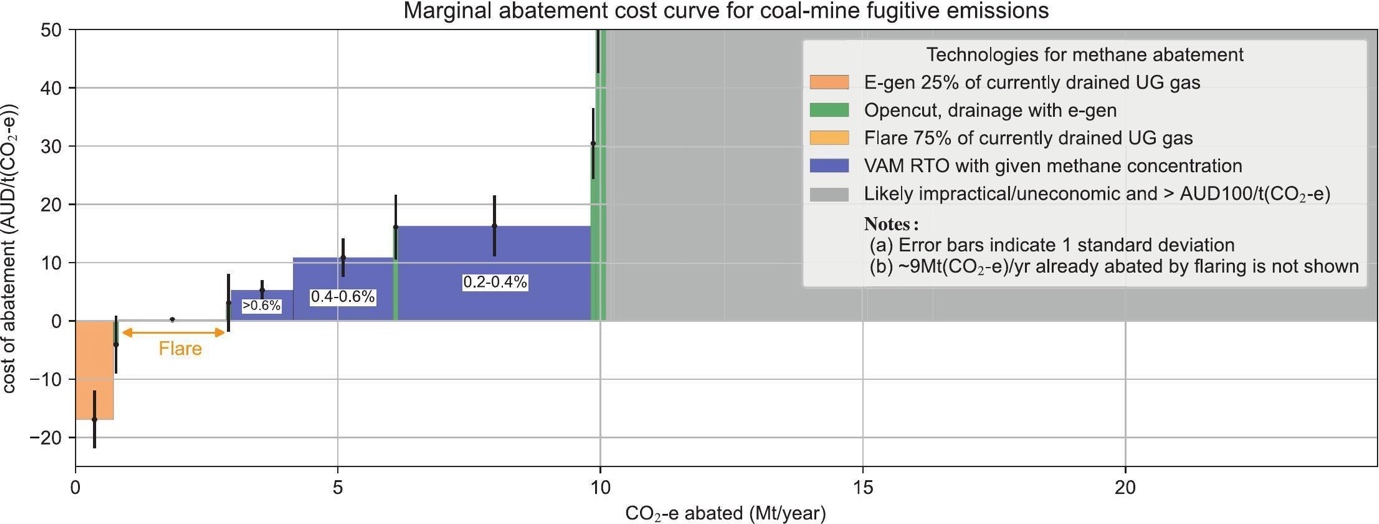
Nonetheless, the average abatement cost is well below the ACCU price, so cost alone doesn’t explain the level of inaction. CSIRO’s techno-economic assessment finds around 6Mt of coal fugitive methane abatement available for less than $11 per tonne of CO2e. Ventilation air methane (VAM) abatement at underground mines accounted for 3.1Mt of this, with 2.8Mt coming from flaring or generating power from gas already being drained for safety (Figure 4).
Figure 4: Marginal abatement cost curve for fugitive emissions at Australian coal mines
Source: CSIRO.
That’s well below the ACCU price of about $38 per tonne of CO2e. This paradoxical outcome has some economists baffled as to why more on-site abatement is not happening. One reason is the high upfront capital costs in relation to the delayed and uncertain benefit of methane abating over an extended lead time, and the International Energy Agency (IEA) has outlined some reasons why methane abatement lacks priority. Decarbonisation capital generally loses out to the primacy of returning funds to shareholders.
Meanwhile, EDL Energy has made a business out of taking waste gas from coal mines and industrial facilities, often overlooked by their owners, to run remote on-site power generation. It displaces grid-supplied electricity or is distributed into the grid. EDL owns assets globally and is reported to be valued at least $2 billion.
For underground mines the opportunities to increase abatement lie in three options: increasing pre-drainage; improving the post-mining drainage capture efficiency; and/or installing VAM abatement technology on mine vent shafts.
Appin Mine, the highest-emitting mine in Australia, outlines the challenge and opportunities in its most recent annual review. The mine emits methane in low concentrations from its ventilation shafts: in FY2024-25 it reported 2.3Mt of CO2e emissions. However, with government co-funding, it has made welcome progress with VAM abatement project studies. In FY2025, it recovered 3.05Mt of CO2e by piping methane from the underground mine to a gas-fired power plant operated by EDL Energy.
Emissions from open-cut mines are typically 50:50 fugitive emissions and diesel combustion. Financial logic and investor pressure for shareholder returns normally means these mines would not spend capital on abatement activities for which there is no financial gain. Without strong Safeguard signals or decline rates, some established open-cut mines (with below-average emissions intensity) can coast along, earning credits despite avoiding on-site abatement.
Methane abatement at open-cut mines is also challenged by lower gas content in the coal than in underground mines. This raises the extraction costs and complexity for each tonne of methane abated. BHP reports it is trialling a new drilling technology at its Saraji mine, to capture and treat methane from coal seams closer to the timing of coal extraction than traditional gas drainage methods.
The Safeguard penalty for exceeding emissions baseline in FY2024-25 was just 14 cents per tonne for the average large open-cut coal mine. That’s on coal worth a few hundred dollars a tonne.
On diesel emissions there is another incentive issue. A large open-cut mine receives a rebate of fuel excise – the Diesel Fuel Tax Credit – worth $5.15 per tonne of coal produced. The rebate credits the excise already paid on diesel, while the SGM taxes diesel emissions. This presents a lop-sided incentive to burn more diesel: against the Safeguard cost of 14 cents, it is a ratio of nearly 40:1 in favour of continuing to use diesel.
Capital funding support is not the issue either. IEEFA found more than $1 billion in government funding that could be used on coal mine decarbonisation remains largely unspent. Some minor co-funding of fugitive methane abatement has occurred, but none for diesel decarbonisation.
The case for on-site abatement at highly emissive mines with long remaining lives is strong. It is less so for mines in a decline phase, or at open-cut mines generally. For many mines lacking incentives for on-site abatement the SGM is structured towards using carbon credits to offset emissions.
Open-cut mine methane measurement challenges
There’s also a less visible problem layered on top of the baseline issue and stalled abatement.
Over the past few years open-cut mines have changed the basis for reported methane. The old state-based emissions factors (Method 1) provided for a constant intensity rate, for each state. Recently mines have moved to a facility-determined approach (Method 2), based on specific mine-site gas measurements. On average New South Wales mines now report methane intensity about 76% lower under Method 2, and Queensland mines report rates about 41% lower.
Meanwhile, the “industry average” emissions intensity rate in the SGM, to which existing coal mines are supposed to be transitioning, remains the same. If left unchanged this will contribute to an oversupply of SMCs.
The change in reporting drove lower reported emissions in open-cut mines when no on-site abatement has taken place. IEEFA considers that open-cut mines are now under-reporting their emissions, due to issues with Method 2. The degree of under-reporting is potentially significant. A recent UNSW-led airborne study of the Bowen Basin found open-cut mines were underestimated by a factor of 3.6 in aggregate. This corroborates earlier IEEFA estimates of this pattern.
The real reporting fix lies in reconciling satellite and airborne measurement against inventory totals. That remains a challenge that the global science community will take time to solve. However, the government has already established an expert panel on fugitive methane emissions led by Chief Scientist Cathy Foley. It has also commissioned the UN Environment Programme’s International Methane Emissions Observatory (IMEO) to run a controlled-release study at a simulated open-cut mine in Australia.
Until then, revisiting Method 2’s sampling standards, which the CCA recommended the government should do “as a matter of urgency” in December 2023, is a narrower and more achievable task. All Safeguard facility open-cut mines have been required to use Method 2 or 3 reporting since 1 July 2026.
A carbon credits supply-and-demand mismatch
IEEFA has projected the approximate volume of credits required from the coal sector through to FY2029-30. Our projections were based on a business-as-usual (BAU) scenario with the following simplifying assumptions:
- Current mining rates and methane emissions intensities are held constant, varying only the baseline according to the SGM algorithm.
- Minor on-site abatement begins from FY2028-29, for distinct advanced abatement projects that miners currently undertaking feasibility studies or production trials.
- Mines close as currently scheduled while new ones open in line with advancing approvals.
- Growth in mining’s diesel intensity at open-cut mines slows to 5% per annum (down from 6-7% actual) due to on-site fuel efficiency measures, equipment upgrades and some ancillary mining equipment electrification, partially offset by mining’s rising strip ratios and lengthening haul distances.
Figure 5: Coal mining sector credits – demand projection
Coal production and total emissions are essentially flat over the horizon but net demand for credits increases to 10-15 Mt in FY2029-30, due to declining emissions baselines. Underground mines in particular consume more credits to meet their steeply declining baselines. In contrast, the total pool of coal SMCs earned shrinks to a negligible volume.
Under IEEFA’s modelling, in a mid-range case, coal sector Safeguard activity in FY2029-30 requires about 12Mt of credits, net of SMCs earned.
With no restrictions on the quantity or type of ACCUs that available to miners, much debate centres on the quantity and quality of ACCUs miners use to offset emissions, including the use of land-based ACCU projects. Across the coal sector, the average coal mine facility uses ACCUs to the value of 21% of its baseline to offset emissions, and 60% of these ACCUs are from land-based vegetation projects. Figure 6 overlays coal’s approximate credit requirements on the national issuance of credits. Issuance is tracked from CER’s Quarterly Carbon Market Report data, with volumes held flat from FY2025-26 through FY2029-30.
Figure 6: National ACCU issuance (land vs methane-based) against coal’s demand
Supply of compliance ACCUs has been increasing in the land-based vegetation category, such as plantation projects or protection of vegetation. The methane-based credits, such as Waste and Industrial fugitives issuance declined. Industrial fugitive credits supplied only 5.6% of coal mining ACCU compliance. The CMWG method generating those credits expired in March 2025 and the government confirmed in April 2026 that it will not be remade – so that share can only fall.
Therefore, as coal’s projected demand approaches the total annual methane-based issuance, it isn’t a static comparison. Coal isn’t just absorbing the methane pool – its demand is being met by land-based carbon credits.
In addition to ACCUs issued, there were 4.5 million non-coal SMCs issued into the supply pool. These were mainly from oil and gas extraction, and as Figure 2 indicates, that sector has a growing thirst for credits as well. Then there’s the already considerable banked volumes of ACCU and SMC holdings to consider in the supply-side pool.
Nonetheless, coal’s increasing demand for credits cannot be met from new methane-related supply and is the product of BAU practices in coal mining, driven by current SGM rules and fuel tax credits.
Coal’s own (net) credit requirements are approaching 100% of the supply of methane-based ACCUs issued in FY2025-26. From currently being a negligible amount of the total national supply including land-based schemes, it is expected to climb drastically. By FY2029-30, coal alone could be seeking more than half of the national ACCU supply issuance. It only tapers off after that if on-site abatement occurs at coal mines.
Coal cannot cover its own compliance on an ongoing basis; nor can the pool of methane-only offsets be used to offset coal’s projected emissions. These projections indicate it will increasingly be supplied by land-based ACCU credit schemes. The bigger picture is the sector’s continued release of fugitive methane and its inaction on diesel use. This poses a risk to national and state emissions reduction targets.
Increased transparency is urgently needed
SGM data disclosure is much improved in recent times. Emissions are now segregated into greenhouse gas types and the method of estimating methane emissions is now disclosed. The addition of a source-category breakdown to the data release would require no new data collection. This data is collected but is not published in SGM disclosures. This stemmed from concerns over potential confidentially issues, though some coal miners now publish this data in their ESG reports – albeit not on a consistent or wide-spread basis.
This is a low-cost, high-value addition that would let policymakers and investors immediately distinguish structurally different abatement challenges — a coal mine that is 95% fugitive-driven needs a completely different decarbonisation strategy than one that is majority fuel-combustion-driven.
Another area of improved visibility is the methodology determinations for Safeguard ACCU surrenders, which has informed coal mining’s sourcing of ACCUs in Figure 1c. The CER should extend these method-type disclosures to also trace the ACCU project identification, to inform the integrity of carbon credits.
Improved transparency has to be one of the cheapest forms of action available. Disclosure of information already collected by companies and regulators to the register is available at no cost. Monitoring of the integrity risk of carbon credits used to offset emissions is likely to be an important foundation in future as offsetting via land-based projects becomes the norm in the coal sector.
The coal sector’s gross or on-site emissions are not falling, unlike in other sectors of the economy. How coal goes about achieving its net emissions reductions in future will be an important part of the success of the SGM.
The government’s consultation will examine views on appropriate baseline setting for coal mines past 2030 and the use of carbon credits. Coal sector demand for offsets is driving demand for carbon credit markets. Australia ranks among the world’s largest exporters of coal, so we must ensure that the SGM is fit for purpose in managing its emissions. If not, the coal industry’s emissions reduction agenda will increasingly depend on land-based carbon projects, crowding out other sectors that will be forced to carry the load on real emissions reduction.

Related Content