Electrifying ironmaking: The potential of direct electrolysis of iron ore
Download Briefing Note
View Press Release
Key Findings
While the energy consumed in the electrochemical process rivals conventional ironmaking, the scale of clean electricity required presents a challenge for its widespread adoption.
Regardless of whether renewable electricity is used to produce green hydrogen or directly reduce iron through electrolysis, greater investment in firmed renewable electricity will be essential to decarbonise primary steel production.
While electrochemical technologies are mature and widely used in metal production, they have only just begun to attract attention in the steel sector as the global effort to decarbonise industry intensifies, according to a briefing note released today.
Direct iron electrolysis has advantages over other ironmaking processes but questions over its scaleability and commercialisation could limit its role in transforming one of the world’s most carbon-intensive industries, finds the note Electrifying ironmaking: The potential of direct iron electrolysis.
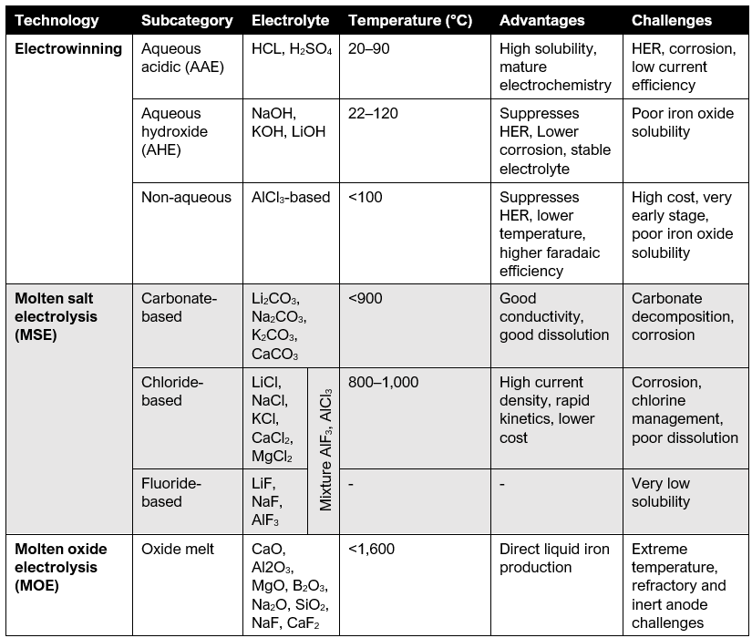
Soroush Basirat, IEEFA’s Energy Finance Analyst, Global Steel, runs the rule over the three major electrochemical pathways for ironmaking:
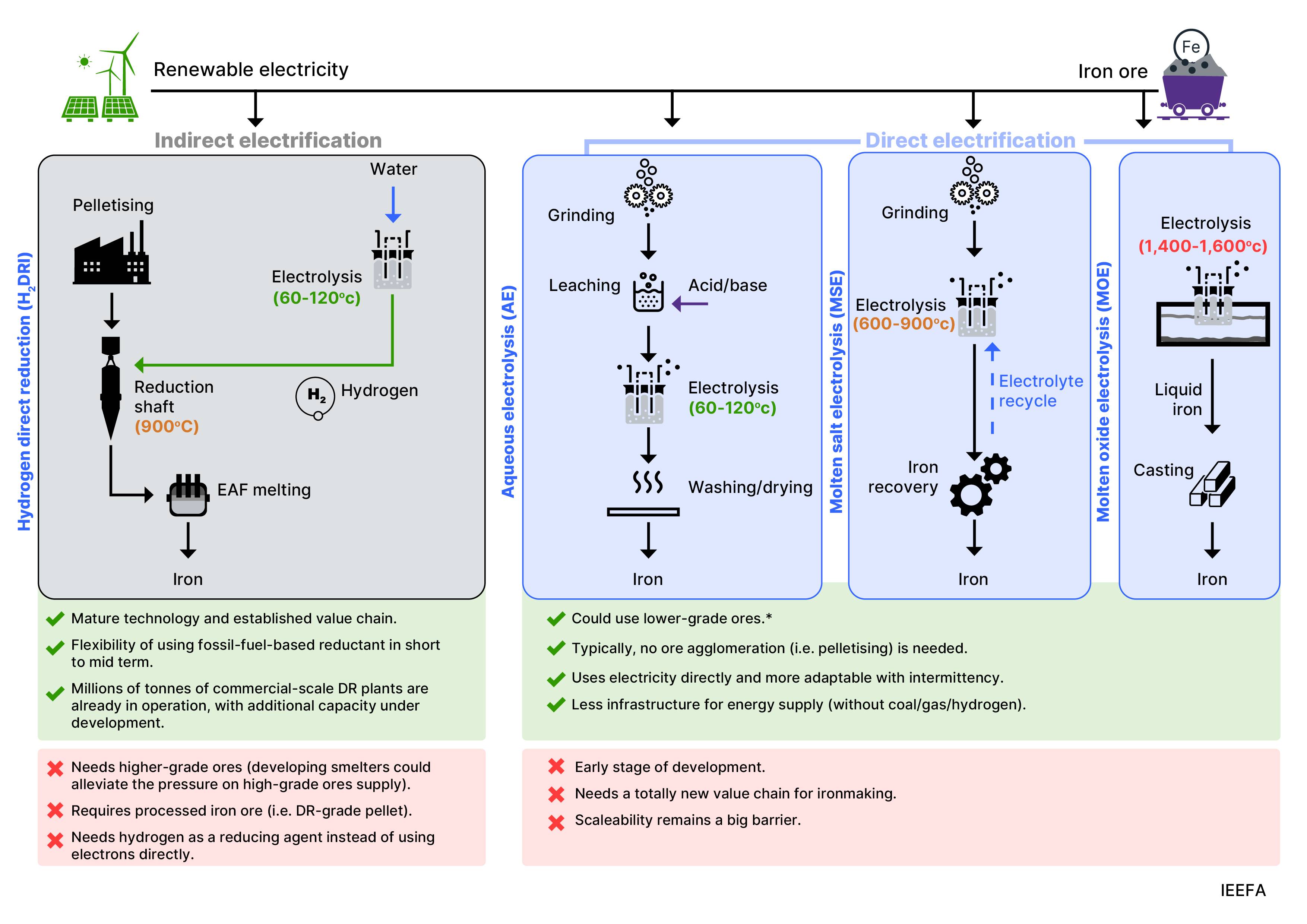
- Low-temperature electrowinning – operates at 20–120°C
- Molten salt electrolysis (MSE) – 800–1,100°C
- Molten oxide electrolysis (MOE) – <1,600°C.
Each process uses iron ore either dissolved in solution or suspended in an electrolyte at varying temperatures; with electricity passed through to reduce the ore into pure iron. Each has its own advantages and challenges, which developers around the world are striving to overcome.
Theoretically, electrolysis, when powered by clean electricity, has the potential to produce near-zero-emissions iron, and has been identified as a potential solution to the global steel decarbonisation challenge.
Among these pathways, MOE and electrowinning in aqueous solution with real world initiatives are better understood, whereas MSE remains less advanced. However, significant technical and commercial challenges remain before the technology can be deployed at scale.
US-based Boston Metal has been at the forefront of iron electrochemistry, attracting backers including major steelmakers and iron ore producers, such as BHP, Vale, ArcelorMittal and Tata Steel. However, it suffered a serious technical setback at its Brazil plant in January 2026, underlining the precarious nature of this nascent technology.
Elsewhere, Electra and Volteron are trialling separate direct iron electrolysis pathways at pilot plants. In Australia, Fortescue and Element Zero are also pursuing variations of the process, albeit at much earlier stages of development.
Decarbonising steelmaking: direct electrification vs indirect electrification
Round-the-clock access to clean energy is a prerequisite for green iron and steelmaking, however, the intermittent nature of renewable energy adds a further layer of complexity to the technical challenges of decarbonising via electrochemical processes.
Electricity is the primary cost driver in iron production via electrolysis. Therefore, access to abundant, low-cost clean electricity will be a key factor in the commercial viability and widespread deployment of electrochemical ironmaking.
Beyond the availability of firmed renewable electricity, some electrochemical ironmaking technologies may offer greater operational flexibility in electricity consumption.
Some studies identify the ability to operate directly on renewables as a potential advantage of direct iron electrolysis, suggesting some processes may be more tolerant of intermittent power supply.
Electrochemical ironmaking remains in its infancy. Developers face a long road ahead to prove the technology can work at scale and compete in the global market. Production is limited to tonnes per day, at best. To challenge mature, clean technologies such as hydrogen-based direct reduced iron (H2–DRI), the technology must be scaled up significantly. Although scaling up is the primary roadblock, integration and adoption challenges loom large as well.
Overcoming the technical challenges associated with direct electrolysis is only part of the transition. The adoption of entirely new system would require a fundamentally different ironmaking value chain, one that is largely unfamiliar to the steel industry.
Despite these challenges, electrochemical ironmaking takes a novel approach to the steel industry's decarbonisation crisis.
It has unique advantages that differentiate it from other pathways. In particular, the ability to use lower-grade iron ores with minimal or no processing (even magnetite ore as low as 35% Fe) and, in the case of low-temperature processes, greater compatibility with intermittent renewable electricity.
By eliminating the use of coal, gas and even hydrogen as reducing agents, electrolysis requires less energy infrastructure at the steel plant, such as bulk handling systems, pipelines, storage facilities and related port infrastructure.
The overall process configuration is simpler, as it removes the need for several upstream processing steps, including cokemaking and agglomeration processes such as sintering and pelletising.
These characteristics could enable direct electrolysis to establish a niche role in smaller-scale green iron production, particularly in regions with abundant renewable energy resources and access to lower-grade iron ores, even in the absence of an existing steelmaking industry.
Direct electrolysis of iron ore pathways

Related Content