Policy reset could significantly expand wind and solar generation in Mexico
Key findings
Key findings
Mexico has relied heavily on fossil fuels to generate electricity for the past 25 years, but solar and wind, backed by dispatchable battery storage, may soon be supplying a much higher share of Mexico’s electricity demand.
Mexico’s recent policy changes, together with ongoing technological improvements in solar, wind, and dispatchable battery storage systems, could unlock the country’s renewable resources.
To get a sense of how quickly Mexico’s energy transition could happen, it’s worth looking at the dramatic transformation in electricity generation that has unfolded in the U.S. states along Mexico’s northern border.
The energy transition in Mexico could support increased economic growth, energy independence, stable power prices, better grid reliability, and improved access to power for people and industry.
Mexico has relied heavily on fossil fuels to generate electricity for the past 25 years, with oil, gas, and coal producing nearly 80% of the country’s power between 2000 and 2024. But solar and wind, backed by dispatchable battery storage, may soon be supplying a much higher share of Mexico’s electricity demand.
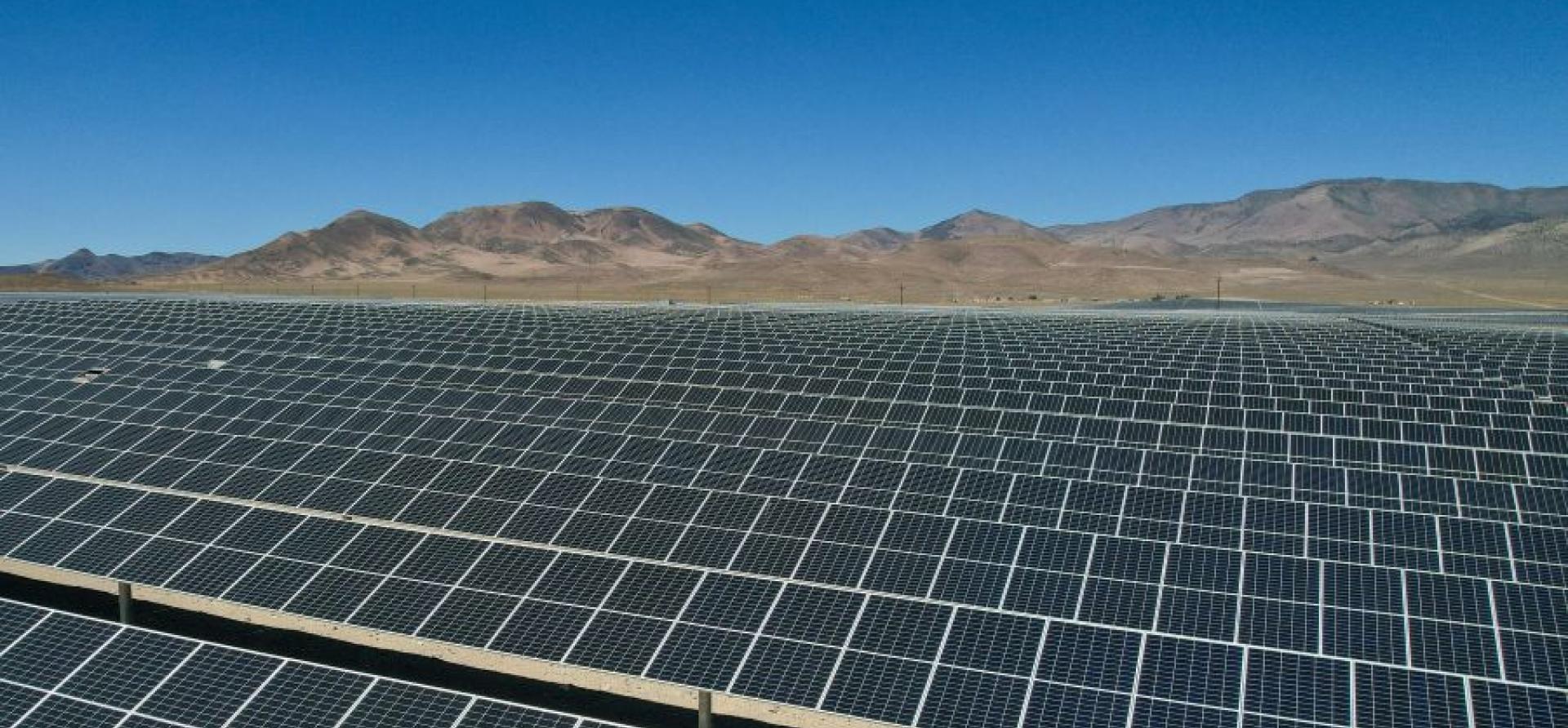
Under a revamped energy policy framework set in motion by President Claudia Sheinbaum, who took office in late 2024, 7,410 megawatts (MW) of utility-scale solar and wind projects were selected in June out of nearly 38,000 MW that had been proposed, highlighting strong investor interest to develop renewable projects in the country. Most of the winning projects, about 6,700 MW, were solar photovoltaic, with the remaining 700 MW awarded for wind. All of the projects are required to have battery storage equivalent to at least 30% of their capacity and a duration of at least three hours under the new rules. Initial reviews, interconnection studies, contracts, and permit application milestones are unfolding into the fall; the government’s goal is to complete this process by the end of the year.
Since 2000, Mexico’s fossil fuel consumption has undergone a significant shift from oil to gas, much as the U.S. has shifted from coal to gas. In 2000, oil fueled 45% of Mexico’s power generation, with gas contributing 22%. By 2024, oil’s share had fallen to just over 7%, while gas-fired power rose to 62%. Coal use has declined somewhat, from a high of about 13% in 2005 to around 7% today.
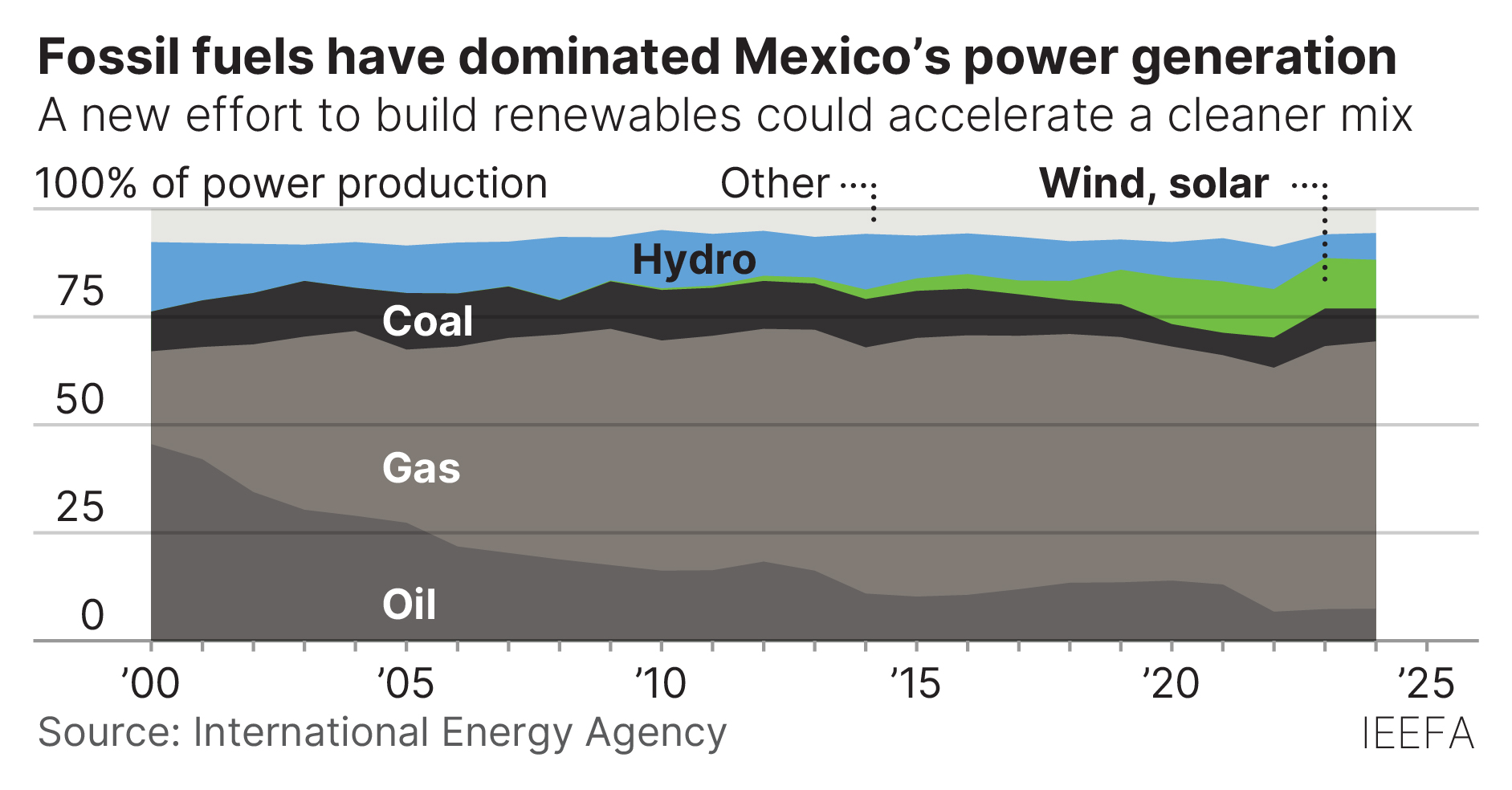
Wind and solar generation enjoyed a growth spurt between 2017, when their market share stood at 3.2%—almost all from wind—and 2021, when it had grown to nearly 12%, split about evenly between the two resources. Then, development all but stopped, as did the increase in market share. Under the new rules, the energy transition in Mexico could shift quickly back to growth, while providing a boost to the nation’s energy security, economic development, and grid resilience. The government hopes to add about 20,000 MW of renewables and 5,000 MW of battery storage by 2030.
To get a sense of just how quickly and far reaching that transition could happen, it’s worth looking at the dramatic transformation in electricity generation that has unfolded in the U.S. states along Mexico’s northern border: Texas, New Mexico, Arizona, and California.
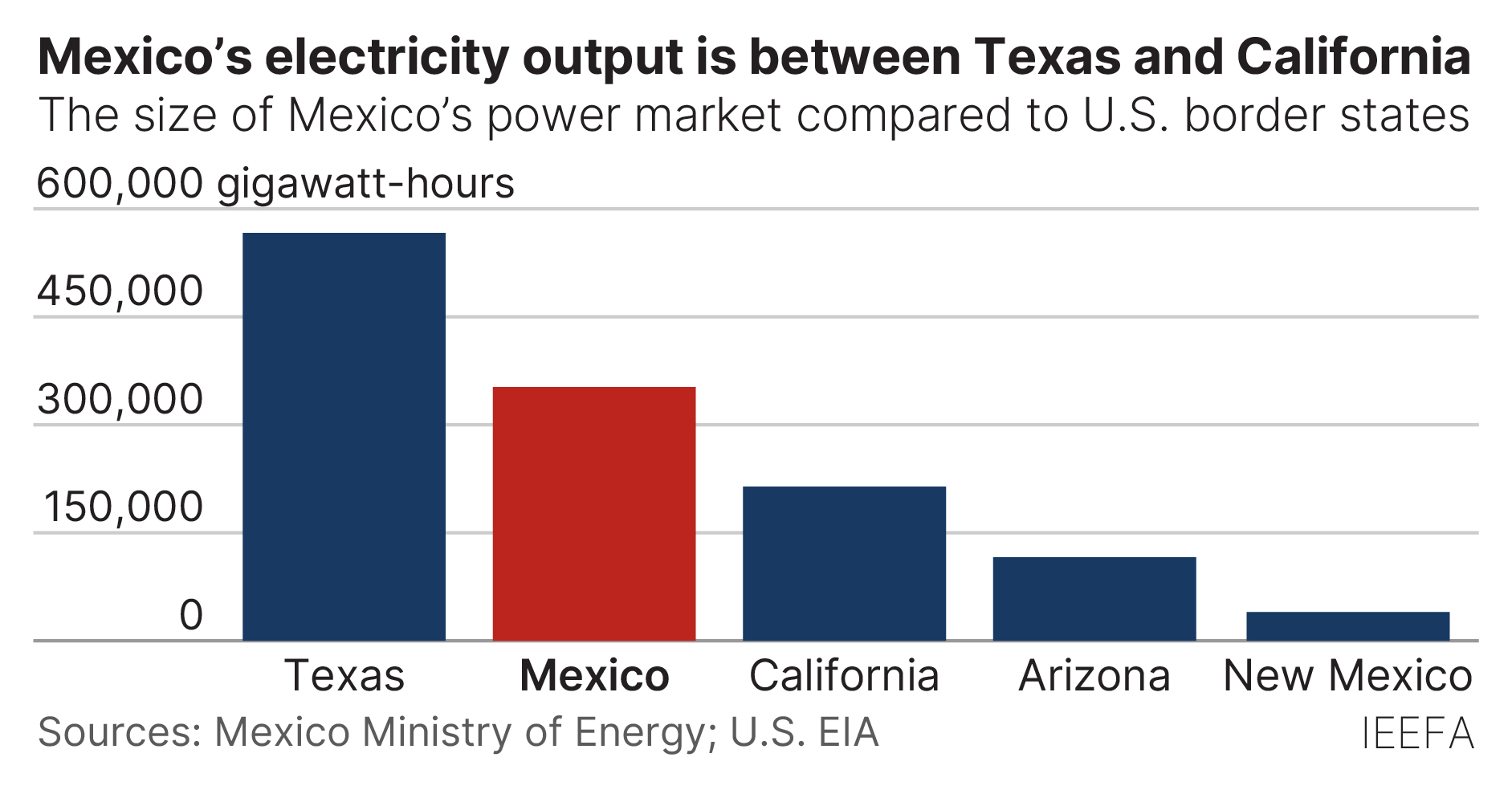
Those four states also provide a good comparison to the size of Mexico’s power market. In 2024, the country’s net electricity generation totaled 352,305 gigawatt-hours (GWh), according to data from the Mexico Ministry of Energy. That’s far less than the 566,503 GWh that Texas produced the same year, but more than California’s 214,191 GWh. Arizona generated 116,027 GWh and New Mexico 39,697 in 2024, according to the U.S. Energy Information Administration (EIA), making the combined electricity production from the three Western states, at 369,915 GWh, about equivalent to Mexico’s output.
Along the border, the most dramatic change has been in New Mexico’s fuel mix. In 2001, New Mexico depended on fossil fuels for over 99% of its power—mostly coal. As recently as 2015, 91% still came from coal and gas, a far higher share than Mexico. By 2025 that share had been cut in half, to 47%. At the same time, wind and utility-scale solar’s share of total generation soared from 8% to 52%, pushing coal and gas generation out of the market.
Texas has also undergone a remarkable shift. In 2001, 87% of the state’s power came from coal and gas. By 2025, that was down to 58%, even as electricity demand in Texas soared. That shift was made possible by wind and utility-scale solar, which grew seven times faster than fossil fuels during the period, and now supply more than 34% of the state’s power.
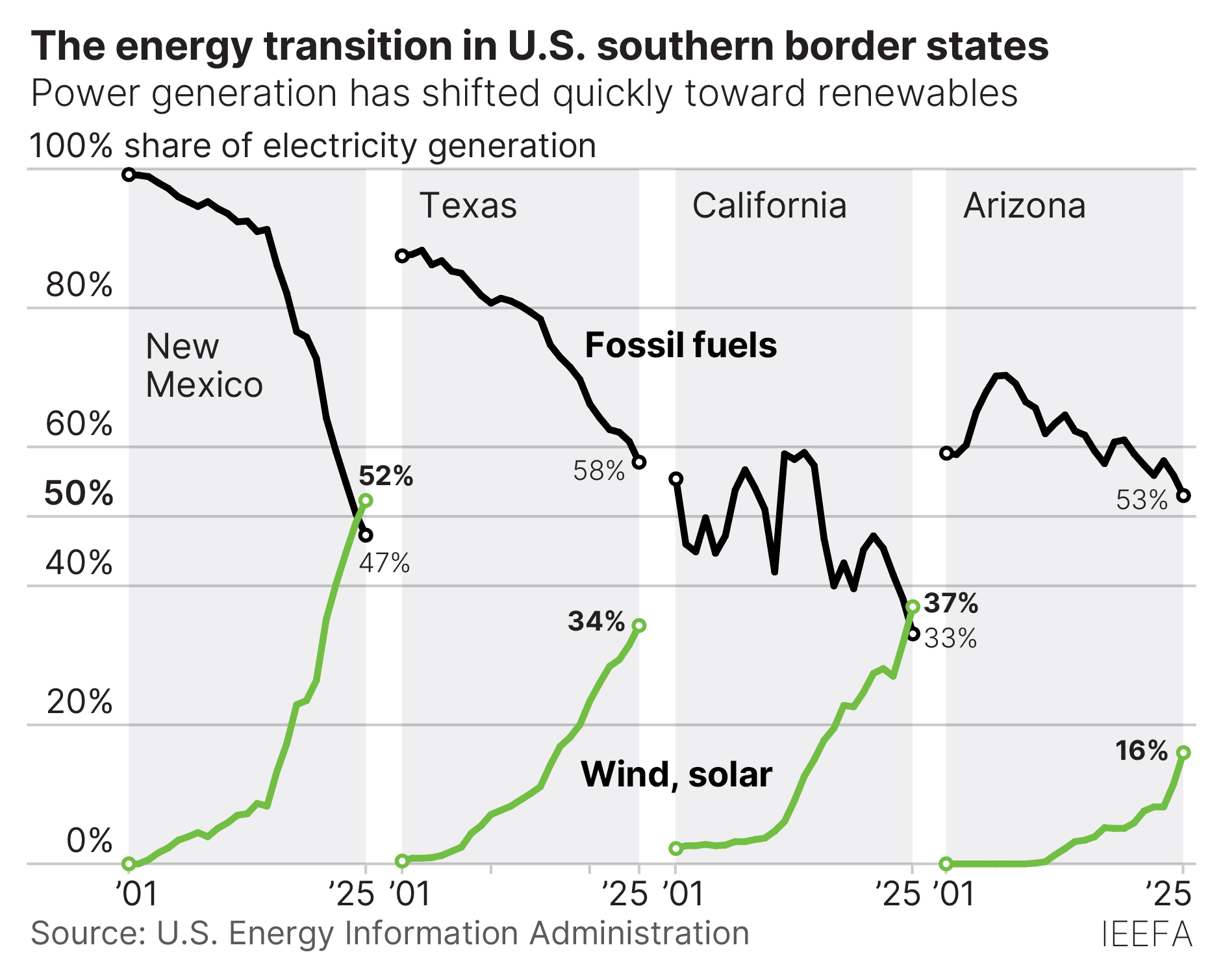
In California and Arizona, the changes have also been substantial, especially in the past few years, but these states have always produced a lot of power from nuclear and hydroelectric resources, and were never as coal- and gas-reliant as New Mexico or Texas. Arizona, for example, generated 32% of its power from nuclear in 2001 and 27% in 2025, while California’s nuclear plants provided more than 18% of the state’s electricity in 2001 and 9% in 2025.
In both states, however, a buildout of wind and solar has led to big increases in market share as they have replaced fossil fuels, as well as covering for declines in hydro output in Arizona and nuclear power in California. Leading the U.S. in its push for renewable power, by 2001 California’s utility-scale solar and wind was already producing 2% of its power, which had risen to 15% by 2015. By 2025, that had leapt to 37%. Meanwhile, fossil-fuel use, mostly gas, fell from 55% in 2001 to just 33% last year.
A major reason why the energy transition has accelerated recently in these states—especially Texas and California—is the rapid addition of dispatchable battery storage. Mexico’s inclusion of battery storage capacity in its renewable project requirements will likely boost the impact of its new policy approach, but the country also might benefit from an even more aggressive buildout of storage. Why? In states like Texas, large deployments of batteries are providing multiple layers of improvements for the grid, including lowering overall power prices, especially during peak demand times; increasing grid stability; addressing some transmission constraint issues; and supporting a more efficient and economic use of generation resources. These improvements allow significantly more renewable projects—especially solar—to be built, and sharply reduce the need for new, expensive peaker plants.
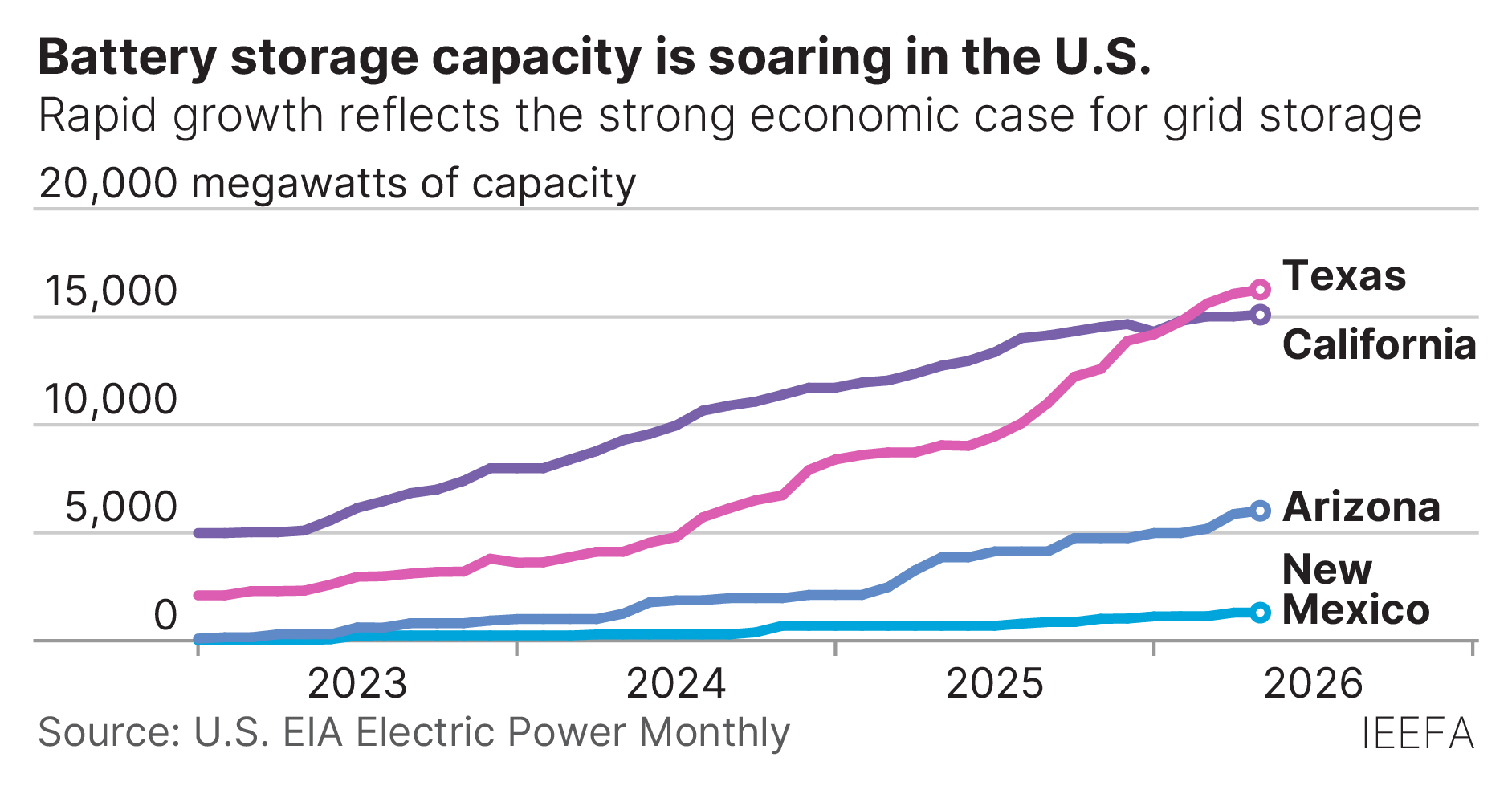
These are all challenges that Mexico’s electrical grid faces. Parts of the system, notably the Baja and Yucatan peninsulas, are relatively isolated from the rest of the country. The strongest solar resources are in northern and western states, while wind resources are more concentrated in the northeast and farther south in Oaxaca. Balancing increased power production from these renewable resources, and delivering that electricity to central Mexico—where the majority of the country’s 134 million people are concentrated—would likely happen faster and more efficiently with a substantial increase in battery storage capacity. In the United States, upgrades and additions to transmission systems have been slow and costly, and have faced significant opposition. Battery storage has addressed some of the shortcomings and allowed new generation to continue to be built, even as it improves grid reliability.
In Mexico, a reinvigorated energy transition in the power sector may be unfolding, much as it has in the U.S. states along its northern border. Mexico’s recent policy changes, together with ongoing technological improvements in solar, wind, and dispatchable battery storage systems, could unlock the country’s renewable resources, supporting increased economic growth, energy independence, stable power prices, better grid reliability, and improved access to power for people and industry.

Related Content