Modelling Bangladesh’s energy future

Key Findings
Bangladesh’s energy system has reached an inflection point. In addition to the financial burden of imported liquefied natural gas (LNG), existing industries are operating at lower capacities due to an energy supply crunch. The perceived challenges in meeting the country’s growing energy demands have also compelled the government to suspend future industrial gas connections.
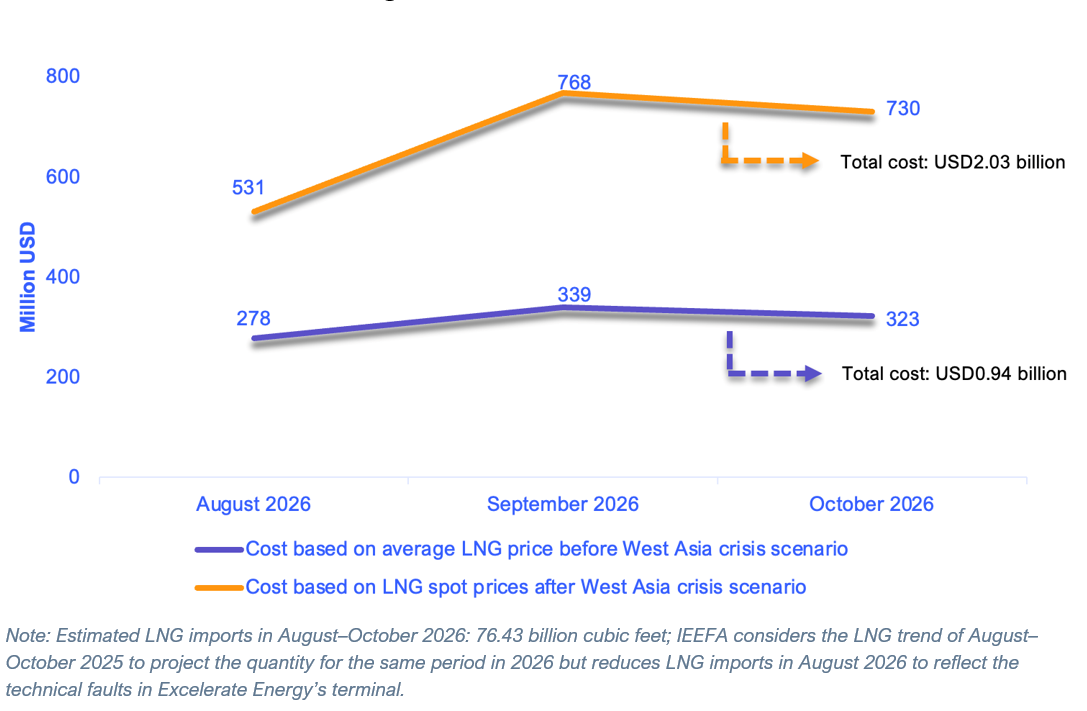
Based on the LNG import trend of 2025, Bangladesh will likely incur an additional USD1.09 billion (BDT134 billion) to meet its demand for LNG from August to October 2026. While the government will cover the additional cost of LNG for now, it will need to adjust gas prices in the future.
The power sector currently receives gas at BDT15.5 per cubic meter (m3) (USD0.13/m3), a price far below the average price of imported LNG prior to the West Asia crisis. If the government raises the gas price for power plants to even BDT25/m3 (USD0.2/m3), the fuel cost to generate electricity in a 55%-efficient combined cycle plant will surge to BDT4.65 per kilowatt-hour (kWh) (USD0.038/kWh) from BDT2.88/kWh (USD0.023/kWh). This will ultimately increase the average grid-based power generation cost, leading to the need for a power tariff adjustment.
While a short-term crisis is manageable, Bangladesh’s energy sector shows symptoms of a prolonged energy crunch. It must model its future energy pathway better to navigate oncoming challenges, whether due to global disruptions or rising demand.
Bangladesh’s energy system has reached an inflection point. In addition to the financial burden of imported liquefied natural gas (LNG), existing industries are operating at lower capacities due to an energy supply crunch. The perceived challenges in meeting the country’s growing energy demands have also compelled the government to suspend future industrial gas connections. Amid a lack of information, entrepreneurs had reportedly made significant investments dependent on gas supply to commence operations.
Additionally, Bangladesh’s energy system has, thus far, not been able to address the need for technological shifts on the demand side arising from a domestic gas supply shortage (for example, a transition to highly efficient heat pumps that run on electricity).
The country’s past energy models could not properly capture the high cost of imported LNG and the required changes in technologies on the demand side.
Bangladesh must draw lessons from its previous experience and build an evidence-based energy model, incorporating future demand projections while considering uncertainty.
Prolonged LNG shock for Bangladesh
While Bangladesh used to procure more than 50% of its LNG through its long-term contracts, the force majeure triggered by the West Asia crisis is compelling it to source the fuel from spot markets. In May 2026, IEEFA estimated that the subsidy burden could reach about USD1.07 billion (BDT132 billion) on account of LNG imports from April to June 2026.
Now that QatarEnergy has extended its force majeure through mid-October 2026, Bangladesh braces for a prolonged exposure to costly LNG. The country will likely require importing expensive LNG even beyond mid-October 2026. Based on the LNG import trend of 2025, Bangladesh will likely incur an additional USD1.09 billion (BDT134 billion) to meet its demand for LNG from August to October 2026 (see Figure 1). This is assuming that the average LNG price in August 2026 was USD22 (BDT2,705) per million British thermal units (MMBtu), taking an average of the purchases at USD22.35/MMBtu (BDT2,748/MMBtu) and USD21.55/MMBtu (BDT2,649/MMBtu). The average prices in September and October 2026 are predicted at USD26/MMBtu (BDT3,196/MMBtu), and the average import price of LNG in the pre-West Asia crisis scenario is taken to be USD11.5/MMBtu (BDT1,414/MMBtu).
While the government will cover the additional cost of LNG for now, it will need to adjust gas prices in the future. The power sector currently receives gas at BDT15.5 per cubic meter (m3) (USD0.13/m3), a price far below the average price of imported LNG prior to the West Asia crisis. If the government raises the gas price for power plants to even BDT25/m3 (USD0.2/m3), the fuel cost to generate electricity in a 55%-efficient combined cycle plant will surge to BDT4.65 per kilowatt-hour (kWh) (USD0.038/kWh) from BDT2.88/kWh (USD0.023/kWh). This will ultimately increase the average grid-based power generation cost, leading to the need for a power tariff adjustment. This shows the perpetual vulnerability of Bangladesh’s dependence on LNG.
Disorganised energy transition in industries
Bangladesh’s suppressed demand for gas is evident — the demand-supply gap is more than 1,300 million cubic feet per day. As a result, existing industries are exploring multiple, disorganised energy sources. During periods of low pressure on gas supplied through the grid, some industries use liquefied petroleum gas (LPG) imported by the private sector. Some purchase compressed natural gas (CNG) provided by the government to fuelling stations. Some industries occasionally use diesel-run generators imported by the government, but the use of diesel in power generation raises costs significantly. A few industries have installed biomass boilers as a cleaner and cheaper alternative. As sustainable biomass resources are dispersed and not readily available in industrial belts, a sustainable fuel supply chain remains a concern. Many industries have installed rooftop solar and different energy-efficient technologies. Despite these efforts at diversification, many industries operate at lower-than-optimal capacity due to the ongoing gas crisis.
A technical glitch at Excelerate’s LNG regasification unit resulted in a slump in national gas supply of around 19% in August 2026, forcing existing industries to further cut back on production.
A recent conversation with a high official of the Bangladesh Textile Mills Association (BTMA) reveals that industries were never apprised of the possible energy pathways they should follow to avert the oncoming energy crisis. Instead of being briefed on what alternatives to gas-dependent industrial operations exist, entrepreneurs were left in the dark, facing uncertainty over gas connections after setting up new gas-dependent operations.
Evidence-based modelling for a future energy pathway
Bangladesh needs to design a sustainable energy pathway that accounts for uncertainty and future demand-side requirements.
Bangladesh should model its future energy pathway based on evidence of what will likely work and what will not. To this end, it should carefully assess the high cost of imported LNG as opposed to cheaper alternatives, such as domestic gas and renewable energy.
Bangladesh should factor in the potential of imported hydropower from Nepal and Bhutan in reducing the country’s future dependence on gas, thereby limiting the role of imported LNG. It could also explore the cheaper renewable energy sold in India’s green day-ahead market to rein in Bangladesh’s rising power generation costs. As a first step, this will involve strengthening the framework conditions for cross-border energy trade through the Bangladesh-Bhutan-India-Nepal (BBIN) network.
In previous power and energy sector master plans, Bangladesh barely considered technological changes on the demand side. But consideration of technological solutions could transform Bangladesh’s energy future. For instance, heat pumps — highly efficient compared to gas boilers — could likely offer a solution to textile industries in the foreseeable future. Additionally, with the rising prevalence of renewable energy, electrification on the demand side will remain key to Bangladesh’s energy future. As the government’s plan to set up new renewable energy capacity of 10,450 megawatts (MW) includes utility-scale renewable energy capacity of more than 4,500MW between 2026 and 2030, the demand side should respond by transitioning to electric systems. This should include increasing the reliance of industries on grid power and the adoption of heat pumps to replace gas boilers.
While a short-term crisis is manageable, Bangladesh’s energy sector shows the symptoms of a prolonged energy crunch. It must model its future energy pathway better to navigate oncoming challenges, whether due to global disruptions or rising demand.
This article was first published in "Pathway to Sustainable Energy", the anniversary special (Vol 1) of Just Energy News.

Related Content