Higher gas prices and unwanted supply in the pipeline from Beetaloo
Download Full Report
View Press Release
Key Findings
APA has stated the Beetaloo is largely intended as an “export play”, and using Beetaloo gas to backfill Queensland LNG plants is unlikely to be financially viable.
Demand for Beetaloo gas is highly uncertain given falling gas demand in eastern Australia, uncertain demand growth in LNG markets and a looming LNG supply glut.
Financing the pipeline project will materially increase APA’s already high debt, potentially affecting the company’s credit rating and shareholder distributions if it stretches APA’s finances too far.
Investing in new gas infrastructure will affect APA’s ability to invest in electricity transmission and generation assets at a time when electricity demand is forecast to boom.
Executive summary
The Beetaloo sub-basin has been promoted as Australia’s next major gas producing province, and a solution to emerging gas shortfalls in eastern Australia in the early 2030s.
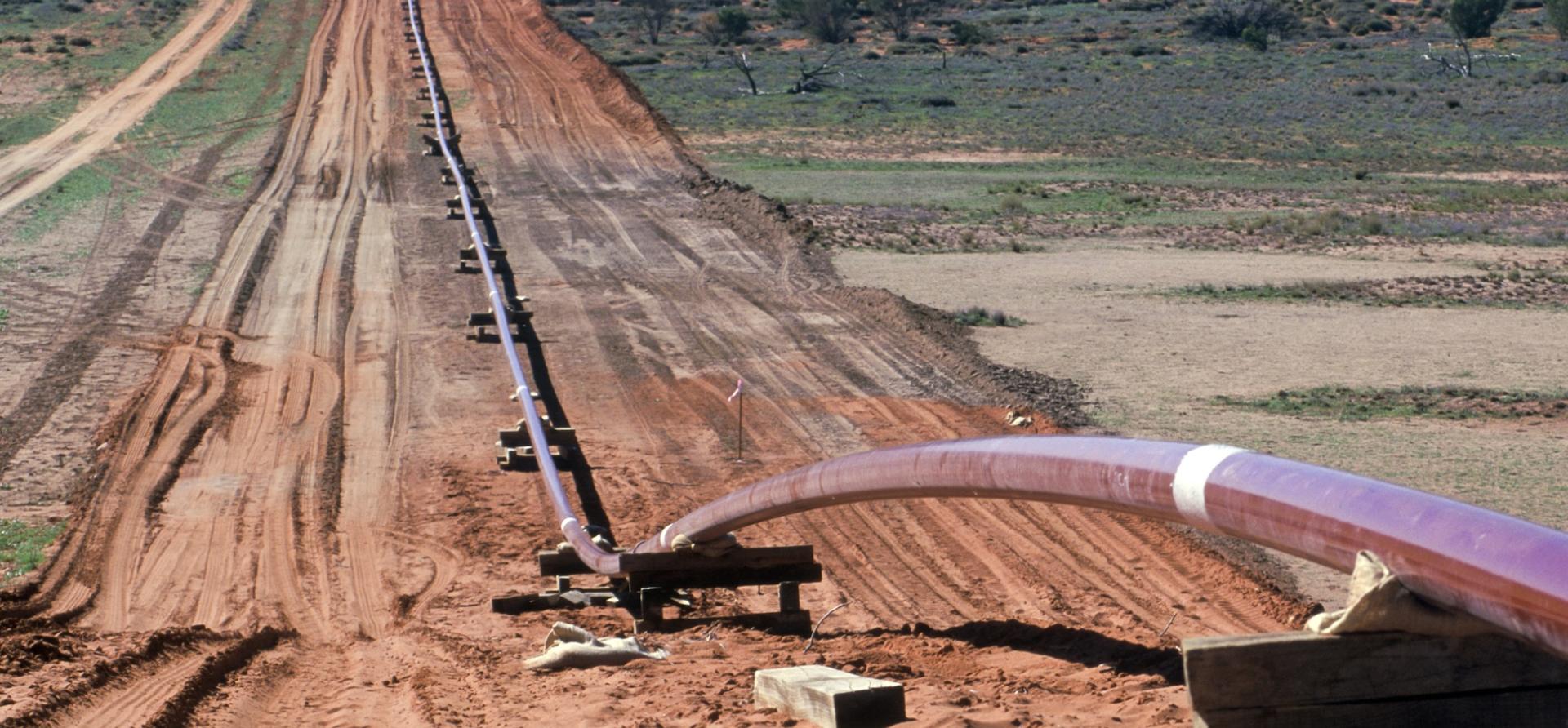
However, the Beetaloo, part of the McArthur Basin in the Northern Territory, is remote, far from gas users, and existing gas transmission networks linking the NT and eastern Australia have limited capacity. APA Group, Australia’s largest gas pipeline operator, plans to build the 1,561km North to East Australia (NEA) pipeline to supply Beetaloo gas for both domestic use and for LNG exports from Gladstone in Queensland.
IEEFA’s analysis raises substantial questions about the financial case for the pipeline, due to its high costs, and uncertain future demand in both domestic and LNG markets.
The most prospective source of demand for the pipeline is the Gladstone LNG (GLNG) project, which may need to source new gas to meet both its upcoming domestic requirements and any renewed LNG export commitments. Other potential customers are likely to have much more cost-effective options to choose from, particularly with a new reservation policy likely to increase gas supply from Queensland. However, GLNG’s demand for gas to feed LNG exports is uncertain in light of a looming global supply glut and highly uncertain future demand in Asian markets, which were expected to absorb the large increase in global supply. GLNG also has more than 6000 petajoules (PJ) of gas reserves and resources in the Surat Basin it could develop before seeking gas from the Beetaloo.
Based on a range of potential demand scenarios, IEEFA estimates capital costs for the NEA pipeline of AU$5.3–7.1 billion, and costs could be even higher given APA is seeking regulatory approval for a pipeline of up to 48 inches, which IEEFA conservatively estimates would cost AU$8.3bn.
High capital costs will likely translate into high tariffs. Assuming APA sets tariffs to fully recover its costs through foundation gas transportation agreements (GTAs), IEEFA estimates breakeven effective tariffs of AU$2.01–3.76 per gigajoule (GJ) for modelled demand scenarios (see Appendix for more information). This is in addition to Beetaloo gas production costs, which are already estimated to be relatively expensive, from AU$7.00–9.15/GJ.
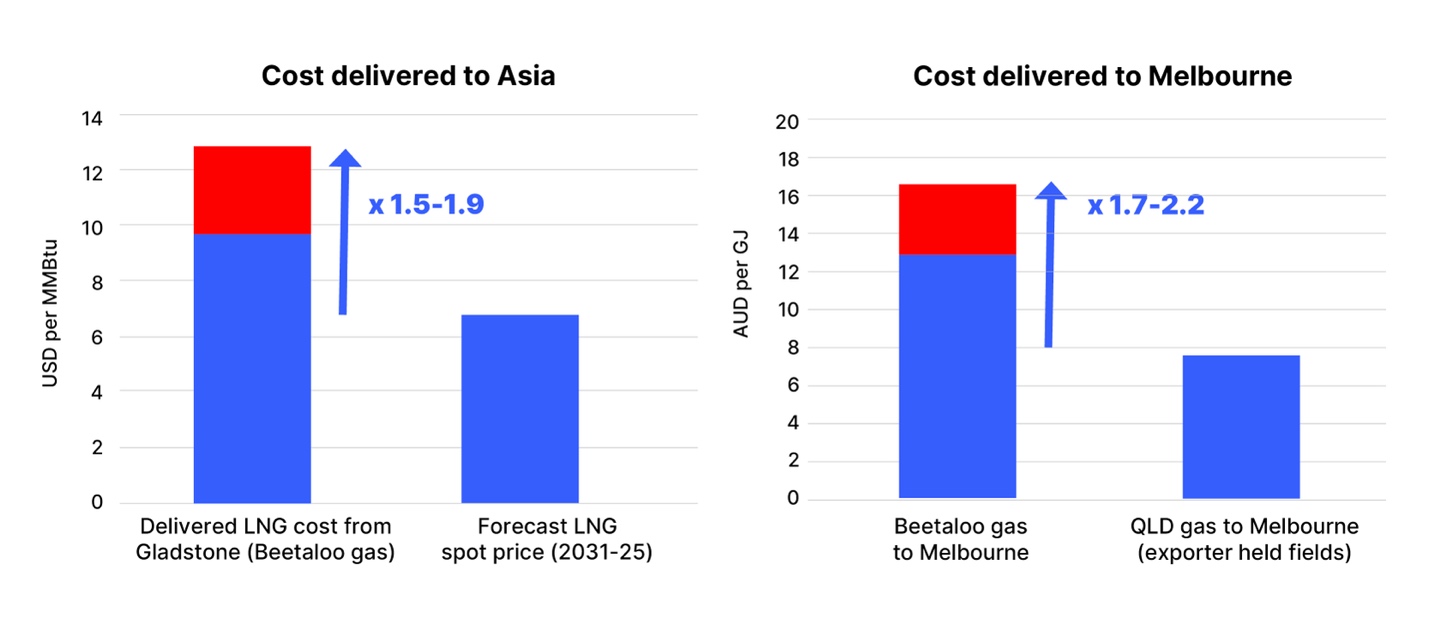
APA has stated the Beetaloo is largely intended as an “export play”, and GLNG Joint Venture partner Santos has stated that Beetaloo gas is dependent on LNG exports. However, using Beetaloo gas to backfill Queensland LNG plants is unlikely to be financially viable. IEEFA estimates delivered LNG costs of US$9.8–12.7 per million British thermal units (MMBtu), significantly higher than both the IEA’s recent forecast of US$6.80/MMBtu in 2035, and Goldman Sachs’ forecast Asian LNG spot price of US$6.75/MMBtu from 2031–35. These results suggest gas supplied by the pipeline would be too expensive to make financial sense for GLNG (and other exporters), undermining the financial case for the project.
Beetaloo gas much more costly than export and domestic alternatives
Source: IEEFA.
In the domestic market, IEEFA estimates Beetaloo gas at AU$11.10–14.80/GJ delivered to Wallumbilla in Central Queensland or AU$12.8–16.4/GJ to Melbourne. This compares with average prices in July–October 2026 of AU$10/GJ. The lower end of the range corresponds to the pipeline serving large volumes of both domestic and export markets, while the higher end corresponds to the pipeline meeting a smaller amount of demand.
This has two possible implications: GLNG could develop its own reserves for a much lower cost than purchasing gas from the Beetaloo, meaning the pipeline may not be needed or; if Beetaloo gas is used to supply the domestic market, it will push up prices materially.
Availability of gas to fill the pipeline also presents another risk. The Beetaloo sub-basin is still in the appraisal phase and has not yet been proven as commercially viable. In practice, the timing and volumes of any future gas production remain uncertain, creating a risk around the availability of gas.
Financing the pipeline may also present challenges given APA’s high debt levels, with any increase in debt possibly affecting the ratio of funds from operations (FFO) to debt (a key metric used to determine APA’s credit rating). Major rating agency S&P indicated APA would need to maintain an FFO to net debt ratio threshold of at least 8.5%, which IEEFA estimates leaves a maximum “headroom” of about AU$4bn, with actual headroom likely to be lower due to committed capital expansions. This is much lower than estimated pipeline capital costs of AU$5.3–72bn, which IEEFA notes may require additional debt before operations, and therefore revenue.
Additional debt obligations could limit the ability of APA Group to invest in electricity infrastructure at a time when growing electricity demand is increasing the need for investment.
More details on the parameters and assumptions underpinning this report’s findings can be found in a separate Appendix and Technical Appendix.


Related Content