Methane abatement in India’s coking coal push: Opportunities and costs
Download Briefing Note
View Press Release
Key Findings
India’s push to expand domestic coking coal production could significantly increase methane emissions unless abatement is integrated into mine planning. As production moves to deeper, underground coking coal reserves, methane intensity is expected to rise, creating a growing and largely overlooked climate risk.
Coking coal methane emissions are concentrated: Seven mines account for 81% of emissions from the 30 operating mines tracked, almost all of them in Jharkhand. Targeting methane mitigation in this small number and embedding methane management into Mission Coking Coal could deliver rapid and cost-effective emissions reductions while avoiding long-term emissions lock-in.
Around 87% of India’s abatable coking coal mine methane emissions can be mitigated for less than USD20/tonne of carbon dioxide equivalent (tCO₂e). This is in line with global estimates from the International Energy Agency (IEA), demonstrating that costs should not be a barrier to methane mitigation.
India should also prioritise lowering coking coal demand in steel through methods such as Electric Arc Furnace (EAF), scrap utilisation, and green hydrogen. Additionally, utilisation of coal mine methane (CMM) and coal bed methane (CBM) in the steel value chain itself can help lower coking coal demand and meet steel decarbonisation targets.
India’s coking coal production is projected to increase significantly to meet the growing demand from its expanding steel sector. This increase in production, particularly from underground mining, is expected to raise methane emissions due to the higher methane intensity of coking coal and the deeper, more gas-rich reserves being accessed. To mitigate this, stronger policy support for methane abatement technologies is crucial. Supported by existing cost-effective technologies, India can drive action on this through policy mandates, operational guidelines, and pilot projects.
Why methane?
Methane is emerging as a critical but under-addressed component of India’s climate challenge. While policy attention has majorly focused on carbon dioxide (CO2) emissions, methane is also a significant contributor to the climate challenge and requires targeted mitigation measures. According to the Global Methane Pledge, “Methane has been responsible for 30% of total warming since the Industrial Revolution and is the second largest contributor to global warming after CO2. Without action, global anthropogenic methane emissions are projected to rise by up to 13% between 2020 and 2030.”
Methane is especially important for near-term climate action because it is a short-lived but highly potent greenhouse gas. The Intergovernmental Panel on Climate Change (IPCC) estimates that methane has a global warming potential (GWP) of 84–87 over 20 years (GWP20) and 27–30 over 100 years (GWP100). This means that even relatively small methane leaks can have a significantly high warming impact. The IPCC also notes that global methane emissions must be reduced by 30–60% below 2020 levels by 2030 to be consistent with least cost-pathways of limiting global warming to 1.5°C this century.
The energy sector, including oil, natural gas, coal, and bioenergy, is a major source of methane emissions. It accounted for over 40% of the total human-driven methane emissions of 375 million tonnes (Mt) in 2024. Other human-attributed methane-emitting sectors are agriculture and waste. Abatement of energy sector-related methane emissions is important from environmental and economic perspectives. It is considered the easiest to tackle among all human-attributed methane emissions as cost-effective technologies and operational processes can help manage and abate energy-sector methane emissions to a large extent.
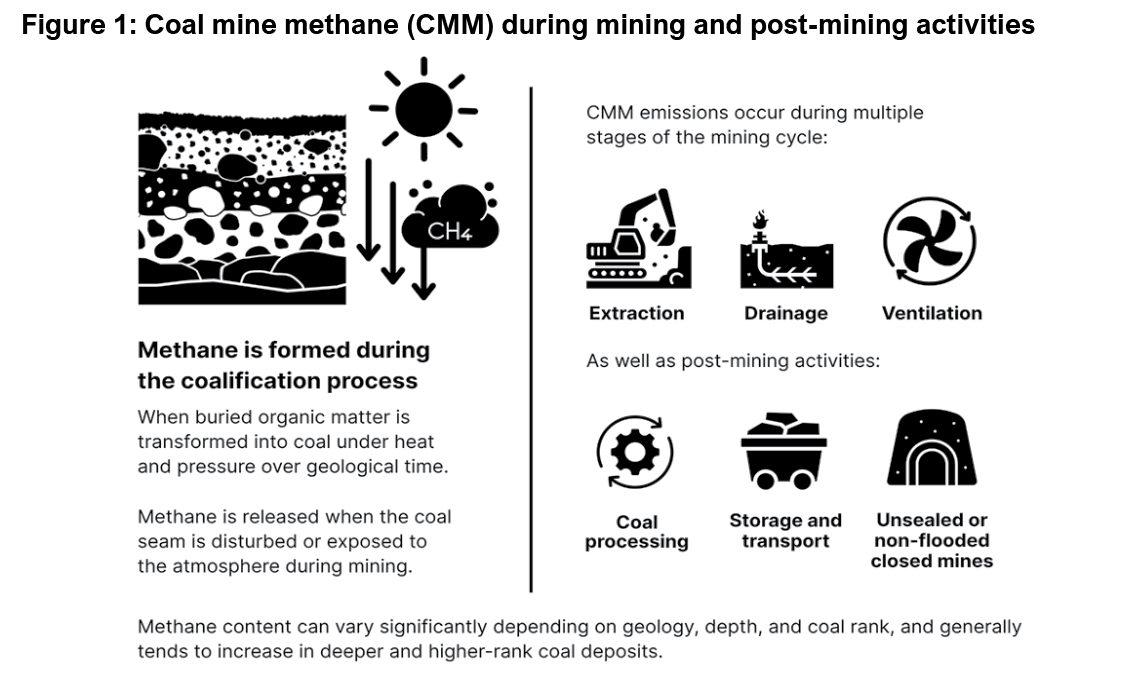
Within the sector, oil and gas operations account for 56% of methane emissions, followed by 29%, or an estimated 39Mt, from coal production. Within the industry, methane emissions from coal mines are referred to as coal mine methane (CMM). They offer a key abatement opportunity as existing technologies available can substantially reduce emissions. For India, this becomes more relevant as the country plans on adding to its existing coal mining operations, under various government targets.
CMM mitigation and abatement are particularly relevant for coking coal, which has a higher emission intensity than other coal types as it is often extracted from deeper, more methane-rich deposits. Emissions at these sites are also often the most cost-effective to reduce because of their high methane levels and economies of scale. This is particularly true for India, given the many proposed coking coal mines and the government’s incentives for underground mining.
According to the International Energy Agency’s (IEA) Global Methane Tracker 2026, India’s coking coal mining resulted in around 234.7 kilotonnes (kt) of methane in 2025 with a methane intensity of 5.1kg CH₄ per tonne of coal equivalent (tCH₄/t coal), 50% higher than for steam coal, at 3.4kg.
Given its higher emissions intensity and expected increase in demand by the steel sector, methane abatement and mitigation will be essential for coking coal in India.


Related Content