Valuing the Future: Pennsylvania’s shrinking fossil fuel footprint leaves a widening fiscal gap
Download Full Report
View Press Release
Key Findings
Pennsylvania’s budget deficit will widen as state spending outpaces tax receipt growth.
The largest economic contributions from the state’s coal industry, its petrochemical sector, and its natural gas business are several years in the rearview.
Tax credits that are 26 times the size of effective tax rates on the fossil fuel industry are adding fuel to the fire.
The state’s tax policy toward natural resource extraction should be revised to align industry contributions with policy goals.
Executive Summary
Pennsylvania’s budget is heading towards a crisis. The state’s expanding deficit is unabated as projected spending is growing at twice the pace of tax receipts. The fossil fuel industry’s structural decline and the state’s prior decisions to forego adequate tax revenue from the sector are important contributors to the state’s fiscal problems.
Pennsylvania’s Independent Fiscal Office (IFO) February 2026 Budget Brief noted that the Fiscal Year 2025-26 General Fund deficit was estimated to rise to $3.9 billion before climbing to $6.7 billion in FY2026-27 (see Table 1). Before FY2018-19, the state’s revenue was growing faster than spending. But these patterns have reversed in recent years, and the condition is projected to worsen over the next two fiscal years.
Table 1: Pennsylvania General Fund Revenue and Spending ($ Billion)
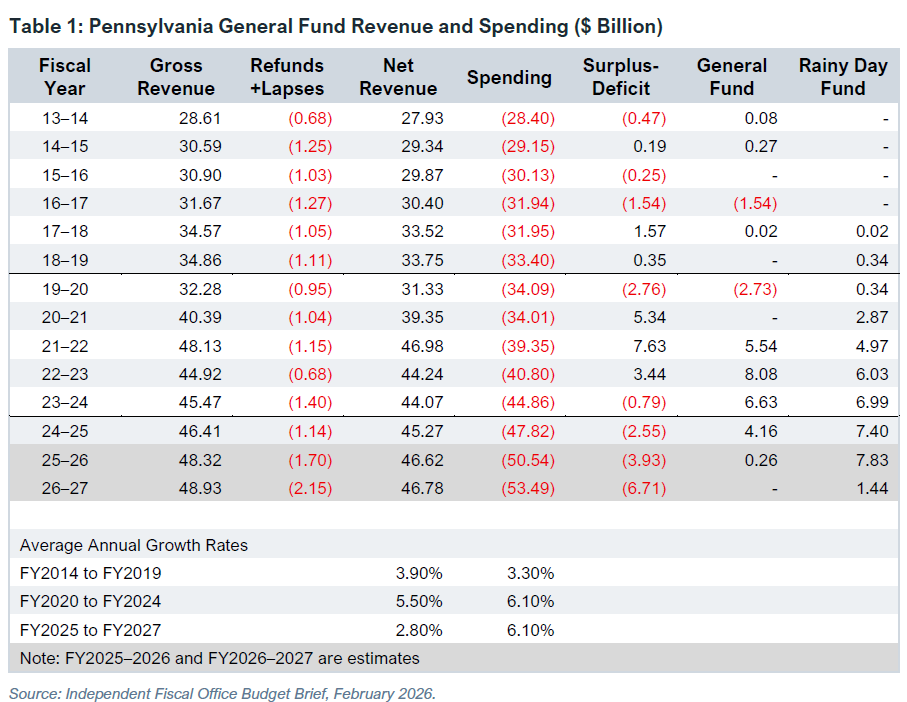
Pennsylvania’s officials have plotted a course for the state’s spending that will wipe out its General Fund surplus balance and will severely deplete its Rainy-Day Fund (RDF). The IFO has estimated the RDF surplus will drop from $7.8 billion in FY2025-26 to $1.4 billion by the end of FY2026-27. During this time, IFO predicts spending will grow twice as fast as revenue.
This paper offers a pragmatic view of the role of fossil fuels in the modern Pennsylvania economy. We find the industry provides only a small—and declining—contribution to the state’s economic and fiscal standing.
Compared with peer fossil fuel-producing jurisdictions such as Texas, Pennsylvania has failed to capitalize on its producers’ private gains. As the natural gas boom from more than a decade ago recedes, employment in fossil fuel extraction and petrochemicals production is faltering.
Future extraction employment faces structural headwinds in a rapidly changing economy. Pennsylvania was a pioneer in American industrialization, in the dawn of the oil age, and in the fracking revolution. But the narrative that fossil fuels are a bedrock of the commonwealth’s modern economy—one that policymakers and industry interests have long advanced—is not backed up by the data.
As the Pennsylvania legislature considers options to raise revenue and manage its deficit, the state’s application of its taxing authority to natural resources should be a part of the discussion. Further, the ill-advised logic promoted to subsidize the construction and operation of the state’s first ethane cracker is a harbinger of arguments claiming “we have abundant cheap natural gas” to justify future development and subsidies using public monies, rather than transparent, peer-reviewed economic analysis. These arguments should be met with healthy skepticism.



Related Content