First-of-a-kind cooling plan at Fermi Nuclear Project likely to be costly, time-consuming
Download Briefing Note
View Press Release
Key Findings
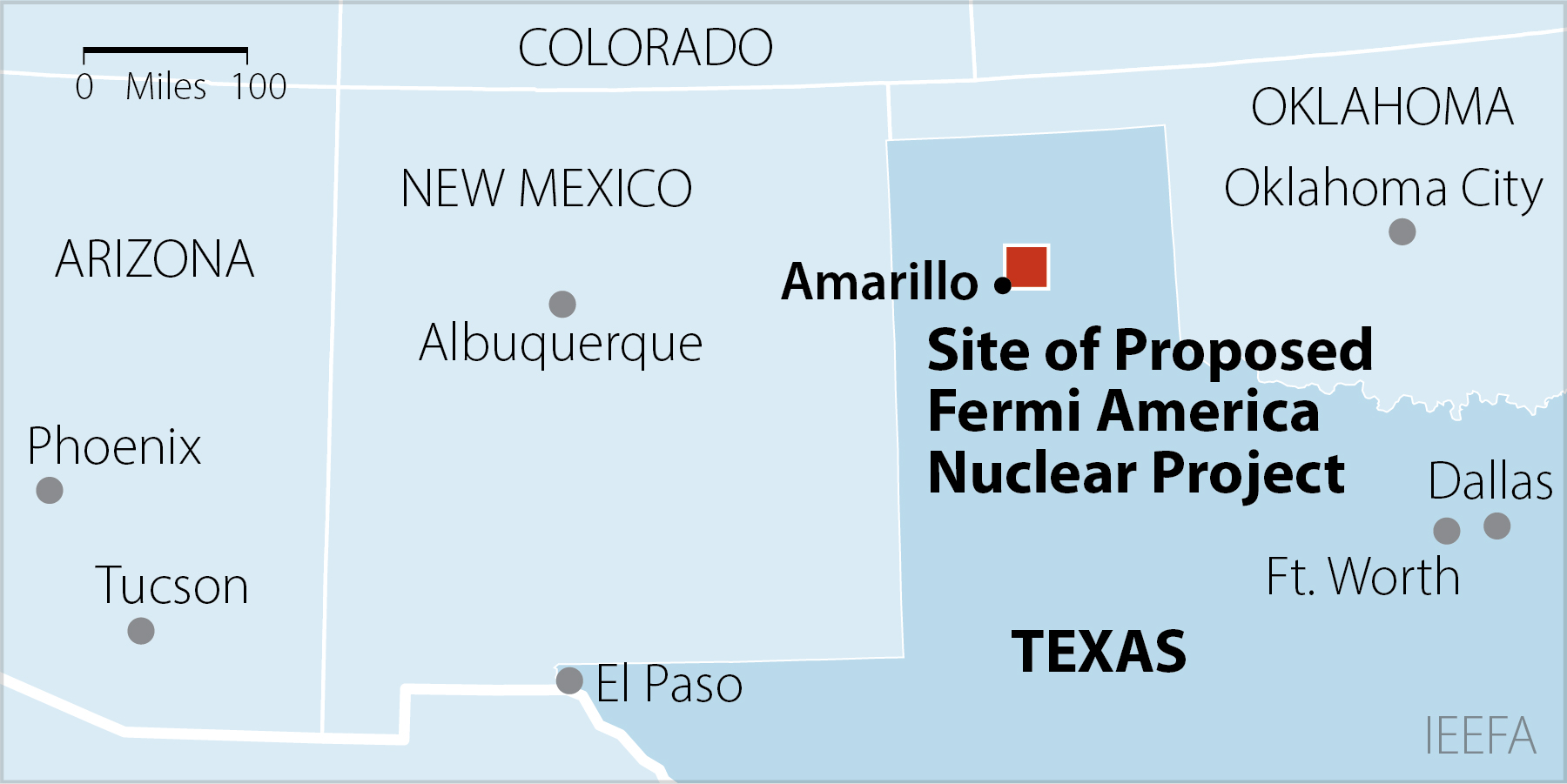
Fermi America, a year-old startup with no completed power projects to its credit, wants to build a massive generation facility in the water-stressed region near Amarillo, Texas, theoretically to supply demand from new data centers.
The company still does not know how it is going to cool its four planned nuclear reactors—meaning it also does not know what those systems are going to cost, how long they will take to construct, or even if those systems will be approved for use by the NRC.
Fermi should not be able to proceed with construction of its planned reactors without securing NRC approval for its hybrid cooling system—a potentially time-consuming and expensive process since no large reactor in the U.S. has ever operated using anything other than water for its cooling systems.
Fermi’s plan to use a cooling system that is both unique and unlicensed is the opposite of standardization, and raises the real possibility that the cycle of cost overruns and construction delays that has plagued the U.S. nuclear industry will continue.
Introduction
The nuclear industry’s argument for expansion has been “if only we can achieve a standardized design and repeat it over and over, then we can get costs down.” The Westinghouse-designedAP1000 at Vogtle 4 has become the blueprint for this standardization for conventional large reactors, and the backbone of the administration’s proposed 100-gigawatt (GW) expansion of nuclear power in the country.
Fermi America, a year-old startup with no completed power projects to its credit, has hopped onto this expansion bandwagon and wants to build a massive generation facility in the water-stressed region near Amarillo, Texas, theoretically to supply demand from new data centers. The company’s plans include the proposed construction of four AP1000 reactors, with 4,456 megawatts (MW) of generating capacity, leveraging this “standard.” There is only one problem: they want to completely change the cooling system to an unproven, unlicensed design.
The problems with Fermi America’s plans have been evident from its initial licensing filings submitted to the Nuclear Regulatory Commission (NRC).
In one section, the company declared: “The operational phase of the AP1000 units at Fermi America will not rely on wet cooling towers. Instead, air-cooled condenser (ACC) systems significantly reduce consumptive water use, limiting demand to system makeup, domestic supply, and incidental process needs.”
In another, it acknowledged that the specifics of the cooling system have not yet been designed: “Fermi America’s cooling system TO BE PROVIDED LATER [emphasis in original].”
The two quotes raise significant questions about how Fermi is going to cool the reactors at its planned mega data center and power production campus in the Texas Panhandle. These questions have gone largely unanswered, overshadowed by the recent corporate blowup in which Toby Neugebauer, one of Fermi’s founders, was removed as CEO, and the company’s CFO, Miles Everson, resigned.
The company’s problems have now broken out into a bitter proxy fight between Neugebauer and Fermi. How that will be resolved is uncertain, but it cannot be helping the company. Fermi’s stock has been below $10 a share since early March, even before the executive shakeup, and it is down more than two-thirds from its initial opening price last October.
While the corporate shakeup and resulting stock battle have garnered most of the recent headlines, the questions regarding how the reactors will be cooled are as important, if not more so, than the startup’s executive structure. Indeed, these questions tell a story about the uncertainty surrounding Fermi’s nuclear construction plans, and point to significant risks both for investors considering funding the construction of the massive nuclear power plant complex, and data center developers and customers looking to lock in electricity supplies at competitive prices and on definitive timelines. IEEFA will unravel this story in the body of this analysis.

Related Content