Thailand's draft Power Development Plan 2026 signals a historic retreat from gas power
Key Findings
Thailand's draft Power Development Plan (PDP) 2026 projects gas capacity falling from 32 gigawatts (GW) in 2025 to as low as 16GW by 2050, with no new large-scale gas developments planned through 2037 due to an inability to secure gas turbines.
Global gas turbine shortages have tripled the capital costs of combined-cycle gas turbines (CCGTs) to USD2,400 per kilowatt (kW) and are increasing gas development timelines. This has driven 10GW of gas-fired cancellations in Thailand since 2021.
The draft PDP 2026 targets 27GW of renewable capacity and 14GW of battery storage systems by 2037, with total capacity potentially rising to 114GW and 55GW, respectively, by 2050.
IEEFA estimates that the Thai government’s recently announced funding package to deploy 5GW of rooftop solar next year alone could displace up to 0.82 million tonnes of liquefied natural gas (LNG) demand per year, helping to avoid USD1.02 billion in annual fuel import costs.
In August 2026, the Government of Thailand released an overview of its draft Power Development Plan (PDP) 2026. The draft outlines projected electricity requirements through 2050 and four potential combinations of power capacity to meet them. Following public consultation in September, the plan is expected to be finalized by the end of 2026.
While the complete PDP has yet to be released, available details indicate a notable departure from previous versions. The draft PDP 2026 calls for a reduction in gas-fired capacity across all four policy scenarios, ranging from a conservative base case to more ambitious pathways in which renewables and batteries could account for 78% of the power mix by 2050.
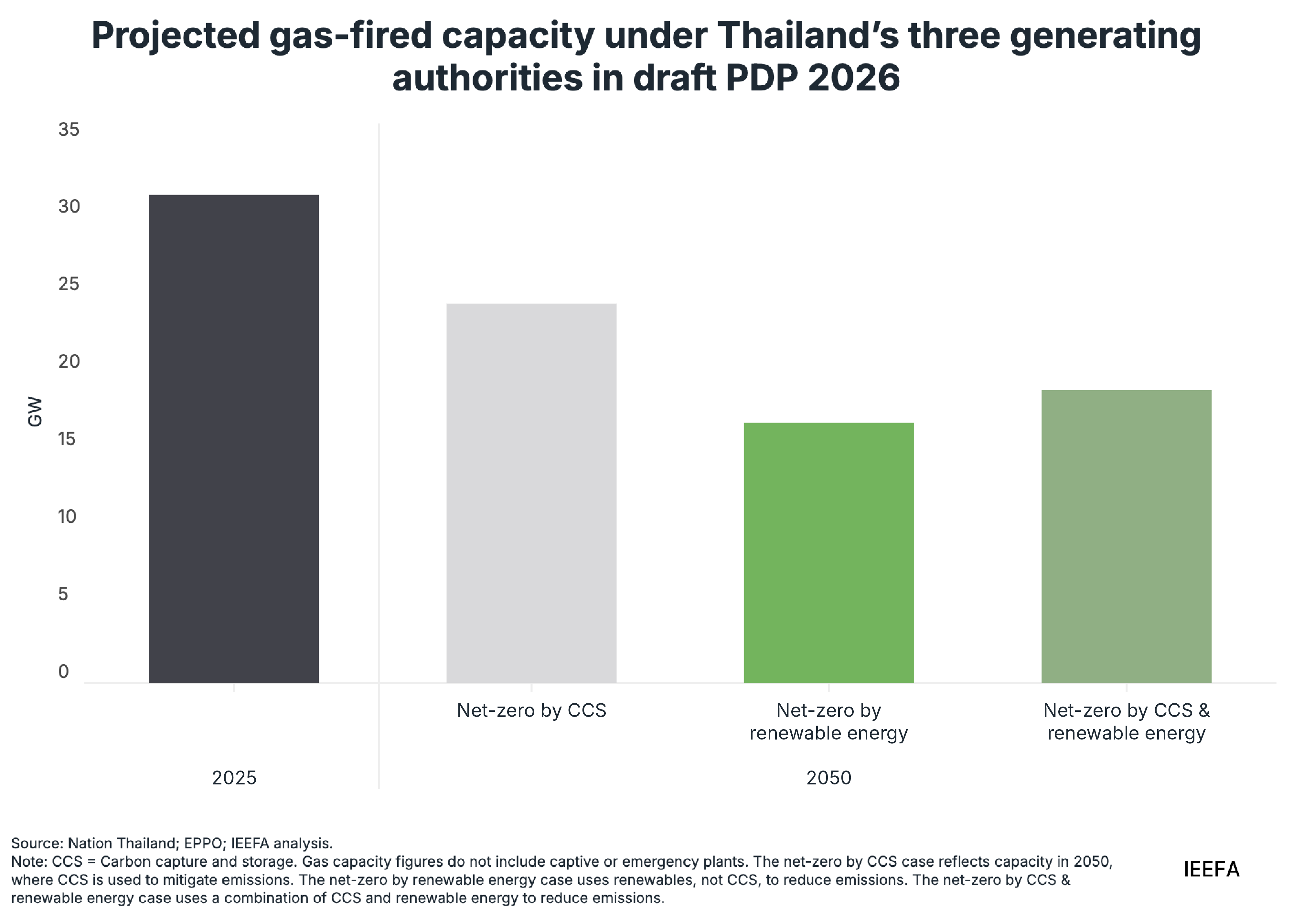
An analysis of media reports suggests that the draft PDP 2026 envisions gas capacity contracted by the country’s three state-owned electric utilities falling from almost 32 gigawatts (GW) in 2025 to as low as 16GW by 2050. Renewable energy capacity, mainly solar, would increase to offset the decline in gas, reaching 27GW by 2037 and up to 114GW by 2050. Battery capacity would also increase to provide grid stability, rising to 14GW by 2037 and approximately 55GW by 2050. This shift would reduce the share of gas from 66% of power requirements in 2026 to 11%–35% by 2050.
The draft PDP will also reportedly include a near-term target to deploy 5GW of additional rooftop solar by the end of 2027. In September 2026, the Thai government announced a THB200 billion (USD6.02 billion) emergency fund to provide subsidies and loans for households to install solar panels — a move specifically designed to mitigate exposure to global commodity markets.
The renewable pivot in the draft PDP 2026 reflects growing recognition that gas-fired plants take too long to build and are too expensive to power Thailand’s energy future.
Gas turbine shortages central to Thailand’s pivot away from gas
Under the draft PDP 2026 scenarios, Thailand does not plan to develop any new large-scale gas-fired power plants from 2026 to 2037. Instead, the government plans to complete the delayed 0.54GW Burapa power plant, currently under construction, and recontract 8.5GW of existing plants with expiring power purchase agreements (PPAs). A government source attributes this decision to the gas turbine shortage, which has extended equipment delivery lead times to approximately five years or more.
This aligns with a recent report by the Institute for Energy Economics and Financial Analysis (IEEFA), which found that most of Thailand’s proposed gas expansion plans were facing extensive delays. IEEFA assesses that an inability to secure turbines has resulted in 10GW of gas-fired cancellations in Thailand since 2021.
Gas plants in Thailand take, on average, 8.5 years to complete from an inaugural public announcement. By comparison, rooftop solar can be deployed in months, utility-scale solar in under a year, and onshore wind in under two years.
A tripling of capital costs for combined-cycle gas turbines (CCGTs) to USD2,400 per kilowatt (kW) over the past two years likely contributed to Thailand’s decision to abandon gas expansion. The levelized cost of energy (LCOE) of utility-scale solar is estimated to be one-third of baseload CCGTs using gas at Thailand’s 2025 average pool gas price of USD8.85 per million British thermal units (MMBtu). Using current liquefied natural gas (LNG) prices above USD20/MMBtu, baseload CCGTs cost four times as much as solar and are uncompetitive with solar firmed with battery storage.
This cost disparity is compounded by the low utilization of Thailand’s gas power plants. IEEFA found that 11GW of gas plants have been dispatched at less than 30% of their capacity since 2023, while receiving THB61 billion (USD2 billion) in availability payments during months when the units generated zero electricity.
In Thailand, availability payments primarily compensate producers for the fixed capital costs of building generating plants. During the first tariff cycle of 2026, availability payments accounted for 17% of the base tariff paid by end users.
Building new CCGTs at current capital costs would increase per-unit generation costs, putting upward pressure on consumer electricity tariffs. Instead, the government appears to be prioritizing lower-cost, faster-to-deploy renewables to meet incremental capacity and demand requirements.
Accelerating renewables requires policy changes
Recent developments in Thailand support this approach. Solar capacity additions — including rooftop, off-grid, and floating installations — have outpaced those of gas.
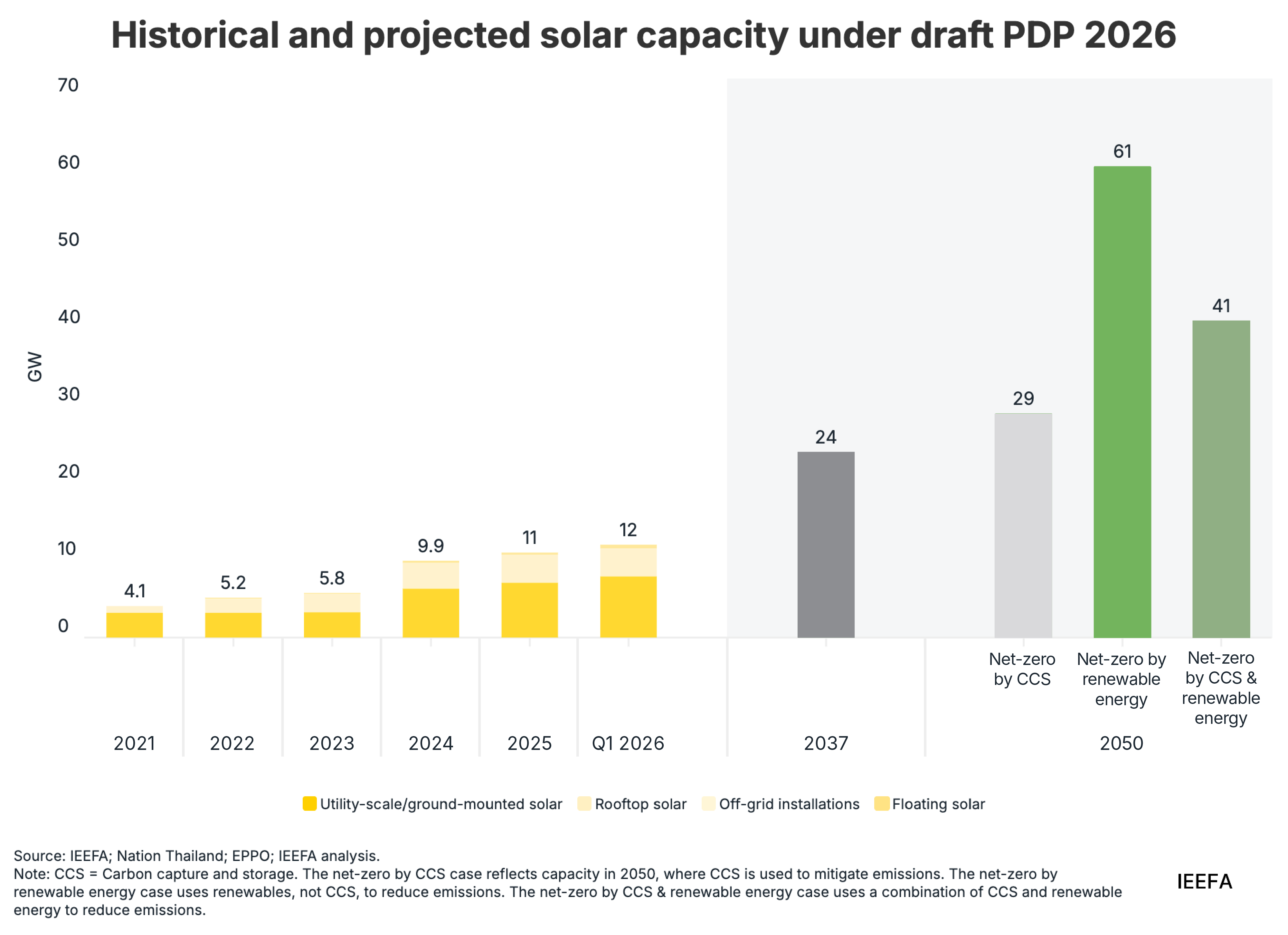
However, achieving the draft PDP 2026 targets would require sustained renewable additions. The first-phase target of 24GW would require average annual additions of 1.1GW through 2037, increasing to 2.8GW annually through 2050 under the most ambitious scenario.
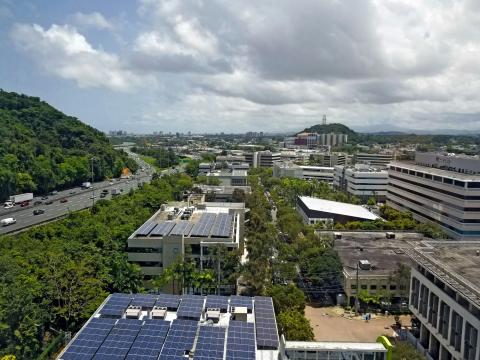
Thailand’s estimated rooftop solar potential of almost 34GW could provide over half of the capacity projected under that scenario, and the recently announced goal to deploy 5GW of rooftop solar over the next year is a step in the right direction. Assuming a direct displacement of LNG-fired generation, IEEFA estimates that this additional solar output could reduce LNG demand by 0.82 million tonnes per annum (MTPA), or 12 cargoes annually. At current LNG prices, this would avoid USD1.02 billion in annual LNG import costs, and more than USD25.6 billion over the 25-year lifetime of solar installations.
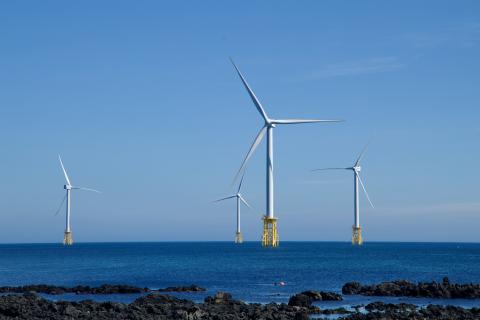
Other policies could help meet the ambitious PDP 2026 schedule, including ongoing permitting reform, increasing buyback rates under the net-billing framework, and easing annual quotas for participation in that scheme. Meeting the draft PDP 2026’s renewable targets would also require enabling a policy environment that supports the large-scale development of wind and battery storage over the next decade.
Thailand’s LNG ambitions remain at odds with the draft PDP
Despite the power sector’s shift toward renewables, LNG development continues. Gulf Development (Gulf), a major Thai energy and infrastructure conglomerate, is constructing a third LNG terminal, which it hopes to commission in 2029. State-owned gas supplier PTT is expanding its trading arm, aiming to increase annual LNG handling volumes from 3.3 million tonnes (Mt) in 2025 to 15Mt in 2035.
With gas-fired power demand potentially declining, Gulf’s new import terminal could face significant underutilization once it comes online. Moreover, as the global LNG market moves toward oversupply, PTT may have to compete with larger, better-capitalized Chinese and Japanese traders, as well as traditional LNG suppliers, to offload surplus cargoes.
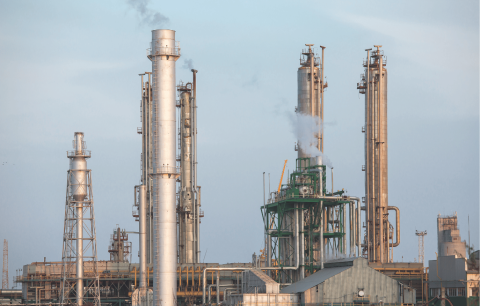
Thailand is coming to terms with a power sector gas fleet that is overbuilt, underutilized, and increasingly expensive. By aligning gas development plans with the draft PDP 2026, Thailand can seize the opportunity to dislodge gas from its economy, further embrace renewable energy, and strengthen long-term energy resilience.

Related Content