Eastern Australia gas demand continues to fall
Key Findings
Eastern Australia’s gas consumption continues to fall along with domestic gas supply, extending a longer-term trend of demand reduction.
Gas use for exports remains relatively stable, meaning exporters are accounting for a larger share of domestic gas production.
Falling gas consumption reflects a range of factors, including government policy, the price impacts from the start of LNG exports and the redirection of domestic gas to export markets.
Gas consumption in eastern Australia has continued its downward slide, with new data showing consumption by households, businesses and generators fell over the past financial year.
Total gas consumption in FY2025-26 (excluding the LNG sector) was 6% lower than in calendar year 2024 (Figure 1). While the rate of demand decline in the residential, commercial and industrial sectors appears to be slowing, the opposite is true in the electricity sector. Gas demand for generation fell by more than 24 petajoules (PJ) in just one year due to increased electricity supply from grid-scale battery storage.
Since FY2022-23, only the LNG export sector has shown net growth in gas demand.
Figure 1: Changes in eastern Australia’s gas consumption
Sources: AEMO, IEEFA.
Falling domestic consumption has coincided with declining domestic gas supply, which fell from 231PJ to 214PJ year on year to the first half of this year (more than 7%). In contrast, Queensland exported almost 645PJ of gas over that period, with exporters using an additional 61PJ to run their operations.
In the first half of this year, the domestic market accounted for just 23% of domestic gas production, down from 25% a year earlier, the lowest level since at least 2019. As a consequence, and reflecting stable LNG export levels, the LNG sector’s share of domestic production increased from 75% to 77% year on year.
Recent falls in demand are part of a much longer trend of demand destruction in eastern Australia. After growing consistently from FY2005–06 to FY2012–13, domestic gas demand began falling from FY2014–15, the year LNG exports started from Queensland, in part due to the price impacts from the export sector.
Why is gas consumption in eastern Australia falling?
A range of factors have affected both gas supply dynamics and pricing, which in turn contributed to falling consumption in eastern Australia.
The start-up of the Queensland LNG export sector increased east coast gas demand several times over, with implications for domestic gas flows. Exporters that previously supplied the domestic market decreased supply as their exports ramped up. For instance, to meet its export commitments, Santos’s Gladstone LNG (GLNG) contracted gas from South Australia’s Moomba basin that previously went to the domestic market.
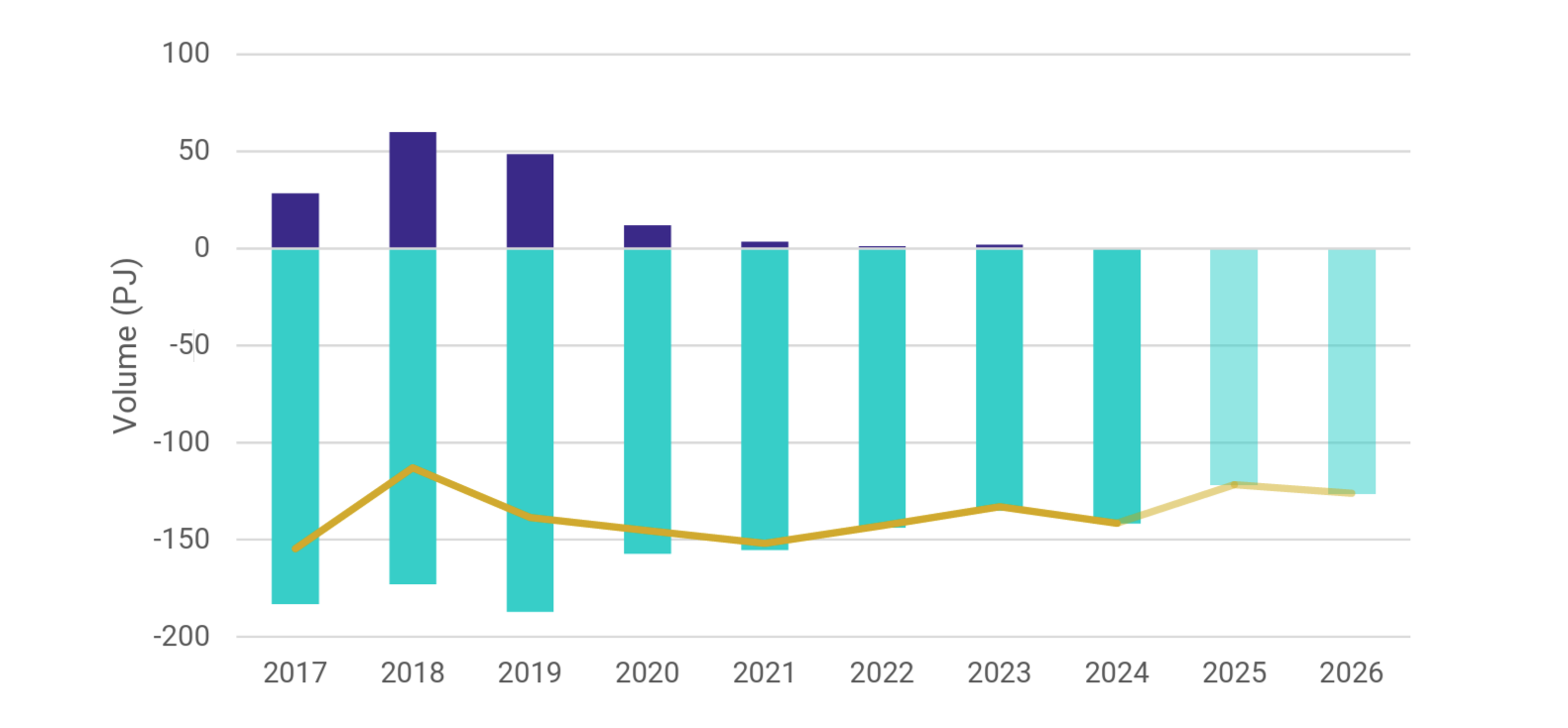
These third-party purchases came despite earlier assurances that the GLNG project would not affect the domestic market as it would use its own gas production to meet export commitments. As has been widely reported over the past decade, GLNG turned to the domestic market to augment its production as it faced difficulty developing its own gas reserves to meet long-term contracts. Recent reporting shows GLNG has siphoned more than 1000PJ of gas from the domestic market since 2017, equivalent to more than two years of domestic demand (Figure 2).
Figure 2: GLNG’s domestic sales (positive values) vs purchases (negative values)
Source: Australian Competition and Consumer Commission (ACCC) analysis of information provided by GLNG.
Note: 2017–2024 is based on actuals data provided to the ACCC while 2025 and 2026 are based on the latest available forecasts.
Changes in gas supply dynamics and linkage with international LNG prices, in turn, pushed up domestic gas prices with flow-on effects for consumption. However, this was foreshadowed even before the first LNG cargo was shipped overseas.
Santos investor presentations from 2014 highlighted that gas prices were rising due to increased demand from exporters (including its GLNG plant), which it noted would also increase the value of its domestic gas sales. Tellingly, a Credit Suisse note suggested that increasing domestic gas prices was part of the strategy underpinning its investment in GLNG (which would appear to contradict earlier assurances about the impact of the project).
The impact of GLNG’s third-party purchases may lessen in future if it enacts plans to increase development of its reserves. Crucially, GLNG now has sufficient reserves to meet its contractual obligations, meaning it is well placed to reduce third-party purchases.
Government policy to support and drive electrification, particularly in Victoria, has also contributed to falls in gas consumption by households and small commercial users, while broader support for renewable energy and battery storage is also displacing gas in the electricity system.
The impact on domestic gas users from the export sector over the past decade has been so material that the Australian government has also implemented new regulatory measures intended to insulate domestic gas users, to little avail.
As a result, the federal government is designing a reservation policy to ensure sufficient domestic supply and put downward pressure on prices. The design of the reservation will be crucial for determining its impacts and efficacy, particularly if it allows GLNG to continue to export gas purchased from the domestic market.
With gas demand in eastern Australia continuing to fall, and with a decade of ineffective policy interventions, it is vital a reservation scheme actually solves domestic supply issues.

Related Content