Power supply deals become tools for European companies to protect against high prices
Key Findings
The ongoing energy crisis has turned power purchase agreements (PPAs) into instruments for European companies to hedge against high electricity prices.
Current European PPA prices are roughly half the spot market power price during stress periods.
There has been a rapid shift in Europe towards PPA contracts that deliver power to companies when the cost risk is the greatest.
Higher European corporate PPA demand has not accelerated deal execution, as some renewable energy developers favour selling power on the spot market.
Before the US and Israel attacked Iran on 28 February 2026, the European corporate power purchase agreement (PPA) was a sustainability instrument for most companies. Now it has become a tool to protect against high prices.
Procurement teams used to sign PPAs to meet environmental, social and governance targets and satisfy emissions reporting requirements. Management tolerated the premium over wholesale power prices as the cost of compliance. The energy security argument existed in theory, but it was rarely validated.
The 2026 Iran war has changed that calculus faster than any policy intervention managed in the preceding decade. Corporations that in January 2026 were debating whether a PPA price premium was justified are now looking at expensive day-ahead power prices of €120–150 per megawatt-hour (MWh) in Germany and Italy. Electricity-intensive industries are now asking a different question: Why are we still exposed to this?
Gas sets the marginal electricity price in countries such as Germany and Italy for a substantial share of hours, as IEEFA has highlighted. This is because gas plants are typically the last, most expensive source called on to meet demand. Ongoing disruptions in the Strait of Hormuz have pushed up European gas prices, increasing wholesale power prices with them. This situation has drawn attention to PPAs. Businesses have accelerated decisions on PPAs already in the pipeline and, in several cases, revived deals that had stalled pending approval.
Current European PPA prices are in the €60–85/MWh range, according to pricing platform LevelTen Energy. This is roughly half the €120–150/MWh spot market power prices during stress periods, per the European Network of Transmission System Operators for Electricity.
For energy-intensive manufacturers, data centre operators and large retailers, the question is no longer whether PPAs are worth the premium. It is why they do not have more of them. That is a different conversation from the one happening in most European electricity-intensive industries 12 months ago.
From compliance to risk management
Annual European PPA contracted capacity peaked at 17.1 gigawatts in 2023. The deal terms have changed significantly since then.
A shift from sustainability-driven to risk management-driven PPA procurement produces fundamentally different contracts. Sustainability-driven PPAs often have long tenors and fixed prices. The goal is a stable carbon accounting narrative and making progress on sustainability targets. Locking in 15 years of renewables supply delivers both.
Risk management-driven procurement prioritises protection from price spikes rather than long-term price certainty. The result is a market shifting toward 5- to 10-year contracts with minimum and maximum prices and indexation clauses, features pricing platform Pexapark reports as standard in recent deal flow. These were minority preferences as recently as 2023.
A floor at €50–55/MWh protects the developer if the Iran war ends and gas prices fall. A price ceiling that limits what buyers pay to €90–100/MWh provides budget certainty. Indexation linked to gas or carbon market prices replaces yearly price increases, reflecting a market that now factors in commodity risk.
Several developers are also selling 30–40% of project output on the spot market rather than contracting it all. By doing so they are betting that the current price environment will continue and exposing themselves to the volatility of global gas prices.
Innovative contracts take centre stage
Risk management procurement exposes a structural problem that sustainability procurement could largely ignore: the mismatch between when renewable assets generate electricity and when the market prices that output.
Gas-driven power price spikes tend to be in evening peak hours. Meanwhile, growing solar generation is increasingly pushing midday power prices to zero or below in markets such as Germany, Spain and Italy. Solar projects in markets with lots of solar earn less than the baseload power price when their output peaks.
A PPA to protect against high prices can’t just deliver power when it’s cheap and abundant. It must cover the hours when prices spike. The response is a rapid shift toward PPA contracts that provide power when the cost risk is the greatest. These contracts feature shaped structures, day/night splits, hybrid solar-wind-storage bundles and storage-backed baseload-equivalent products. What was tailor-made structuring two years ago is becoming a common requirement in larger transactions.
Supply-side reservations
Although many buyers now see PPAs as a way of providing financial protection, the supply side has its reservations. More demand has therefore not automatically translated into accelerated deal execution.
Signing a PPA at €75–85/MWh means developers would miss out on the €120–150/MWh they could earn selling on the spot market. Several developers in Germany and Italy are favouring spot market exposure over locking in contracted revenues at current levels.
Project finance lenders are also getting stricter, often requiring larger safety margins on debt repayments, guaranteed minimum PPA prices and shorter contracts. This creates a mismatch: Lenders require PPA coverage for the full 10- to 15-year loan period, but the market wants 5- to 7-year contracts. This leaves a refinancing gap in the second half of the loan term that developers must cover with projected spot market revenue or additional equity.
The EU Electricity Market Design reform, with its two-way contracts for difference, is drawing some developers toward state-backed revenue certainty rather than corporate PPAs, particularly in countries with auction programmes.
A new PPA era
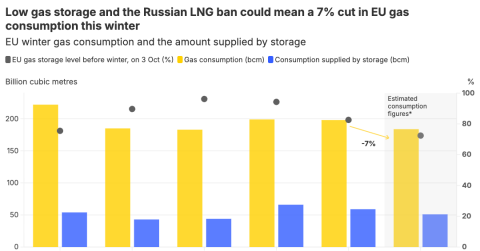
The PPA demand shift does not depend on the Iran war persisting. EU gas storage was 27.6% full at the start of April 2026, well below 58.5% at the same point in 2024. This leaves the EU structurally short of gas and exposed to the next price shock, so the incentive to hedge will not reset when the Iran war ends. The structural exposure of wholesale electricity prices to gas is unchanged. A ceasefire does not repair that vulnerability.
The institutional memory of the 2022 energy crisis has already survived 18 months of price normalisation. Industrial consumers will not forget the €120–150/MWh spot power prices they have weathered in 2026 when gas prices on the Title Transfer Facility — the European benchmark gas trading hub — fall back to €40/MWh.
There is a strong pipeline of renewables projects in Europe that can service demand for PPAs. The PPA market that emerges from the Iran war will be more financially sophisticated, more geographically differentiated, and harder to navigate than what existed before February 2026.
But its demand base is now based on energy security, not just sustainability. That is a significantly more durable PPA foundation.

Related Content