Strengthening BRSR for climate transition plan disclosures in India
Download Briefing Note
View Press Release

Key Findings
Embedding transition planning elements within the existing Business Responsibility and Sustainability Reporting (BRSR) framework through a phased approach, supported by clear guidance, offers a practical path to improving the credibility and usability of corporate transition plan disclosures in India.
In the first phase, a transition plan snapshot disclosure can be introduced as a short, integrated summary populated from data already required under BRSR and voluntarily published by companies outside the framework.
The second phase can add a focused set of new metrics to BRSR over time, prioritising those that are material, feasible to disclose, and aligned with the International Financial Reporting Standards (IFRS) Sustainability Disclosure Standards and the Transition Plan Taskforce (TPT) framework.
The phased structure closely follows the rollout pattern of BRSR Core, allowing companies to build internal capacity, data systems, and assurance practices while regulators refine guidance.
This briefing note builds on two previous reports by the Institute for Energy Economics and Financial Analysis (IEEFA). The first report, titled Bridging the net-zero gap, is an empirical assessment of transition plan disclosures by 33 Indian companies across six high-emitting sectors. The second, titled Corporate climate transition planning and disclosures in India, is a comparative mapping of Business Responsibility and Sustainability Reporting (BRSR) and the International Sustainability Standards Board’s (ISSB) International Financial Reporting Standards (IFRS) S2 Climate-related Disclosures standard against IEEFA’s transition plan assessment framework. Both reports concluded that the BRSR provides a strong base for sustainability disclosures but does not, in its current form, support the forward-looking, financially integrated transition plan information that capital providers such as lenders and investors increasingly require.
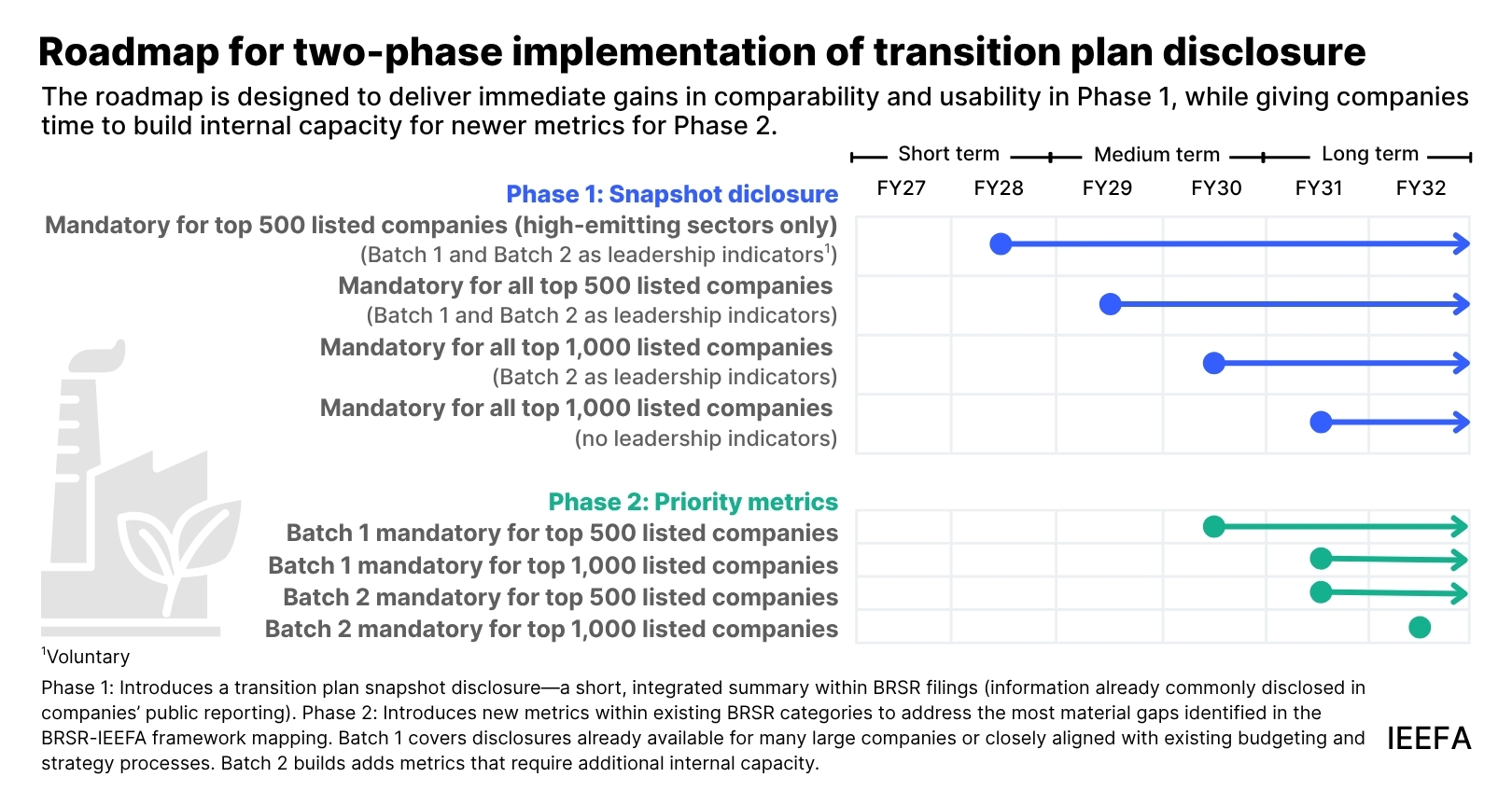
This note translates those findings into a concrete, two-phase pathway that the Securities and Exchange Board of India (SEBI) and Indian companies can use to embed transition planning within BRSR. The objective is not to create a parallel disclosure regime, but to make BRSR fit for the purpose by reorganising existing disclosures, supplementing them with a small set of priority metrics, and sequencing the introduction of new requirements in a manner sensitive to corporate sector readiness.


Related Content