Delhi’s electricity transition challenges and opportunities: A SCOPE study
Download Briefing Note
View Press Release
Key Findings
Delhi’s total energy requirement reached 38,482 million units (MU) in financial year (FY) 2026, accounting for around 2.2% of India’s total energy requirement.
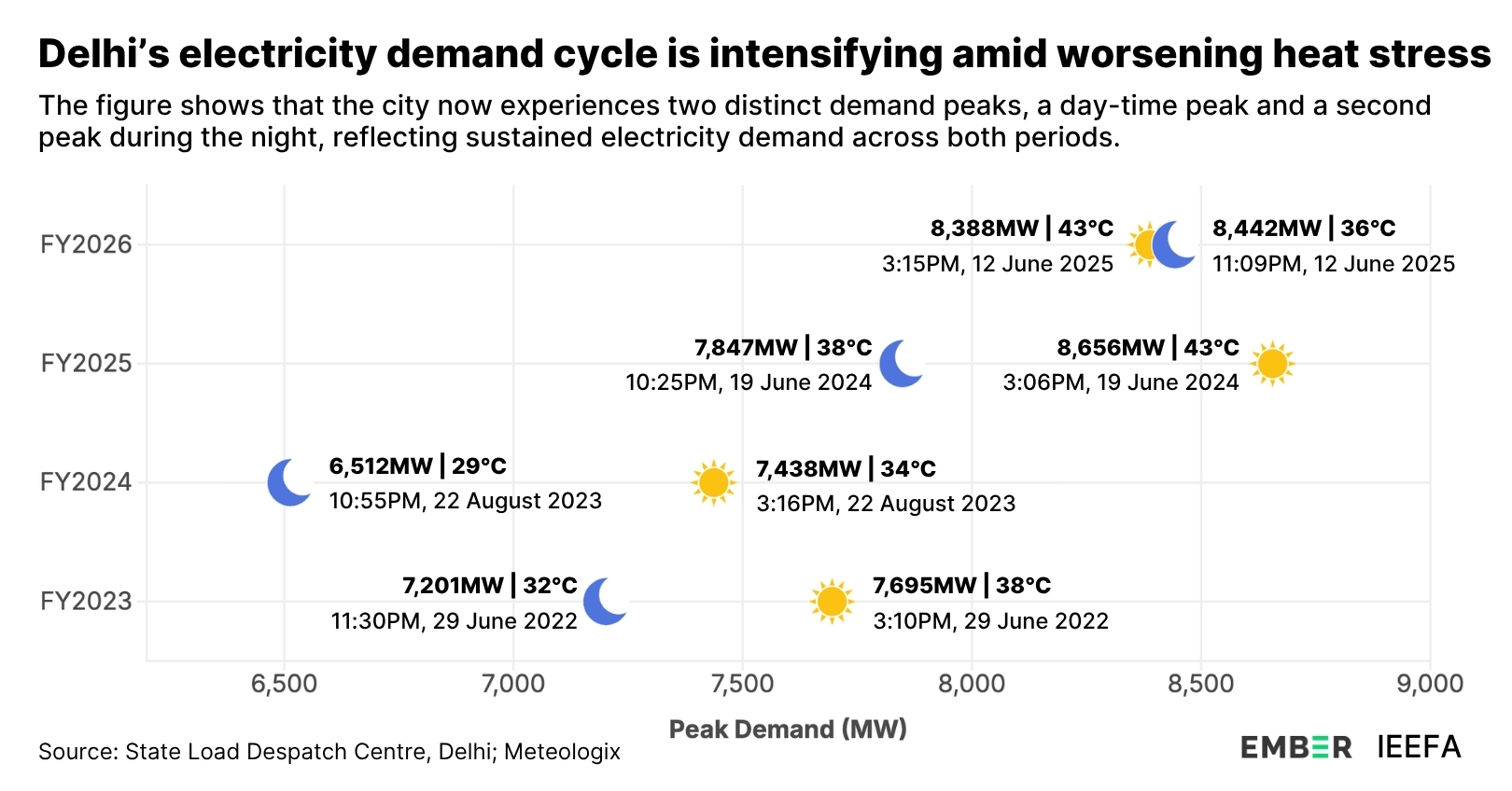
Delhi has so far effectively managed its peak demand, which rose from 7.7 gigawatts (GW) in FY2023 to 8.7GW in FY2027 by June 2026. The emergence of significant night-time peaks underscores the importance of energy storage to utilise renewable energy resources in meeting evolving demand patterns.
Delhi has untapped rooftop solar potential with ~446 megawatts (MW) achieved as of June 2026 against the 750MW target set under the Delhi Solar Energy Policy 2023.
The introduction of solar-hour-aligned time-of-day (ToD) tariffs would encourage consumers to shift flexible loads to periods of high renewable energy generation and improve overall system efficiency. This will require smart meter deployment to enable dynamic pricing and informed consumer participation to achieve the desired scale.
The National Capital Territory (NCT) of Delhi is one of India’s most urbanised regions and occupies a unique position in the country’s electricity transition. The city’s high electricity requirement is shaped by rising cooling demand, high commercial activity, and growing electrification of transport and services. It has limited own generation capacity and depends heavily on electricity purchased from neighbouring states. This makes it particularly sensitive to power market dynamics, transmission availability, and renewable energy integration. At the same time, Delhi has emerged as an important policy testing ground for distributed solar with group and virtual net-metering, a constant push for electric mobility, battery storage, and power distribution reforms. Its experience therefore offers important lessons for how rapidly urbanising areas in India can balance reliability, affordability, and decarbonisation objectives in an increasingly electricity-dependent economy.
This assessment also builds on insights from the Indian States’ Electricity Transition (SET) 2026 report launched by the Institute for Energy Economics and Financial Analysis (IEEFA) and Ember in February 2026. It assesses the progress of 21 Indian states across three key dimensions of electricity transition: decarbonisation, readiness and performance of the power ecosystem, and market enablers.
This briefing note discusses Delhi’s electricity transition through the lens of SCOPE — (S)trengths, (C)omplexities and (O)pportunities, (P)olicies, and (E)nablers.



Related Content