Submission: Feedback on the Draft Delhi Electric Vehicle Policy 2026
Download Full Version
8 May 2026
To,
The Joint Commissioner (EV)
Transport Department
Government of the National Capital Territory of Delhi
Sub: Feedback on the draft Delhi Electric Vehicle (EV) Policy 2026
Thank you for the opportunity to provide feedback on the draft Delhi EV Policy 2026 on behalf of the Institute for Energy Economics and Financial Analysis (IEEFA).
IEEFA is an independent energy finance think tank that examines issues related to energy markets, trends and policies. The Institute’s mission is to accelerate the transition to a diverse, sustainable and profitable energy economy.
The following are IEEFA’s suggestions:
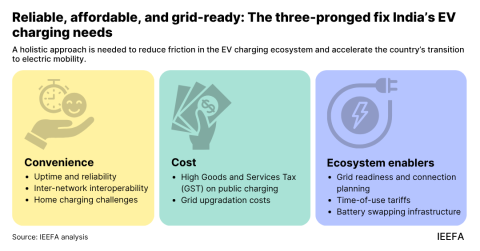
- Accountability and incentives for reliability, uptime of chargers: Low historical demand for EV charging and a lack of incentives for operations and maintenance have led to poor maintenance and upkeep of public EV chargers. In a 2024 study on the status of public EV charging stations in Delhi, IEEFA found that nearly 84% of EV chargers examined in a representative sample across South, Central, West, and East Delhi regions were not functional. The primary reasons for these non-functional chargers were: a) theft of charging equipment like connectors and copper cables; and b) lack of maintenance of charging equipment, leading to no power supply and non-functional display screens.
The Delhi EV Policy 2026 can include minimum uptime requirements for public chargers, which may be tied to funding, licensing or the use of public land. For example, the UK requires a 99% average annual uptime for rapid public chargers (across the network) along with a 24x7 free consumer helpline, with penalties for non-compliance. In California, the US, laws require 97% uptime for public chargers, and for charge point operators (CPOs) to share real-time data on charger availability and accessibility. Delhi’s EV policy can mandate that uptime and reliability requirements are explicitly incorporated into Delhi Transco Limited’s (DTL) guidelines.
- Upgrading/modernising older chargers: There are several old (low-voltage or outdated) public EV chargers in Delhi. Government or public sector undertaking (PSU)-owned chargers that are outdated and non-functional may be re-tendered for upgradation. Operations and maintenance (O&M) contracts may also be issued to ensure uptime and reliability. Private-operator run public chargers installed on government land may be issued mandates for maintaining uptime.
- Location and accessibility of public EV chargers: Clause 6.2 of the draft policy requires every original equipment manufacturer (OEM) to deploy at least one charger per dealer, with siting to follow the PM E-Drive operational guidelines to the extent feasible. Since this provision will determine where a significant share of new public chargers will be located over the coming years, the siting framework deserves careful design. IEEFA conducted a preliminary spatial analysis of 4,000 neighbourhood-scale cells in Delhi (see Appendix in the full version), and it suggests that the location question is, in the base case, less consequential than it might appear. Whether dealers install at their own premises or at PM E-Drive Category B or C sites, the resulting coverage and utilisation outcomes are broadly comparable, because dealerships are themselves spread across Delhi's commercial and residential corridors. The bigger risk to the policy's intent is not non-compliance with PM E-Drive siting, but bunching, that is, multiple dealers converging on the same handful of popular sites, leaving other neighbourhoods uncovered.
IEEFA, therefore, recommends that the policy (i) permits dealers to install at either their own premises or at a PM E-Drive Category B/C site, with both treated as compliant pathways, since this simplifies enforcement without materially weakening coverage; (ii) introduces a per-site cap on the number of dealer-mandated chargers permitted at any single location (IEEFA’s analysis indicates a cap of around three per site materially improves equity and reduces bunching) — this is the single highest-value amendment and should apply regardless of which siting pathway is used; and (iii) publishes a geocoded, publicly accessible registry of every existing and planned public charger in Delhi, with coordinates, operator, status, and site category, so that once a site reaches the cap, the next dealer is automatically directed to an alternative nearby location. The registry would also serve as foundational infrastructure for the government, OEMs, and citizens to plan based on actual ground reality.
- Home charging challenges: Home charging is a primary enabler for the electrification of transport. It is cheaper and more convenient, and it mostly happens at night when electricity demand is lower. In the US, about 80% of EV charging happens at home. Although many houses in Delhi may not have dedicated off-street parking lots, it helps to facilitate home charging for those who have dedicated parking spaces. However, installing EV chargers at home in Delhi, especially in multi-family dwellings, faces significant challenges, including opposition from resident welfare associations (RWAs). Such opposition arises due to a lack of clear guidelines and building codes for installing private charging points. The policy can provide clarity and designate authorities to develop building codes and power infrastructure standards for both existing and new constructions.
- Electrification mandates for fleet operations: The draft policy (Clause 8.4.1) mandates that fleet aggregators and delivery service providers do not induct pure internal combustion engine (ICE) vehicles into their two-wheeler fleets from 1 January 2026, while allowing the induction of Bharat Stage VI (BS-VI)-compliant vehicles until 31 December 2026. Many delivery persons operating in these fleets are driver-owners who earn supplementary income from deliveries. This mandate will not allow driver-owners of older vehicles to operate in fleets unless they upgrade to EVs — a requirement that applies retrospectively, given the 1 January 2026 effective date. Despite the availability of an incentive of up to INR30,000 per vehicle for upgrading to an EV, this will still constrain gig workers’ ability to operate in fleets and reduce their incomes. Given these complexities, EV mandates may be applicable only when the fleet aggregator owns the vehicles.
- Cost of financing: Commercial EVs are financed at more than 15–20% interest rates, depending on the borrower’s profile and vehicle type. In addition to the borrower’s credit profile, EV financing is also negatively influenced by unknowns such as battery performance and degradation, the battery's residual value, and a thin resale market. To counter these, instruments such as first- or second-loss default guarantees, interest subvention, blended finance, and residual value guarantees are often suggested. However, these solutions are seldom available as a single window for financiers. The Delhi EV Policy could call for an integrated financing platform, anchored by a development financing institution, that bundles all risk-mitigation instruments and offers them at the point of lending as a single solution. Such a solution, serving fleet operators and driver-owners of commercial vehicles, can lower financing costs and accelerate EV adoption.
Sincerely,
Charith Konda,
Energy Specialist, IEEFA
Subham Shrivastava,
Climate Finance Analyst, IEEFA


Related Content
Sustainable finance for a just transition in Odisha
Report
Planning for an effective energy transition in Bangladesh
Insights
Submission: AEMC – Gas networks in transition – draft determination
Testimony | Submission
Submission: Inquiry into the Carbon Credits and Other Legislation Amendment (Integrity and Transparency) Bill 2026
Testimony | Submission
Submission: Queensland's Financial Provisioning Scheme review
Testimony | Submission

Recurring energy shocks: From temporary pain to permanent costs
Insights

The implications of NITI Aayog’s net-zero finance report for India: A tempered ambition
Briefing Note

India’s coking coal push needs a methane plan
Insights

From oil shocks to resilience: What BRICS’s new agenda needs to address
Insights
Submission: Australian Energy Market Commission Consultation Paper – Electricity Network Regulation Review – Package 2
Testimony | Submission
Submission: Domestic Gas Reservation Scheme exposure drafts
Testimony | Submission

Submission: Department of Climate Change, Energy, the Environment and Water; 2026-27 Safeguard Mechanism Review
Testimony | Submission