After ‘The BHP Files’: What we learned about policy’s role in decarbonising mining
Key Findings
Recent media coverage of BHP’s clean energy efforts offered key lessons for decarbonising iron ore and other mining.
The necessary technologies are increasingly mature. Mines are implementing some combination of renewables-led power and mass electrification.
Physical constraints can hamper the viability of clean investment in some regions, but the growth and simultaneous decarbonisation of BHP’s copper portfolio demonstrate how location-specific policies drive the ambition to overcome those constraints.
Australian policy reform is critical; insufficient regional planning, diesel tax credits and the Safeguard Mechanism’s design currently skew incentives towards carbon-intensive production and against more ambitious Pilbara decarbonisation.
Note: This analysis is for information and educational purposes only, and is not intended to be read as investment advice. Please click here to read our full disclaimer.
While the dust has settled somewhat following the recent media investigation The BHP Files, it is important to recognise and begin applying the key lessons for Western Australia’s Pilbara and beyond.
Principally, the context surrounding The BHP Files confirmed that solutions for mining decarbonisation are mostly mature. However, policy evolution is needed for uniform action, particularly where other, often global, capital allocation options exist.
Understanding obstacles is vital to unlocking decarbonisation
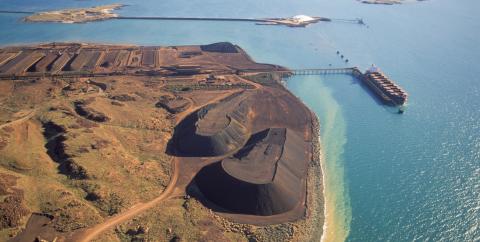
The internal documents leaked through The BHP Files revealed the world’s biggest miner’s deliberations around shelving a clean energy makeover of its Pilbara iron ore assets. Between 2022 and 2025, BHP committed to, then wound back:
- A $3 billion, 500-megawatt (MW) regional renewables rollout, starting with a $400 million development at the Jimblebar mine.
- Electrification of mining equipment, most importantly haul trucks.
- A $1.7 billion Jimblebar iron ore beneficiation plant.
Post-hoc explanations for the change of tack appear at odds with information in The BHP Files. BHP, and supportive commentators, have argued that much zero-emissions technology is “not yet ready” for Pilbara deployment. Yet the leaked documents paint poor economics as the main factor.
New investments must always clear financial as well as technical hurdles. But it is important to understand which concern dominates. This knowledge can help future-proof both iron ore and the Pilbara, which generates 19.2% of Western Australia’s gross state product and 3.4% of national GDP, and inform clean investment strategy elsewhere in Australia.
Renewables-powered mining advances, with electrification to follow
BHP did not explicitly challenge the maturity of renewables-powered mining. Nonetheless, the decision to roll back commitments in this space is worth putting in context.
BHP itself has already achieved 100% renewables at its Chilean copper operations. Even in Australia, BHP’s South Australian copper mines are on track for 70% renewable power by 2030.
Renewables-heavy grids and power purchase agreements (PPAs) have driven BHP’s copper progress. But many Western Australian miners who lack these options have still built successful off-grid solutions. The remote Bellevue Gold Mine has averaged 80-90% renewables generation.
Importantly, both copper and gold mining have greater energy and electricity-intensity requirements than iron ore. The Pilbara does, however, present unique challenges in terms of scale.
Offering more direct comparison with BHP’s task, Fortescue this year began building a new regional grid set to feature 1.8 gigawatts (GW) of solar and wind and 4-5 gigawatt-hours of battery storage (significantly above BHP’s scrapped plans, despite Fortescue exporting a third less iron ore).
Fortescue is targeting a complete but phased elimination of fossil fuels. BHP’s previous renewables plans, by contrast, still retained its Yarmina gas plant and were contingent on electricity load growth. Fortescue expects to soon roll out the first of 300 electric haul trucks, which it developed alongside technology providers with a view to smooth operational integration.
BHP’s electric haul truck adoption remains at the trial stage. It claims technical immaturity forced it to reconsider plans for full deployment in the 2030s. Nonetheless, it received a significant supplier discount for its 2023 purchase of new diesel-electric equivalents for Jimblebar (with an expected 2040s end-of-life).
BHP’s copper pivot shows decarbonisation pathway
Other mining operations have also progressed electrification by tailoring solutions to any challenges encountered. One BHP copper investment, South Australia’s Prominent Hill mine, is again notable.
BHP acquired the mine in 2023, after a 1,300-metre vertical shaft and electric hoist to eliminate underground diesel was already commissioned. Technology partner ABB developed its strongest-ever drivetrain to deliver the project.
The recurring theme of greater decarbonisation via copper is key to understanding BHP and other companies’ motives for mining transformation.
Copper this year overtook iron ore as BHP’s biggest-earning division, driven by the metal’s role in electrification and decarbonisation. However, BHP has also celebrated its strategy to “allocate capital with discipline” as complementing its copper support.
This discipline, somewhat ironically, justified the decarbonisation backsliding outlined in The BHP Files. BHP scrapped the Jimblebar beneficiation plant, for example, despite estimating it could reduce Asian steel emissions by the equivalent of 75% of its Pilbara emissions. Management concluded it was less desirable than alternative spending.
Copper’s rise in BHP’s plans has in turn been influenced by iron ore challenges, including the China Mineral Resources Group, a steelmaking cartel, seeking greater pricing control. Decarbonisation appears to have taken a back seat in this environment.
Supportive policies can unlock profitable decarbonisation
In May, mining electrification leader Dan Gleeson noted that decarbonisation investment “needs to stack up on the normal economic metrics” miners prioritise.
This confirms that profitability matters as much as, or more than, technical performance. More risk-tolerant companies might still see long-term benefit from investing in leading-edge technology. But ensuring all companies chase all achievable progress requires higher baseline ambition – including from policymakers.
Comparing the Pilbara policy environment with other jurisdictions is revealing here. BHP’s progress on decarbonising copper mining in Chile, for example, was influenced by that country’s carbon tax, a 100% renewable power target for mining, and government-industry cooperation on electrification. In South Australia, the state government has supported nation-leading 75% renewables deployment.
Pilbara decarbonisation faces legitimate physical barriers, but policy settings have compounded these. The region’s North-West Interconnected System, for example, is not a cohesive power grid but a web of loosely interconnected, public-private networks, where renewables still generate just 2% of electricity and costs are needlessly high. Poor government oversight has led to inefficient development of regional infrastructure, corporate ecosystems, and local capacity.
The continuation of past approaches would jeopardise decarbonisation. Disjointed clean power sector development, for example, could be $30 billion more expensive than under a common user approach, pushing up electrification costs.
The Western Australian government supports Pilbara improvements, including a more unified power sector. But deploying renewables and electrification here, and elsewhere, will still be unnecessarily difficult while industry pathways remain largely self-determined.
Two federal policies need urgent reform in this respect: the Safeguard Mechanism (SGM) for regulating emissions; and the Fuel Tax Credit (FTC) scheme for rebating diesel excise. BHP’s interactions with these policies indicate they favour the carbon-intensive status quo.
Rather than invest in genuine decarbonisation, BHP’s Pilbara facilities have leveraged the ability to meet their SGM obligations through Australian Carbon Credit Unit (ACCU) offsets. The likely cost of doing so in 2024-25 (when SGM-covered emissions rose by 6%) was less than $8 million.
This outlay is far smaller than the $334 million per year capital expenditure BHP pledged to Pilbara decarbonisation under its scrapped plans (even as this investment anticipated significant future operational savings). The estimated $380 million in FTC rebates BHP received last year to burn Pilbara diesel – the source of 70% of its regional emissions – increases the immediate appeal of offsetting over overhauling production.
Notes: BHP’s Safeguard Mechanism-covered Pilbara iron ore facilities surrendered 223,847 ACCUs in 2024-25. At an average spot market price of AU$35, this would bring the total compliance costs to AU$7,834,645. In 2023, BHP estimated it would spend about US$4 billion on global decarbonisation in 2024-2030. With 40% allocated to the Pilbara, this translates to a AU$334 million annual average, converted to 2023 Australian dollars (though allocated spending was heavily backloaded to 2028-2030).
The BHP Files ultimately confirmed how location-specific policies direct industry decarbonisation choices. BHP has pivoted from iron ore to copper partly because governments have aligned incentives for investing in mature clean technology with incentives for ensuring broader profitability. Well-designed policy reforms could deliver similar outcomes for Pilbara iron ore.

Related Content