Discoms will power the clean energy shift

Key Findings
Despite reform programmes, the poor financial health of India's distribution companies (DISCOMs) remains a bottleneck for the country’s energy transition. As India targets more than 900 gigawatts (GW) of non-fossil fuel capacity by financial year (FY) 2036, financially stronger DISCOMs will be essential to mobilise the investments needed for grid modernisation and renewable energy integration.
Improving fixed-cost recovery through a greater share of fixed charges in tariff design can provide more predictable revenues, strengthen DISCOM finances, and enhance their ability to invest in substations, transformers, feeder upgrades, advanced metering infrastructure and other network improvements needed to integrate higher shares of renewable energy.
A sudden increase in fixed charges could raise affordability concerns for low-consumption households and micro, small, and medium enterprises (MSMEs), and encourage some large consumers to further reduce grid dependence through captive renewable energy and storage. A phased approach would help avoid price shocks and allow regulators to assess impacts across consumer groups.
As India accelerates its clean energy transition, a challenge that cannot be overlooked is the persistent financial stress the country’s distribution companies (DISCOMs) have struggled with for years. Despite successive reform programmes, such as the Ujwal DISCOM Assurance Yojana (UDAY) and the Revamped Distribution Sector Scheme (RDSS), many utilities continue to face significant financial and operational challenges. In financial year (FY) 2025, aggregate technical and commercial (AT&C) losses stood at 15.04%, while DISCOMs reported losses of INR11,270 crore (USD1.35 billion), taking cumulative sector losses to INR6,47,210 crore (USD77.5 billion).
Addressing these persistent challenges will require structural reforms, with tariff rationalisation playing a central role. In this context, a report released in May by the Central Electricity Authority (CEA) on rationalising consumer fixed charges strikes at one of the root causes of DISCOM financial stress: The mismatch between fixed costs incurred and fixed charges recovered from consumers.
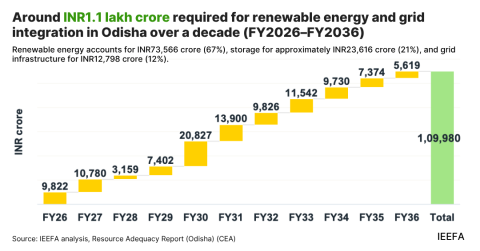
Resolving these weaknesses assumes even greater importance as India pursues its clean energy goals. The CEA’s transmission plan envisages supporting more than 900 gigawatts (GW) of non-fossil fuel capacity by FY2036. Achieving this goal will require all parts of the power ecosystem — from renewable energy generation and transmission to distribution and grid integration — to function effectively. While renewable energy costs have fallen sharply and deployment continues to grow, the next major challenge lies in strengthening and modernising the grid infrastructure needed to evacuate, transmit and integrate this power.
The challenge is already evident. India lost around 300 gigawatt-hours (GWh) of renewable electricity during the first quarter of 2026 due to transmission constraints, highlighting the growing mismatch between renewable energy additions and grid readiness. Addressing these bottlenecks will require substantial investments across both transmission and distribution networks. However, mobilising these investments will depend on a financially healthy power sector, particularly the distribution segment that sits at the centre of the electricity value chain.
Rethinking fixed charges
Strengthening the financial health of DISCOMs, one of the power sector's most persistent weak links, is critical. Rationalising fixed charges, in particular, can help correct a long-standing mismatch between fixed costs and revenue recovery.
Currently, fixed costs including capacity payments to generators, transmission and load dispatch charges and distribution infrastructure costs, account for 38–56% of a DISCOM’s Annual Revenue Requirement (ARR). However, fixed charges currently contribute only 9–20% of total revenue. As a result, a large share of fixed costs is recovered through energy charges linked to electricity consumption. This exposes DISCOM revenues to fluctuations in demand, weather conditions and economic activity, even though many of their costs remain fixed.
The challenge has become more pronounced as commercial and industrial consumers increasingly adopt open access, captive generation and rooftop solar. While these consumers may purchase fewer units of electricity from DISCOMs, they continue to rely on the grid for reliability, back-up power supply and network access. As a result, utilities must continue maintaining infrastructure while recovering a smaller share of revenues through energy sales. Improving fixed-cost recovery through increase in fixed charges in the tariff design can therefore provide greater revenue certainty, strengthen DISCOM finances, and also improve their ability to undertake the capital investments needed to modernise and expand the grid.
Stronger and more predictable revenues would enhance DISCOMs' ability to invest in substations, transformers, feeder upgrades, advanced metering infrastructure and other network improvements needed to integrate higher shares of renewable energy. Improved financial health would also strengthen payment security across the power sector, supporting investments in transmission infrastructure critical for renewable energy expansion.
A gradual and state-specific reform
While improving fixed-cost recovery can strengthen DISCOM finances, a sudden increase in fixed charges could create affordability concerns for low-consumption households and micro, small, and medium enterprises (MSMEs) by making electricity bills less responsive to actual usage. Higher fixed charges could also encourage some large consumers to further reduce grid dependence through captive renewable energy and storage investments. A phased approach is therefore essential to avoid price shocks and allow regulators and DISCOMs to monitor the impact across different consumer categories.
The impact of increasing fixed-cost recovery will also vary across states, given significant differences in existing tariff structures and the share of fixed charges in consumer bills. This reinforces the need for a gradual and state-specific approach, allowing regulators to align reforms with local consumer profiles and market conditions. Regular cost-reflective tariff revisions can complement these reforms by strengthening DISCOM finances and improving their ability to support the energy transition.
Strengthening fixed-cost recovery is a step in the right direction to improve DISCOMs' ability to invest in grid infrastructure. As grid modernisation and network expansion become increasingly critical for renewable energy integration, financially stronger DISCOMs will be essential to unlocking the investments needed to support India's next phase of clean energy growth.
This article was first published in The Hindu Business Line.


Related Content