From connection to consumption: Why India’s clean cooking revolution must be electric
Key Findings
While subsidies have driven the expansion of LPG and PNG for cooking in Indian households over the past decade, many are still reliant on solid fuels.
LPG and PNG are heavily import-dependent and subject to global price volatility despite the subsidies.
Greater electricity grid expansion and reliability can drive a surge in e-cooking, however high capital cost and lack of awareness are limiting uptake.
Like LPG and PNG, strategic government incentives could drive the uptake of
e-cooking and reduce India’s reliance on costly fuel imports.
Strategic subsidy incentives for liquefied petroleum gas (LPG) and increased infrastructure deployment for piped natural gas (PNG) have shaped India’s clean cooking transition in the past decade. The rapid increase in connections for these fuels has helped people transition away from solid fuels, resulting in health and environmental benefits.
However, while a massive infrastructure push has expanded LPG and PNG coverage to 330 million and 15 million connections respectively, a large segment of India’s population still depends on solid fuels for cooking. Apart from deeper issues such as cultural barriers or lack of access to distribution channels in remote locations, affordability of clean fuels is key to this connection-consumption gap.
Both LPG and PNG are import-dependent fossil fuels with pricing affected by international markets. As India imports a large share of LPG from Saudi Arabia, non-subsidised LPG prices are directly correlated to Saudi Aramco propane prices. For instance, when geopolitical disturbances pushed international propane prices beyond USD700, the LPG retail price in India also crossed INR1,000. Similarly, the linkage between the benchmark spot liquefied natural gas (LNG) price—Japan Korea Marker—and PNG prices is prevalent. This is despite long-term contracts and India’s domestic supplies of PNG. The price implications of India’s recent deal with the United States to import 2.2 million tonnes of LPG next year are yet to be seen. It would offer fuel diversification and two distinct pricing benchmarks but freight and price volatility challenges could remain.
Price volatility has an impact on the consumption of clean cooking fuels. PNG consumption has increased by only 27% in the past four years despite connections doubling in that time. Similarly, the average LPG refill for households under the Pradhan Mantri Ujjwala Yojana (PMUY)—a flagship scheme for below poverty line households—continues to lag the yearly average of non-PMUY households. However, large subsidies have helped allay price concerns and increase consumption for PMUY consumers.
While LPG and PNG connections are expanding, another revolution is happening in India: An increase in electricity connections. Near universal access to electricity means most Indian households now rely on it as the primary source for lighting. In rural areas, this increased from 72.5% in 2012 to 98.6% in 2023, approaching urban levels (99.7%). Moreover, average daily hours of power supply in urban areas reached 23.5 hours in FY2023-24. This presents a good opportunity to undertake a staggered transition to
e-cooking in urban areas initially, especially as it has been seen to be a more affordable, safer and energy-efficient option.
A recent report by the Institute of Energy Economics and Financial Analysis (IEEFA) found that for a family of four in Delhi, using e-cooking was more affordable than using non-subsidised LPG or PNG. In FY2024-25, the annual cost of using e-cooking for a family of four was INR5,844, 14% lower than PNG and 37% lower than LPG (without the universal INR200 government subsidy). Even with the subsidy, using LPG for cooking was found to be 10% more expensive than e-cooking. 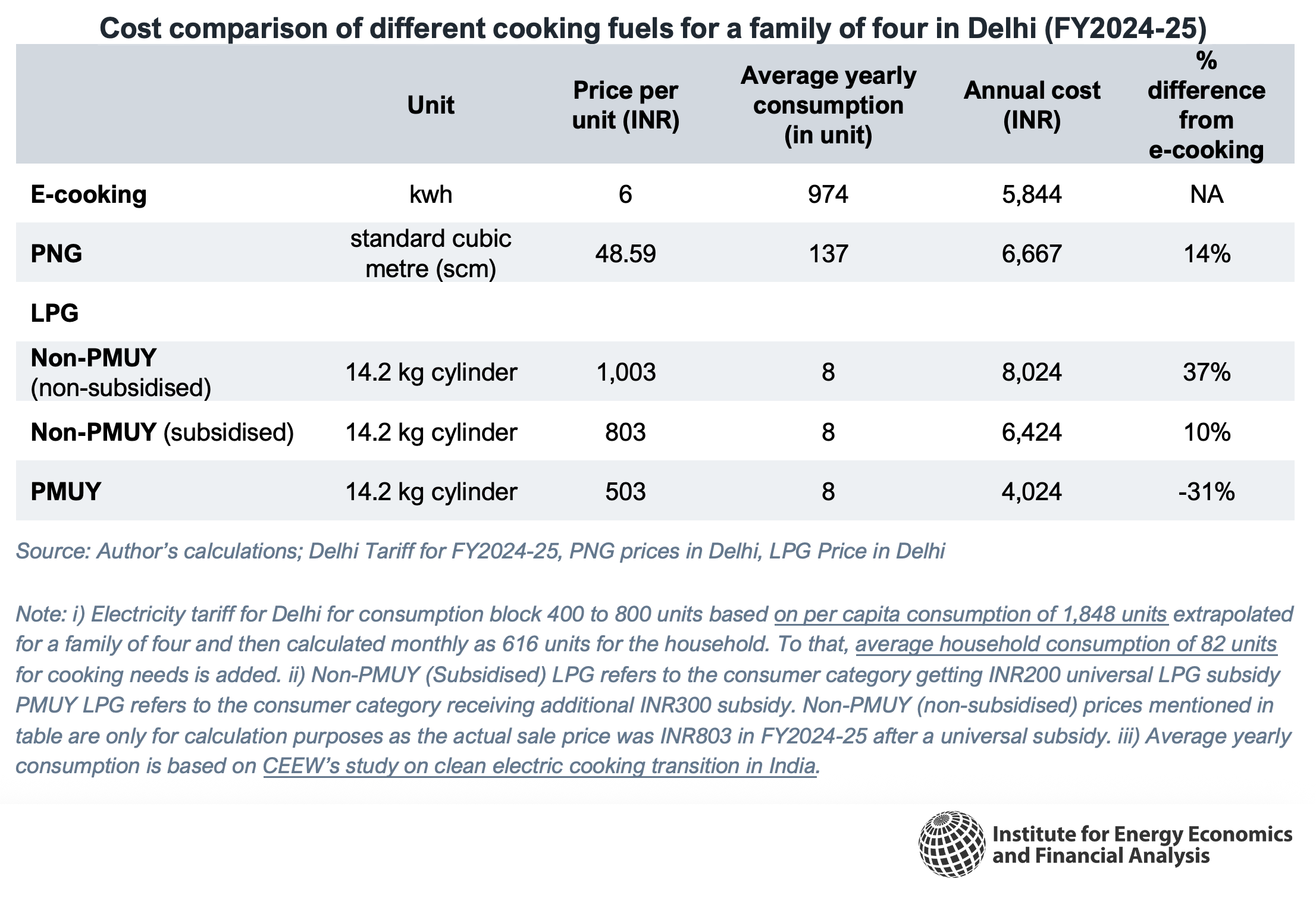
Apart from affordability, electric induction cooktops offer savings in time and energy consumption. For instance, induction cooktops take half the time to reach boiling temperature as LPG- and PNG-based stoves. Induction cooktops also offer 85-90% energy efficiency due to direct transfer of heat to cookware whereas flame-based cooking efficiency drops to 55% due to heat escaping.
Despite the massive benefits offered by e-cooking, its uptake remains limited due to upfront cost barriers and lack of awareness. Small strategic policy interventions can significantly expand e-cooking in urban India, leading to affordability, energy security and efficiency benefits. Central and state government-led awareness and demonstration campaigns on the benefits of e-cooking, usage and maintenance of devices, and managing power supply concerns can drive wider uptake. Complementing these campaigns with direct financial support for a double-induction cooktop and starter utensils to consumers would further enhance demand and uptake.
The connection-consumption disparity in clean cooking signals the urgent need to address the affordability challenge posed by highly import-dependent LPG and PNG fuels. E-cooking has all the ingredients for a successful transition, starting in urban kitchens and freeing up precious import and subsidy-linked resources for rural areas to follow.
This article was first published in Carbon Copy.

Related Content