Accelerating corporate climate transition planning and disclosures in India
Event summary notes
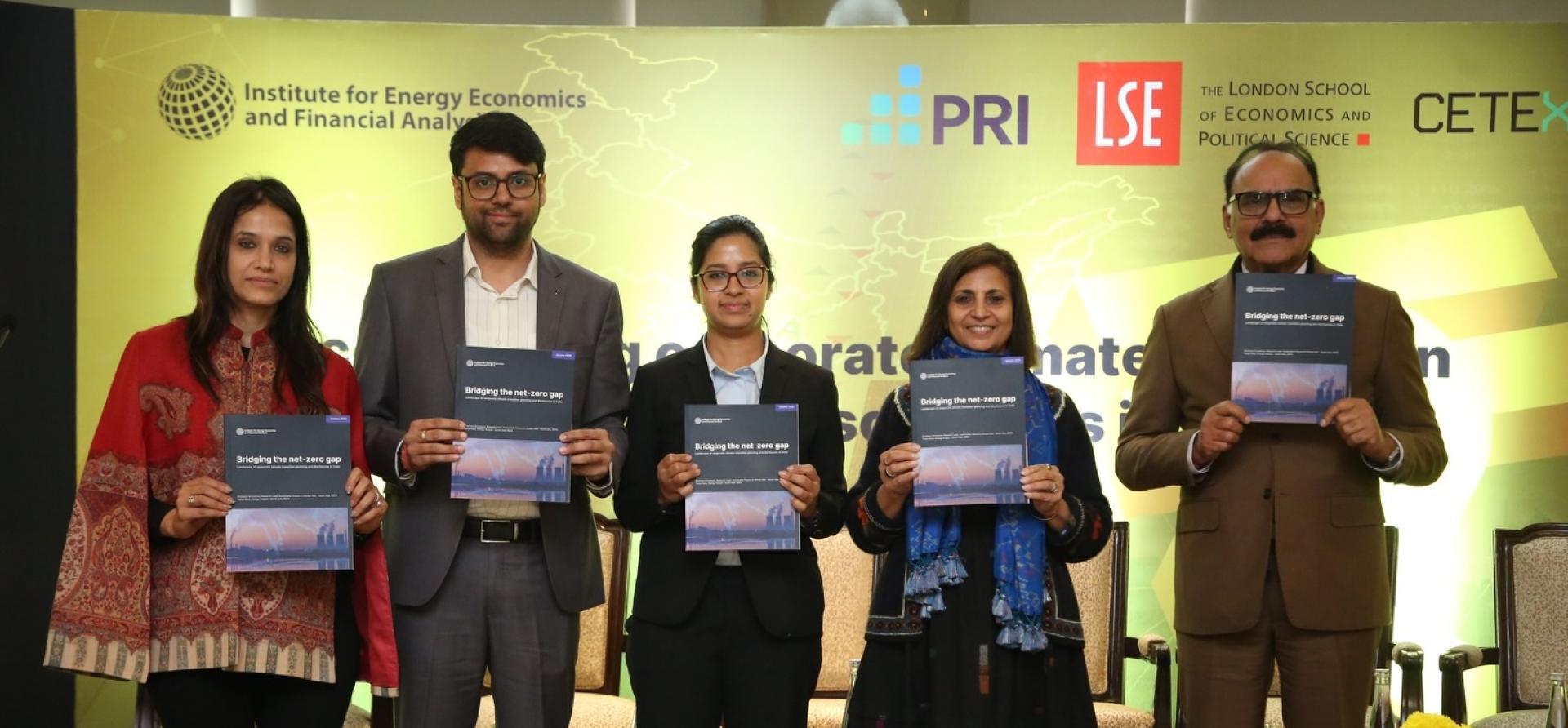
These notes synthesise insights from the “Accelerating corporate climate transition planning and disclosures in India” event, held on 30 January 2026 in New Delhi. As part of the event, IEEFA also launched a report mapping corporate climate transition planning and disclosures in India. The report analyses transition planning and disclosure practices across six key sectors, based on a review of 33 companies (link below).
The event was organised by the Institute for Energy Economics and Financial Analysis (IEEFA), the London School of Economics Centre for Economic Transition Expertise, and the Principles for Responsible Investment. These insights, drawn from corporates, investors, regulators, and policy institutions, reflect the perspectives shared during the panel discussion on "The corporate-investor-regulator nexus: How collaboration can build a robust sustainable finance ecosystem in India" and the roundtable discussion on "Key challenges and the road ahead for accelerating corporate transition planning in India".
Regulatory perspective
Calibrating disclosure and avoiding over-regulation
- Globally, ISSB S2 is emerging as a key framework for climate reporting, as it clearly articulates what investors expect beyond headline targets, particularly the financial pathways and implementation plan to achieve them. While BRSR disclosures capture targets and metrics, a key gap remains in explaining how companies plan to deliver on these commitments.
- At the same time, over-regulation runs the risk of potentially harming the industry in the long run, which is why the regulator is cautious about introducing granular requirements into BRSR at this stage. Continuous feedback from corporates was emphasized as essential to appropriately calibrate disclosure requirements as the market evolves.
- This caution is also reflected in how transition plan–specific disclosures are currently positioned in India. At present, such disclosures are largely limited to the esg-linked debt issuance framework, where requirements are focused and instrument-specific. Embedding similar granular requirements into the BRSR framework, which is broader and overarching in nature, could risk overloading issuers who are at very different stages of readiness.
- Against this backdrop, a phased and tailored regulatory approach, supported by voluntary frameworks and learning-by-doing, is seen as preferable to avoid burdening companies with one-size-fits-all requirements.
- SEBI is part of multiple forums including the national group of taxonomy, and project sustainability committee, set up under the G20 presidency. The organisation is engaging with government and large issuers on a regular basis to get their feedback.
Introducing regulatory enablers
- Given the preference for calibration over compulsion, regulatory enablers can strengthen transition disclosures without adding mandatory layers. In this context, developing a voluntary transition planning framework could help complement BRSR, enabling stronger transition disclosures while avoiding additional mandatory regulation.
- To support this, there is a need to collate global best practices and translate them into practical templates that help companies understand how to incorporate climate transition planning. A phased implementation approach remains important, taking into account sectoral differences, business models, and company size.
- A national-level portal that collates global best practices and case studies, can be valuable here. This is particularly important for smaller businesses, which need clarity on what needs to be done and what to avoid, while investors are seeking greater awareness and consistency in disclosures.
- Technology was highlighted as a critical enabler in this process. Sustainability and transition data is currently fragmented across platforms, and leveraging digital public infrastructure (DPI), which the government is actively building, can help ensure interoperability, streamline disclosures, and improve data quality and comparability for regulators, companies, and investors alike.
- A phased, sector-specific approach, supported by voluntary templates and case studies through national platforms such as the CSR exchange, can further help companies transition at a realistic pace without imposing uniform requirements.
Making scenario analysis usable in India
- These enablers become especially relevant in the context of scenario analysis. Global climate transition risk scenarios often do not adequately reflect Indian realities, making it difficult for companies to translate scenario analysis into actionable business insights. As a result, having scenarios that are specific to the Indian context is seen as particularly helpful.
- To address this gap, there is a need for coordinated efforts by regulators and public institutions to develop standardised, India-specific reference scenarios to support credible scenario analysis and stress testing. Regulators coming out with scenarios similar to Network of Greening the Financial System (NGFS) and International Energy Agency (IEA), but adapted to domestic conditions, could provide a common reference point for companies and investors.
Business perspective
Diversity of contexts and strategic transition
- From a business perspective, there cannot be a singular generalization. It depends upon the size of the business, the sector, the kind of product that is being sold. Transition cannot just be a narrow view of decarbonisation, it needs to be about broader sustainability.
- The top 200 listed companies in India respond very differently on sustainability compared to the next 200-500 companies. There is a need to maintain a holistic perspective and strike a balance between maintaining economic activity and focusing on decarbonisation.
- In an economy like India, the role of regulation and compliance is critical. It takes care of market failures. However, companies ultimately need to move from being compliant to being strategic, ensuring that transition efforts make business sense. Regulations, investors, and customers emerge as three powerful triggers that determine when companies begin to think more strategically about transition.
- Within this context, there is a clear need to move beyond setting net-zero targets towards linking climate ambitions with financial planning. Aligning targets with capex allocation, technology choices, and R&D investments is critical to demonstrate how transition commitments translate into real business decisions.
- At the same time, transition planning must account for affordability and development priorities in a growing economy, such as the implications for end product prices (price of cement quoted as an example), rather than focusing only on emissions reduction.
Business challenges: Capability, data, and governance gaps
- Despite growing ambition, execution remains uneven. A key challenge is determining when internal data and KPIs are mature enough for external disclosures, which creates hesitation and inconsistencies in how companies communicate transition progress.
- This is compounded by the cost-benefit considerations corporates apply to disclosures. Companies often assess whether the cost of collecting information is lower than the potential impact of that information on capital providers. As technology reduces the cost of reporting and disclosures, this equation is likely to change, but it remains a constraint today.
- Scenario planning presents another challenge. While companies based in the European Union clearly articulate how scenario planning informs business and sustainability strategies, Indian companies often struggle to justify its relevance internally. This difficulty is closely linked to broader capability gaps.
- Leadership and governance were repeatedly highlighted as decisive factors. Sustainability should be driven from the CEO and board level and embedded across the organization than being siloed under the Chief Sustainability Officer’s (CSO) functions. This should be complemented by clear articulation of what sustainability and responsible business conduct mean for the organisation.
- Although capacity building remains a major bottleneck, capacity is gradually increasing as more institutions such as National Institute of Securities Markets (NISM), National Stock Exchange (NSE), Indian Institute of Technology (IITs), and Indian Institute of Management (IIMs) provide training. However, gaps persist in advanced areas such as stress testing, scenario analysis, and lifecycle assessment.
- Organisational readiness therefore varies significantly across companies, with site-level capacity and accountability emerging as key bottlenecks in implementing transition actions. Embedding sustainability as a cultural mission, similar to how safety became embedded in the oil & gas and refining sectors, was seen as critical.
System constraint: Value chains and MSMEs
- These challenges are amplified when viewed through a system lens. Applying a Just Transition lens across the value chain, including suppliers and customers, is particularly important in people-intensive sectors.
- Without bringing MSMEs along, the sustainability transition in India is unlikely to succeed. MSMEs face fundamentally different constraints, underscoring the need for a supportive ecosystem rather than compliance-heavy expectations.
Investor perspective
Decision-useful information and practical constraints
- From an investor perspective, disclosures are not ends in themselves. Their primary function is to reduce information asymmetry. Investors want to understand how companies’ targets affect capex and opex, and in turn how these decisions influence cost of capital and borrowing costs.
- Having a credible plan helps investors better understand companies and improves predictability. Capital providers are therefore looking for financial, and implementation plans that support stated targets, reinforcing the importance of transition planning.
- This perspective is increasingly shared by domestic banks, which are reaching out to build capacity among their clients and integrate transition planning with business plans. Banks are particularly concerned about MSME clients, even as they remain cautious that stricter expectations could push larger corporates away.
- At the same time, some investors already have robust climate policies agreed upfront and communicated clearly to investee companies. For these plans to be executed, the capacity and governance structures of investee companies, such as ESG committees, need to be firmly in place.
- However, investors themselves face constraints. Many struggle to gather data and develop scenarios, often getting lost in data and modelling exercises. As a result, there is a growing emphasis on combining top-down and bottom-up approaches, using publicly available data and simple metrics to assess transition risks, rather than waiting for perfect scenario disclosures before acting.



Related Content