Transforming Jharkhand's economy in line with India's net-zero ambitions
Download Briefing Note
View Press Release

Key Findings
The report estimates that US$256 billion (Rs21.52 lakh crore) will be needed between 2026 and 2070 for Jharkhand’s transition from fossil fuels, covering coal mining and thermal power, decarbonising the steel sector, providing social support, and driving economic diversification into low carbon sectors to maintain both social stability and economic growth.
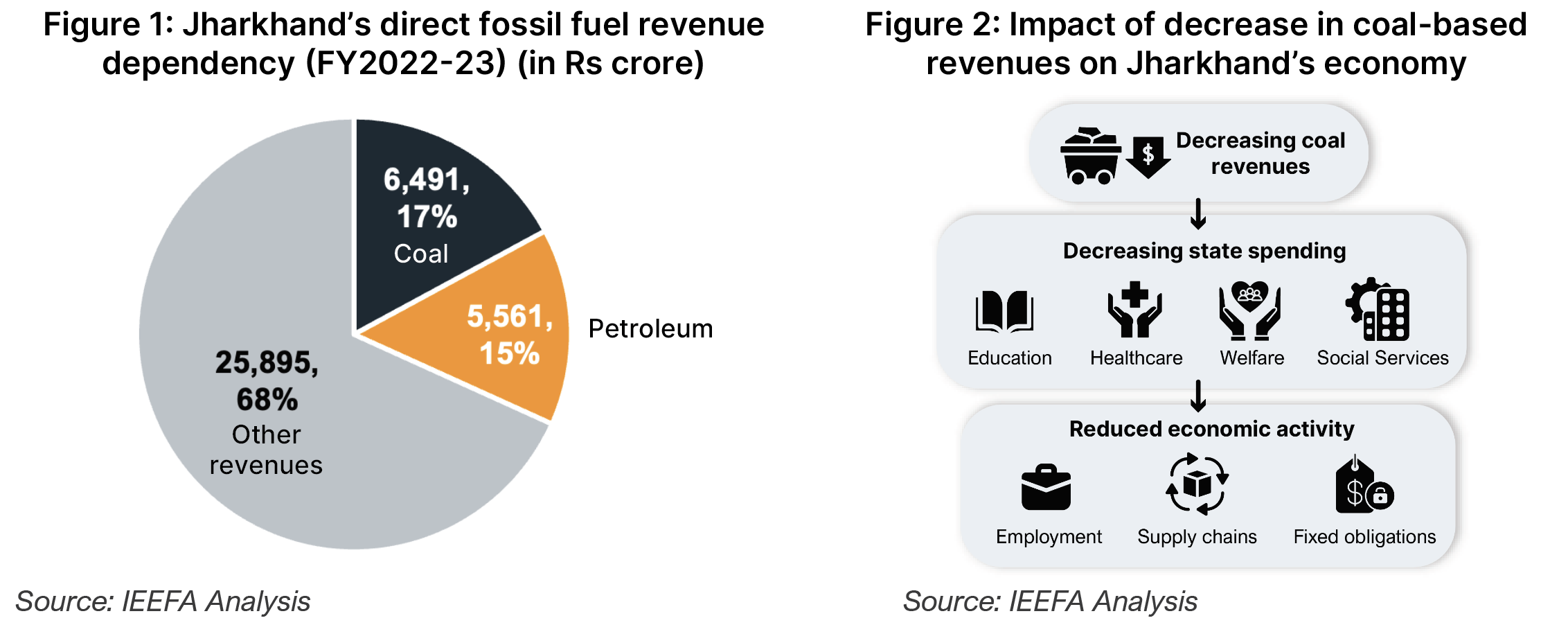
Coal and petroleum contribute 32% to the state’s own revenue, exposing Jharkhand to major fiscal risks as fossil fuel use declines.
Over US$12.5 billion (Rs1.05 lakh crore) will be needed to reskill, compensate and support livelihoods and communities dependent on the fossil fuel economy.
Public funds alone are not sufficient to finance the transition. A sustainable finance framework involving public finance, private investment, concessional debt and international climate funds is essential.
India’s net-zero target for 2070 involves phasing out carbon-intensive assets, developing new low-carbon capacity, and mobilising unprecedented levels of capital. For Jharkhand, this transition is both a high-risk challenge and a high-return opportunity, with the potential to enhance energy security, create large-scale employment, and drive long-term sustainable growth.
Fossil fuels currently account for 32% of Jharkhand’s revenue, with coal alone accounting for 17%. Over half of the state’s Goods and Services Tax (GST) collections come from fossil fuel-dependent industries.
A decline in coal revenues will restrict the state’s ability to fund essential social services and dampen economic activity. Since a substantial share of the budget has already been allocated for fixed obligations, such as administrative costs, any revenue shortfall would further reduce fiscal flexibility.
The state stands at a crossroads. Without proactive planning, the decline of the coal industry could trigger fiscal instability and job losses. However, with a thoughtfully crafted Just Transition strategy, Jharkhand can capture high-growth opportunities in low-carbon sectors, create sustainable livelihoods, and position itself to capitalise on emerging markets.
Jharkhand will require USD256 billion (INR21.52 lakh crore) from 2026 to 2070 to transition from fossil fuel dominant sectors without disrupting the social infrastructure.
This shift entails phasing out carbon-intensive assets, building new low-carbon capacity, and mobilising unprecedented levels of capital.
While these upfront costs are significant, the long-term benefits in terms of new revenues, jobs, and industrial ecosystems will far outweigh them.
The concentration of heavy industries makes Jharkhand an ideal proving ground for a Just Transition to a diversified, low-carbon economy that could become a model for other states and key to India’s achieving its ambitious climate targets.
Jharkhand’s vast renewable energy potential, combined with its industrial base and critical mineral reserves, positions the state to emerge as a hub for low-carbon manufacturing, ranging from EVs, solar panels and battery energy storage systems (BESS) to green hydrogen production. At the same time, natural farming and other, nature-based solutions can strengthen rural livelihoods, open opportunities in carbon markets, and enhance climate resilience.
While public funds will play a catalytic role, most of the required financing will need to come from beyond state government budgets, through private investment, multilateral concessional capital and innovative blended finance structures. With clear and consistent policies, Jharkhand can attract billions in private and concessional capital, unlocking new infrastructure, industrial clusters, and clean energy innovation.
This massive upfront investment required will also deliver a healthy financial dividend, with a net gain of INR6.7 lakh crore (USD79.3 billion) to the state government budget by 2070. This does not include any resultant increases in central government taxes and duties.
Diversifying the state’s economy into new, low-carbon sectors will add to its GDP, contributing materially towards Jharkhand’s economic growth. Thus, the transition will more than compensate for the state’s lost coal-based revenues.
Beyond the fiscal dimension, the transition promises wide-ranging Just Transition benefits. More than USD12.5 billion (INR1.05 lakh crore) will be required to reskill, compensate, and support workers and communities dependent on coal, but this social investment will ensure that vulnerable communities are not left behind, but thrive in a low-carbon economy.
However, these outcomes will not materialise automatically. Achieving them will require strong political commitment, early investments in human capital, and an enabling financial and regulatory ecosystem. Governance and institutional capacity must also be strengthened to ensure transparent implementation and to secure the confidence of different stakeholders.



Related Content