Market success of short-duration batteries paves the way for longer-lasting storage
Download Briefing Note
View Press Release
Key Findings
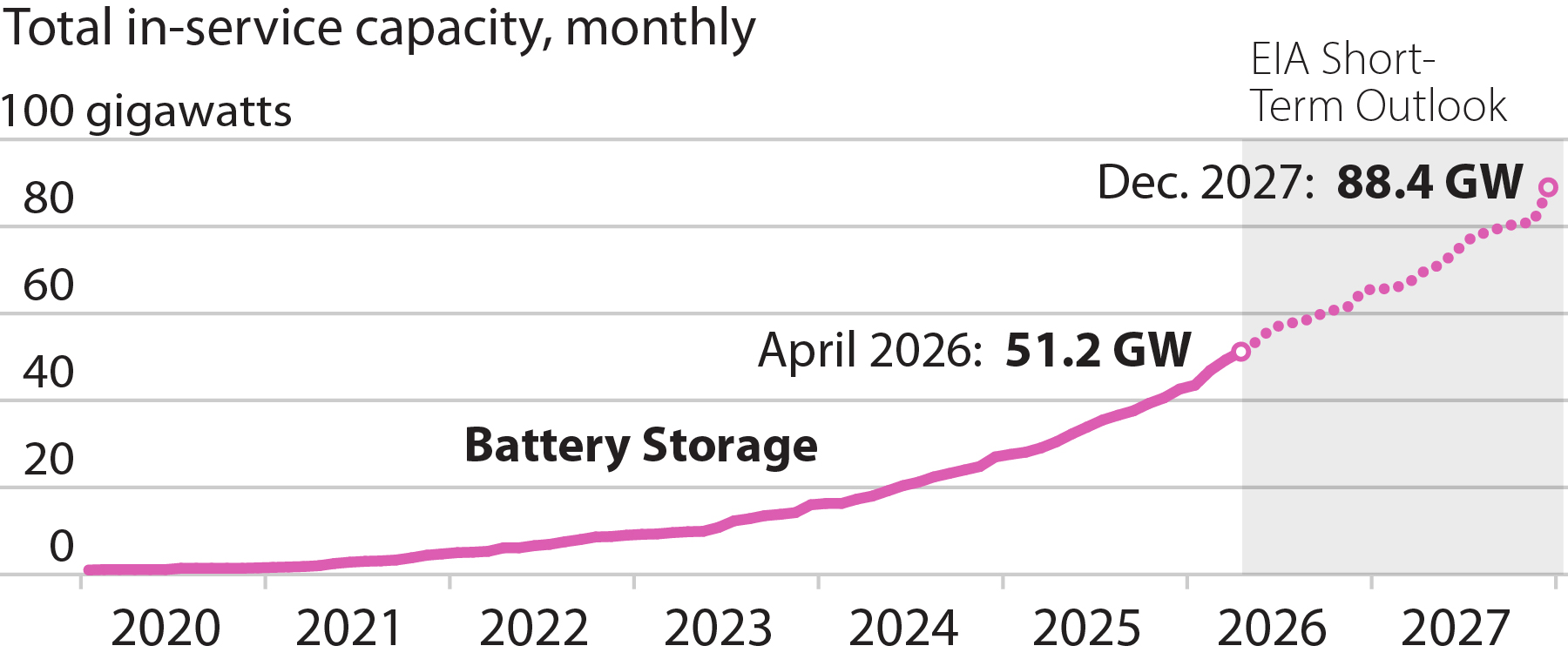
Short-duration battery storage has increased 25x over the last five years.
Installed capacity is expected to double again by the end of 2027.
There is no fast-response, long-duration storage in the U.S., but the outlook for its development in the next five to 10 years is positive.
Advances in technology, rising data center demand, and policy changes could drive the development and growth of long-duration storage.
Introduction
The success and soaring growth of two- to four-hour lithium-ion batteries over the past five years have created an opening for longer-duration storage solutions that can store up to four days of power. In the U.S. today, there is essentially no fast-response, long-duration storage, but the outlook for growth in the next five to 10 years is positive. In fact, long-duration energy storage (LDES) could follow a growth trajectory like that of short-term storage, as advances in technology, demand from new data centers, and policy changes all align.
In just five years, installed short-duration battery storage capacity in the U.S. has increased from 1,694 megawatts (MW) in January 2021 to 43,419 MW in January 2026, according to the Energy Information Administration (EIA). Current forecasts call for installed capacity to double again by the end of 2027, reaching almost 90,000 MW. For comparison, there were 79,944 MW of conventional hydroelectric power capacity and 98,438 MW of nuclear capacity in the U.S. in January 2026—figures that are virtually unchanged from a decade ago.
IEEFA has written extensively about the positive impact shorter-duration battery storage is having on the grid. This research has focused on California and Texas, which have been early adopters of battery storage capacity due to the large and still-growing amount of solar generation in each state. Texas now has more than 18,000 MW of installed capacity, while California has just over 16,000 MW.

Related Content