Europe’s reliance on gas power could increase electricity bills by up to €120 a year
Key Findings
IEEFA estimates that a 60% rise in wholesale electricity prices above pre-February 2026 levels could increase European household electricity bills by up to €120 a year.
Households in Italy, Ireland and the UK are most exposed in Europe to electricity bill increases because gas dominates power price formation in those countries.
Capacity mechanisms and subsidies are keeping European gas power plants artificially online.
More energy storage and demand-side flexibility will reduce the role of gas plants and help lower European electricity prices.
Although the media is largely covering the Middle East conflict as an oil and gas story, for European consumers it is also an electricity story. Gas and electricity are connected by a chain that runs from the Strait of Hormuz to the monthly electricity bill.
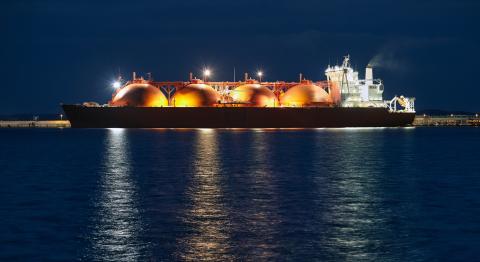
Gas power plants set European wholesale electricity prices for several hours on most days. Those prices are heavily influenced by the Title Transfer Facility (TTF), the European benchmark gas trading hub. TTF prices are tied to the global liquefied natural gas (LNG) market, which depends on the on the Persian Gulf. About a fifth of global LNG trade transits the Strait of Hormuz, almost entirely from Qatar.
The effective closure of the strait means that Asian buyers who normally receive Qatari LNG compete harder for LNG from other suppliers. European import prices rise regardless of where Europe's gas physically comes from. That is how a military blockade in the Gulf of Oman ends up in an Italian electricity bill.
Household electrification and renewables cut bills
TTF was trading at around €34 per megawatt-hour (MWh) before the conflict. It spiked above €60/MWh in March. It has since eased to around €41–42/MWh as ceasefire efforts have progressed and Asian LNG demand has softened. Gas prices remain volatile and are still around 20% above year-ago levels.
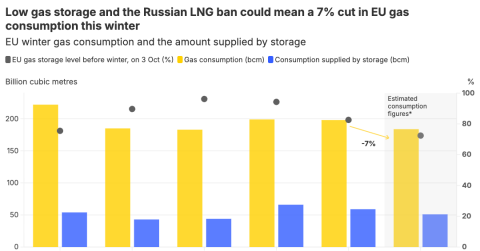
More pressingly, European gas storage entered the spring injection season at 28%, well below the 35% recorded at this point in 2025. The EU Agency for the Cooperation of Energy Regulators estimates that meeting EU gas storage targets for 2026 requires a 13% increase in LNG imports versus 2025. That looks optimistic.
When gas prices rise, electricity prices quickly follow. Gas power stations consume roughly 1.7–1.8 units of gas to generate one unit of electricity. A €10/MWh increase in gas prices therefore adds €17–18/MWh to the cost of marginal generation. Consulting firm Wood Mackenzie notes that limited fuel-switching capability in major European power markets means that a 77% increase in gas prices reduces gas generation by only 5%.
Fluctuations in wholesale electricity prices do not proportionally change household bills. Network charges, taxes and levies account for 40–70% of the typical European electricity bill. But partial exposure to wholesale prices is enough to have an impact.
IEEFA estimates that a 60% (€20/MWh) rise in wholesale electricity prices above pre-February 2026 levels would increase the average European household’s electricity bill by around €80–100 a year, varying by country. This variation reflects one variable above all: how often gas sets the electricity price. The combination of household electrification and renewable energy on the grid provides the lowest prices for consumers. In Italy, for example, gas prices will rise to €113–128 for the average household.
The calculations in the table below are not total bill increases. They are the incremental cost attributable to the ongoing energy crisis, on top of bills that were already elevated relative to pre-2021 norms. Aggregated across millions of households, they represent a significant and regressive wealth transfer from energy consumers to producers and suppliers. Industry, which typically buys electricity on shorter contracts and faces wholesale market prices more directly than households, is both more exposed and feels the impact faster.
Italy sits at the top because of two compounding reasons: gas dominates electricity price formation, and Italy has depended on Qatar for about a third of its LNG supply. The UK and Ireland are similarly exposed through their high reliance on gas for electricity generation.
Germany is in the middle. Despite strong renewables growth, Germany’s share of gas generation has barely moved in recent years because of its nuclear exit and slow coal retirement. Wood Mackenzie expects the role of gas in German power price setting to increase by 2030.
France’s existing nuclear power fleet, built between 1977 and 1999, partially shelters the country from price spikes. The country’s nuclear output grew year on year in the first half of 2025, as some nuclear plants that had previously been under maintenance came back online. Nonetheless, France recorded a 45% increase in wholesale electricity prices, indicating that nuclear power alone cannot mitigate price shocks.
Spain has made real structural progress: Sustained wind and solar deployment has weakened the link between gas and power prices, reflected in some of Europe's lowest wholesale power prices in recent years. Switzerland lies at the lower end because the high share of hydropower in the system means it sets the price most of the time.
The crisis exposes the structural problem of reliance on gas to set prices
Europe has experienced such a crisis before. Russian gas supply cuts in 2021–22 drove TTF prices to record highs and caused the largest energy cost shock in a generation. Europe responded efficiently by diversifying away from Russian pipeline gas, expanding LNG import capacity and accelerating renewables deployment. EU LNG imports rose by 27% in 2025, as pipeline supplies fell. But this has not changed the underlying electricity price-formation structure.
Gas still sets the marginal price in too many markets, in too many hours. Renewables suppress prices when they run, but they increase the system's need for dispatchable backup when they don't. Without storage or demand-side flexibility to bridge those periods, gas turbines fill the gap and price accordingly. German day-ahead power prices neared €1,000/MWh on 12 December 2024 because of low wind. That episode illustrated that the alternatives to gas remain underdeveloped.
Battery storage is growing but nowhere near the scale needed to shift marginal price setting. Pumped hydro has barely expanded across most of Europe in a decade. Demand-side flexibility remains marginal in practice. As IEEFA's recent analysis of Germany's gas dependence made clear, the investment gap is structural, not a temporary lag that the market will close on its own.
Europe's vulnerability is neither a gas supply problem nor a market design problem. The merit order system works as intended: It efficiently clears the market at the marginal cost of the last unit dispatched. The UK announced plans in April 2026 to break the link between gas and electricity prices. But this is not possible without abandoning or overriding the merit order system altogether.
The problem is that gas remains the last unit too often because it is kept artificially online. Capacity mechanisms, capex subsidies for new combined-cycle gas turbines and various forms of disguised state aid are financially sustaining plants that, exposed purely to energy-only prices and declining utilisation rates, would be loss-making and exit the market naturally.
In countries like Italy and Germany, gas sets the marginal price for only a few hundred to at most 1,500 hours a year. Yet its presence in those hours is enough to pull the annual average wholesale price significantly upward.
The crisis does not call for a redesign of the electricity market. It calls for a transparent reckoning with the public subsidies propping up uneconomic gas capacity and the political will to let market fundamentals do their job.
Figures model a sustained €20/MWh wholesale electricity increase relative to pre-February 2026 levels.
Country estimates apply two adjustments: the energy commodity share of the retail bill sourced from Eurostat Electricity Price Statistics and an assessment of how frequently gas sets the marginal price in each market based on data from Wood Mackenzie and the International Energy Agency.
IEEFA’s estimate of how often gas sets wholesale electricity prices is based on the following. In markets where gas generation accounts for a large and structurally persistent share of the dispatch stack, such as Italy, Great Britain and Germany, a wholesale gas shock transmits to power prices with high regularity and limited attenuation. In markets where renewables or nuclear have displaced gas from the margin across a larger share of hours, such as France and Spain, the same gas price shock produces a smaller average wholesale electricity response, and therefore a smaller retail bill impact. This frequency-of-price-setting effect is not captured by Eurostat's retail bill breakdown alone, which reflects the structural share of the energy component but not its sensitivity to gas movements. The combined adjustment is therefore an IEEFA modelled estimate and should be read as indicative. All estimates are indicative ranges and do not account for potential government interventions. Generation mix data are from the European Network of Transmission System Operators for Electricity’s Transparency Platform and the UK government.

Related Content