Green budgeting can help Jharkhand integrate climate and Just Transition priorities into fiscal planning, public investments
Over time, the framework could move beyond reporting to inform fiscal planning, investment decisions and policy choices
Key Takeaways:
Jharkhand can use green budgeting to track how much of its annual spend supports climate goals. Aligning the proposed ‘green budgeting framework’ with the draft Framework of India’s Climate Finance Taxonomy strengthens policy consistency and credibility.
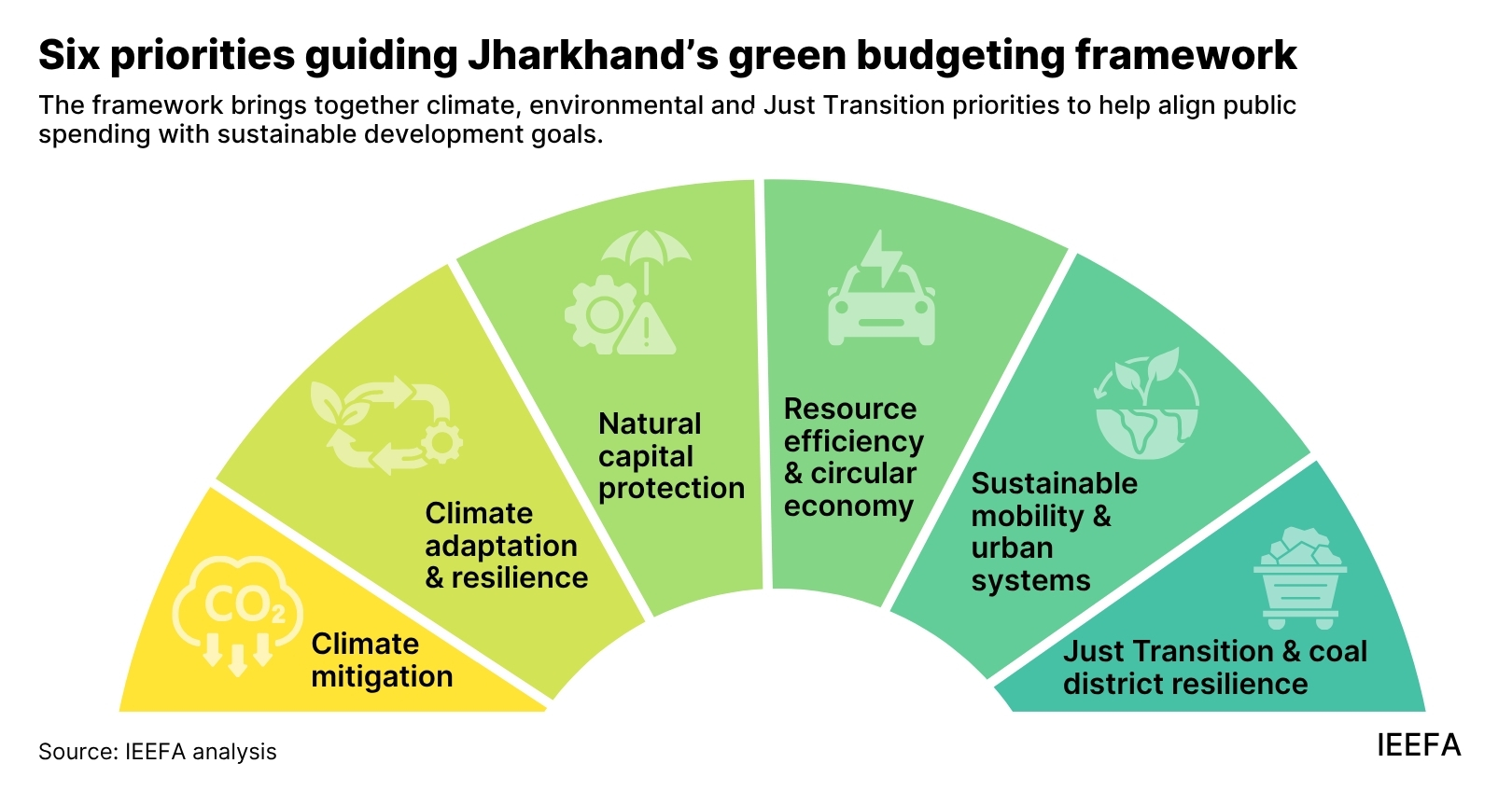
The framework is built around six objective areas: Climate mitigation; climate adaptation and resilience; natural capital protection; resource efficiency and circular economy; sustainable mobility and urban systems; and Just Transition and coal district resilience. These reflect international green budgeting practices and priorities specific to Jharkhand.
A green budgeting cell within Jharkhand’s Department of Finance, supported by the Task Force on Sustainable Just Transition and an independent expert panel, will provide a credible governance structure.
Starting with an annual green budget statement and a green budget portal, Jharkhand can use the framework to make green budgeting not just a reporting exercise, but also a tool that informs medium-term fiscal planning, public investment, and policy decisions.
25 August 2026 (IEEFA): Jharkhand has significant potential to become a frontrunner among Indian states in green public financial management by adopting a green budgeting framework that integrates climate, environmental and Just Transition considerations into government spending and planning.
A new report, titled ‘A Green Budgeting Framework for Jharkhand’ — developed by IEEFA in collaboration with the Government of Jharkhand’s Task Force on Sustainable Just Transition — provides a roadmap for advancing green budgeting in the state.
The framework is built around six thematic objectives. These include climate mitigation; climate adaptation and resilience; natural capital protection; resource efficiency and circular economy; sustainable mobility and urban systems; and Just Transition and coal district resilience.
A central feature is a budget-tagging methodology that goes beyond simply classifying spending as ‘green’ or ‘non-green’. It groups public expenditure into five categories based on its environmental relevance: Green positive (G+), transition enabling (T), enabling or systemic (E), neutral (N), and brown or negative (B). This also allows different components of many public schemes to be assigned coefficients based on the strength of their environmental contribution. The framework additionally proposes a ‘Just Transition flag’, which would identify expenditure directly supporting coal districts, fossil fuel-dependent communities, displaced workers and other populations affected by structural economic change.
The report recommends a phased approach for implementation where the initial stage would focus on piloting expenditure tagging in selected departments and preparing an initial green budget statement. Subsequent stages would expand coverage, strengthen institutional arrangements and data systems, and eventually integrate green budgeting into medium-term expenditure planning, public investment decisions and independent evaluation.
“Green budgeting can help Jharkhand move beyond viewing climate and environmental expenditure as a separate category and instead embed these considerations into routine fiscal decision-making,” says Gaurav Upadhyay, Lead Energy Finance Specialist, India Just Transition at IEEFA – South Asia, and a co-author of the report. “A phased approach would allow the state to build institutional capacity, improve data systems and refine its methodology over time.”
The framework also calls for an annual green budget statement published alongside the state budget, and for establishing a green budget portal to improve transparency and public access to methodologies, classifications and data.
The immediate priority, the report urges, is to establish a green budgeting cell and issuing a budget circular enabling pilot tagging across select departments such as energy, agriculture, rural development, and forest. Lessons from the initial exercise could then inform the expansion of green budgeting across the state government. Over time, the framework could also extend the assessment beyond conventional budgetary expenditure to include resources such as District Mineral Foundation funds and other extra-budgetary sources.
“A green budgeting framework could improve the quality, resilience, and long-term sustainability of public spending, and help Jharkhand manage the economic and fiscal implications of environmental change, while advancing inclusive growth and safeguarding people’s livelihoods,” says Ajay Kumar Rastogi, Chairperson, Government of Jharkhand’s Task Force on Sustainable Just Transition.
The report draws on international practices and frameworks developed by the European Union (EU), the Organisation for Economic Co-operation and Development (OECD), and other institutions. Several countries across different income levels and institutional contexts have adopted green budgeting approaches tailored to their national circumstances. These examples demonstrate that green budgeting is not a one-size-fits-all tool, but a flexible framework that can be adapted to different fiscal structures, development priorities and institutional capacities.
“India has made efforts over the past decade to integrate climate and environmental considerations into public finance,” says Vibhuti Garg, Director, IEEFA - South Asia. “While a formal national green budgeting framework is yet to be established, several initiatives have laid the groundwork for such an approach, reflecting the increasing recognition that public expenditure must be better aligned with environmental priorities to meet the country’s climate and sustainable development goals.”
Read the report: A green budgeting framework for Jharkhand
Media contact: Prionka Jha ([email protected]); +91 9818884854
Author contact: Gaurav Upadhyay ([email protected]), Shantanu Srivastava ([email protected])
About IEEFA: The Institute for Energy Economics and Financial Analysis (IEEFA) examines issues related to energy markets, trends, and policies. The Institute’s mission is to accelerate the transition to a diverse, sustainable and profitable energy economy. (ieefa.org)