Assessing Alberta’s proposed West Coast Oil Pipeline

Uncertain utilization and unfavourable economics
Key Takeaways:
IEEFA’s analysis of future supply scenarios and global market conditions challenges the notion that the West Coast Oil Pipeline can be justified based on capacity need.
Brownfield pipeline expansion projects can accommodate forecasted production growth at lower costs with higher degrees of execution uncertainty.
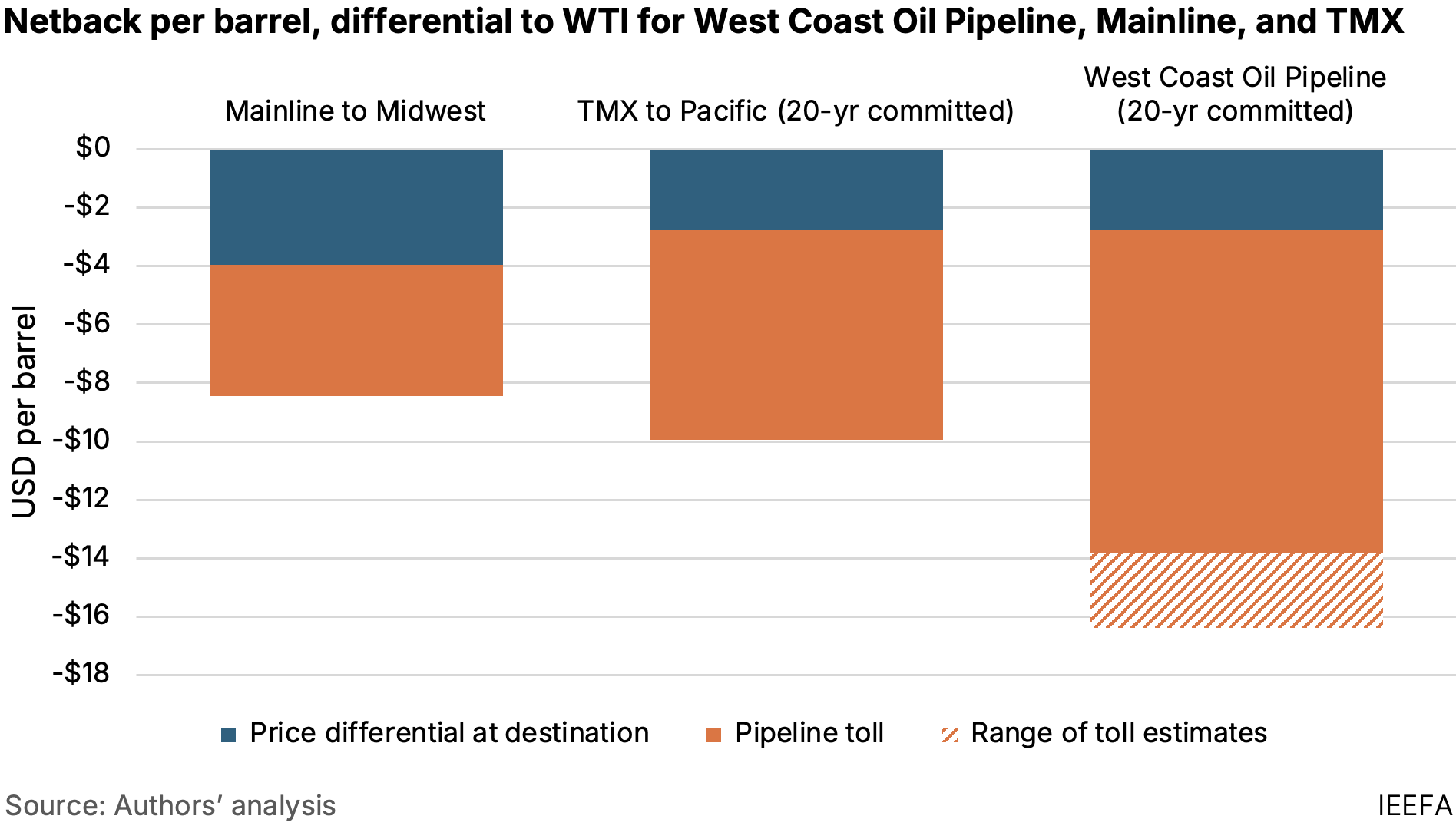
The West Coast Oil Pipeline’s tolls are likely to be significantly higher than existing pipelines, and the project would likely represent a net loss to the industry.
Even if oil exported to the Pacific can achieve a premium, this is unlikely to translate to WCS prices, and high tolls would mean lower netbacks for producers.
September 1, 2026 (IEEFA) – The Government of Alberta is proposing a pipeline that could transport 1 million barrels of crude per day between Alberta and the West Coast of British Columbia, but the latest Institute for Energy Economics and Financial Analysis (IEEFA) report finds that the project is not needed to meet future capacity needs. The report also finds the ongoing energy transition is likely to continue to significantly slow oil demand growth.
Due to the high projected cost of construction, tolls on the pipeline would be much higher than those on existing pipelines. Additionally, existing pipelines and other proposed, lower-cost expansion projects will likely be sufficient to meet forecasted demand. Global oil demand is expected to peak by 2030—well before the pipeline would come into service—and advances in technology could push demand into long-term decline faster than currently expected.
“The oil sector plays a major role in the economy of Alberta and Canada, and decisions around its future must account for a complex landscape of issues,” says Mark Kalegha, IEEFA energy finance analyst and co-author of the report. “The global energy sector is undergoing significant changes, and both the ongoing trade war with the United States and the economic effects of the current Iran conflict have highlighted the importance of economic diversification. It is becoming more and more clear that diversifying the energy economy in Canada towards renewables will be economically advantageous while providing energy resilience.”
The large commitments required to support the West Coast Oil Pipeline may harm rather than secure future returns for Alberta’s oil industry as wider market conditions required to support rapid output growth appear unlikely. The large public investments proposed in the pipeline are also likely to be exposed to significant execution risk.