Hail Creek coalmine extension an unmitigated risk
Key Findings
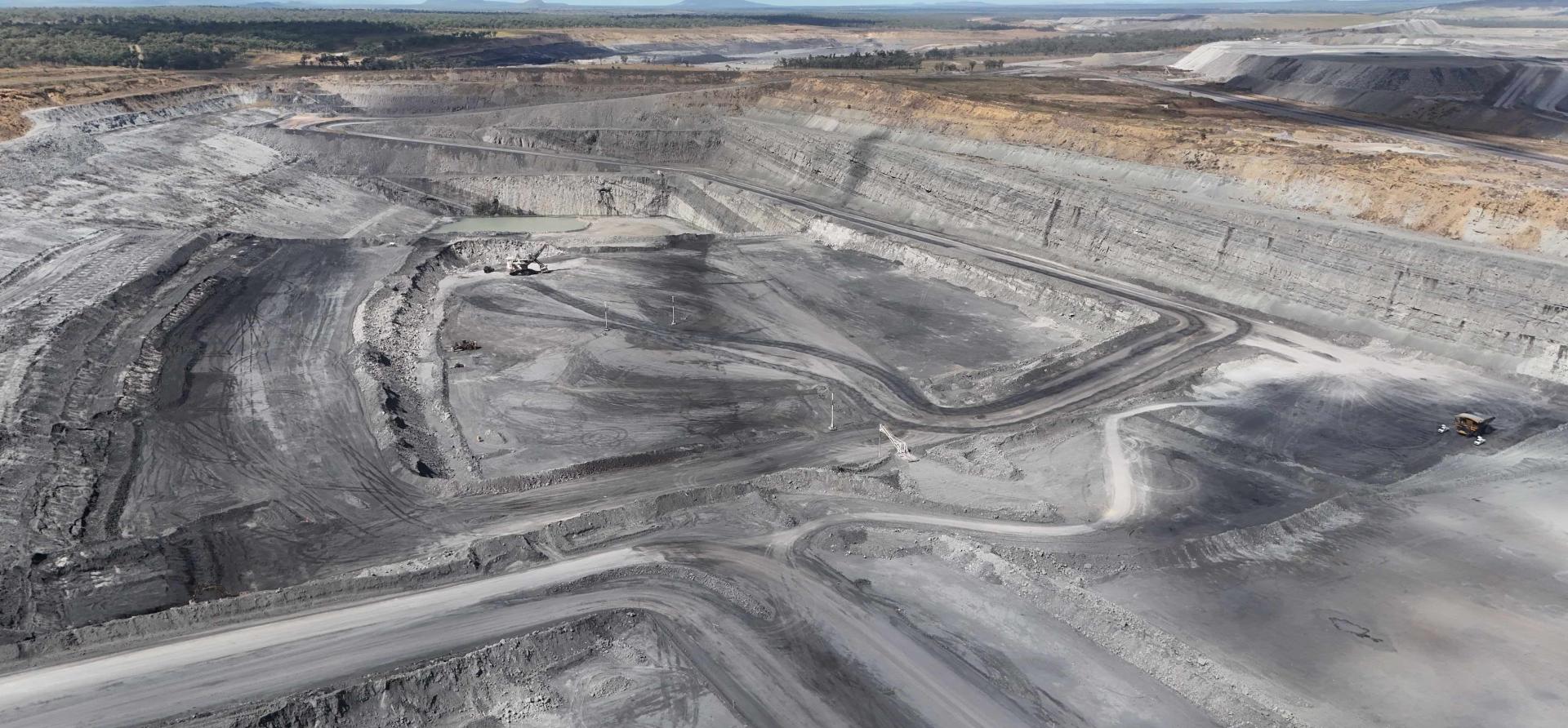
Hail Creek coalmine in Queensland is the gassiest open-cut coalmine in Australia, emitting methane at a rate on par with typical underground coalmines.
Hail Creek’s extension proposal makes no commitment to reduce its emissions, either from methane or diesel use, despite the mine appearing well suited for methane pre-drainage.
The Queensland government should at a minimum ensure that strong emissions reductions are imposed on the mine as a condition of approval.
This analysis is for information and educational purposes only and is not intended to be read as investment advice. Please click here to read our full disclaimer.
Hail Creek coalmine in Queensland’s Bowen Basin – 85% owned by Glencore – is seeking approval to operate until 2038. The state government is due to decide on the four‑year extension – to mine up to 28.9 million additional tonnes of coal – on 17 February.
With ~1.4 million tonnes a year (Mtpa) of direct (Scope 1) emissions, Hail Creek is the highest emitting open-cut coalmine in Queensland, with double the emissions of any open-cut mine in Australia. (Under recent changes to the National Greenhouse and Energy Reporting [NGER] scheme, some mines, including Hail Creek, have moved from Method 1 to Method 2 for reporting methane emissions. Others are expected to follow in April.)
An aerial survey by the United Nations Environment Programme (UNEP) found methane emissions at Hail Creek were three to eight times higher than Glencore was reporting under Method 1. When the mine adopted Method 2 in 2024, its reported methane emissions rate increased threefold. If the UNEP survey results prove accurate, methane emissions could still be underreported by two to three times. Glencore disputes the findings, arguing among other matters, that extrapolating a small sample of observations is not representative of the mine’s overall performance.
Nonetheless, at 0.1366 tonnes of carbon dioxide equivalent (tCO₂e) per tonne of coal, Hail Creek’s official reported Scope 1 emissions intensity for FY2023-24 equates to a typical underground coalmine, which are much more emissions intensive. Of Glencore’s 13 operating open-cut and underground coalmines in Australia, Hail Creek has the highest emissions intensity. About 75% of its emissions are methane, with diesel making up the remaining 25%.
No commitment to reduce emissions
The main option to reduce methane emissions in open-cut coalmines is to drain methane before mining. This is often required at underground mines for safety purposes; the methane is pre-drained and flared, or better still, used for power generation etc. Glencore operates methane drainage and utilisation at its Oaky Creek underground mine, the company’s second-highest emitter.
The Net Zero Commission recently reported: “Developments in directional drilling and site-specific gas resource assessments are enabling pre-concept studies and trials for gas drainage at open cut mines to emerge”. Hail Creek estimated its site-specific fugitive emissions by carrying out drilling from 2022 to 2024 and gas testing and analysis last year. The resulting Gas Assignment Model report, as summarised in Glencore’s response to DETSI requests, would provide a solid basis for a gas drainage feasibility study. The site may be well suited to methane abatement – both the existing mine and the project extension area. Only two seams are mined there rather than up to 15 at its Hunter Valley Operations (HVO), another open‑cut mine where Glencore has argued pre‑drainage is not economically viable. An expert review of open‑cut pre‑drainage concluded that surface‑to‑inseam drilling “works best with one or two thick and gassy target horizons” – the same configuration as Hail Creek.
Despite a request for additional information in 2024, “the applicant should thoroughly investigate the feasibility of pre-drainage, which is the most significant opportunity for the site to reduce its methane emissions”, no such study has been detailed. Instead, Hail Creek’s Draft GHG Abatement Plan outlines a business as usual approach, including: operational control efficiencies, scheduling activities, and continuing to assess technologies to improve efficiencies and reduce emissions – where reasonable and feasible to do so.
Instead, Glencore proposes to start a gas drainage feasibility study within two years of gaining approval for the Hail Creek extension, with no timeline given to complete the study. Pre-drainage, as its name suggests, must occur before mining starts. If Glencore were to complete the study in 2028, with a view to constructing the infrastructure by, say, 2030, it would compromise cost recovery of the investment by the mine’s closure in 2038, rendering pre-drainage uneconomic.
On diesel emissions, the story is similar; there are options, but they are not being pursued.
Glencore cites a study it conducted into alternatives to diesel power, which examined grid‑supplied catenary systems for diesel‑electric trucks, tethered electric machines, B20 biodiesel and hydrogen fuel cells. Yet two important technologies are missing: battery‑electric haul trucks and the use of captured methane as an energy source for heavy mobile equipment.
While the company notes its longstanding use of electric draglines and electric shovels, it makes no commitment to their future use. At its HVO mine, Glencore has already replaced electric draglines with diesel equipment due to climbing strip ratios (the amount of material mined per tonne of coal). Extended truck haul distances with the mine extension will also add to diesel emissions.
Elsewhere, Fortescue is forging ahead with its first mine due to be fully electrified this year. It expects battery‑electric haul trucks to reach total ownership cost (TOC) parity with diesel trucks, which consume 1 million litres of fuel a year each, by 2030.
Growing emissions gap in Safeguard Mechanism
Under the federal Safeguard Mechanism, the extension would require Hail Creek to reduce or offset some of its emissions through carbon credits. Glencore outlines the projected emissions from the mine in Appendix C of its GHG Abatement Plan, and notes that it faces a declining baseline allowance under the Safeguard Mechanism.
The quantity of carbon credits required is calculated by multiplying the run-of-mine (ROM) coal production by the emissions intensity gap (shaded area in figure below).
The figure indicates a growing emissions-intensity gap. In FY2023-24, Hail Creek surrendered 192,103 carbon credits to meet its emissions obligations. If approved, Glencore estimates the mine will produce an average of 1Mtpa of Scope 1 emissions for the remaining 13 years of its operational life. Against a declining baseline, it will be required to relinquish a total of 6.4 million credits if the extension proceeds. The reliance on credits grows exponentially, starting at 16% of its baseline in FY2023-24 to 94% by FY2029-30.
Time to impose conditions on approvals
In Queensland, methane emissions from coal and gas are regulated by the Department of the Environment, Tourism, Science and Innovation (DETSI) under the Environmental Protection Act 1994. DETSI can impose conditions beyond standard requirements to avoid, minimise or manage environmental harm. However, a 2023 review of environmental authority (EA) applications found none of these conditions specifically required methane monitoring and mitigation.
While met coal exports are an important contributor to the Queensland economy, consideration should be given to the merits of extending the largest emitting met coalmine in Queensland on an unabated basis.
Instead of an unconditional extension that locks in a high methane footprint and rising offset costs, IEEFA recommends any EA amendment contain the following conditions for the entire mine, including any extension:
- Follow-up aerial surveys to validate the earlier top-down methane measurements by UNEP.
- A technical feasibility study and staged pre‑drainage trial, with clear performance milestones, before mining in extension areas proceeds.
- A marginal abatement cost curve for methane, comparing utilisation options such as power generation, use in gas-powered haul trucks, or joint development via gas sales with the overlapping petroleum tenure holder to identify highest-value pathways.
- An application for Low Emissions Investment Partnership (LEIP) support for methane abatement, including accelerated feasibility and pilot trials, leading to FID within two years.
- A capital investment plan outlining fleet‑replacement trigger points, and identifying where lower‑emissions technologies (such as battery EVs or methane‑fuelled equipment) could be adopted. This would be updated as part of the annual life of mine planning process.
Hail Creek is the most emissions‑intensive open‑cut coalmine in Australia, with methane levels akin to an underground mine. Methane abatement is both critical and feasible. It is technically possible, but it does require policy support to incentivise action. Similarly, reductions in diesel use are possible, through clean fuel substitution or accelerated mining equipment electrification.
Glencore considers neither approach practical nor feasible for implementation. Rather than investing in structural emissions reductions, the plan effectively treats emissions as a cost of doing business. It has shown no real progress towards mitigating GHG emissions.
A question for the Queensland government is: Does it view federal offset requirements under the Safeguard Mechanism as sufficient environmental management for Queensland, or should Queensland impose independent emission reduction conditions to avoid real emissions and progress the state’s emissions reduction agenda? Whether the coalmining sector – including Hail Creek – is required to contribute to the state’s legislated target of 75% emissions reduction by 2035 remains to be seen. The outlook for emissions is not off to a great start in 2026. Two of the state’s biggest polluting mines – Moranbah North and North Goonyella – have just restarted after long shutdowns caused by methane fires. New gas fields are being opened in Queensland. The state’s resources sector emissions are now rising instead of falling. This may explain why the government has postponed releasing its emissions reduction plans from 2025 to 2030.
If Queensland approves this extension without binding methane- and diesel-reduction conditions, it is not just missing a chance to decarbonise one of its dirtiest mines, it sets a precedent that offsets can substitute for action even where practical abatement is available.

Related Content