BHP: Time to get real about steel technology change and met coal
Download Briefing Note
View Press Release
Key Findings
BHP is prioritising steel technology developments that suit its metallurgical (met) coal and blast furnace-grade iron ore production, but which look unlikely to contribute meaningfully to steel decarbonisation.
Carbon capture, utilisation and storage (CCUS) is making negligible progress in blast furnace-based steelmaking, will not secure the outlook for BHP’s met coal, and fails to address coal mine methane emissions.
BHP’s key met coal importer India is continuing to reduce reliance on Australian coal, and growing energy security concerns provide incentives for it to rely more on its domestic coal as well as steel technologies that don’t use coal at all.
Direct reduced iron (DRI)-based steelmaking is making far more progress than CCUS and is the leading route for steelmaking emissions reductions. BHP should make DRI-based technology its development priority, as well as being more transparent about the future of its met coal business.
Executive summary
This analysis is for information and educational purposes only and is not intended to be read as investment advice. Please read our full disclaimer.
BHP will welcome a new CEO on 1 July, creating an opportunity for the company to reset its strategic approach to steel decarbonisation, according to new IEEFA analysis.
The arrival of Brandon Craig brings the potential for the mining giant to shift its current stance on steel technology change and metallurgical (met) coal. In IEEFA’s view, BHP needs to adopt more realistic pathways for reducing steelmaking emissions.
BHP remains a laggard when it comes to decarbonising steelmaking. Its Scope 3 emissions are huge, and rising, reaching 378 million tonnes (Mt) in FY2025, and it remains out of step with its peers in its approach to emissions reduction. The question is whether this will change under its new CEO.
BHP has acknowledged the significance of its role in the steel industry’s transition towards cleaner processes. However, the company appears to be prioritising technological pathways that involve the continued use of the met coal and blast furnace-grade iron ore that it produces, with a high reliance on carbon capture, utilisation and storage (CCUS). IEEFA believes this is unlikely to contribute meaningfully to steel decarbonisation.
BHP has been advocating for CCUS as a solution for years. However, the technology has made a distinct lack of progress in the steel sector. There are still no commercial-scale CCUS plants for met coal-based steelmaking anywhere in the world.
This lack of progress mirrors the status of CCUS across other sectors. Faced with multiple issues including disappointing capture rates, high transportation cost, doubts over storage site availability and security, as well as the overall cost. The International Energy Agency (IEA) continues to downgrade the role CCUS will play in emissions reduction.
BHP’s focus on CCUS also does little to address the growing issue of coal mine methane, which adds significantly to global steelmaking emissions and is increasingly a risk and a concern for major investors.
Alongside the questionable efficacy of CCUS, BHP’s decarbonisation plans seem to hinge on expectations of sustained long-term demand for met coal, primarily from India. However, IEEFA’s analysis suggests that, while India’s steel demand is set for strong continued growth, it is not certain that Australian coal miners will benefit.
India’s steel sector already faces strong incentives to address growing energy security risks by prioritising the use of domestic coal and diversifying its import sources, reducing its reliance on Australian coal. In the longer term, the outlook for BHP’s met coal looks even dimmer, as other steelmaking routes – such as the use of green hydrogen or a shift to scrap steel recycling – gain momentum.
India is diversifying met coal imports away from Australia
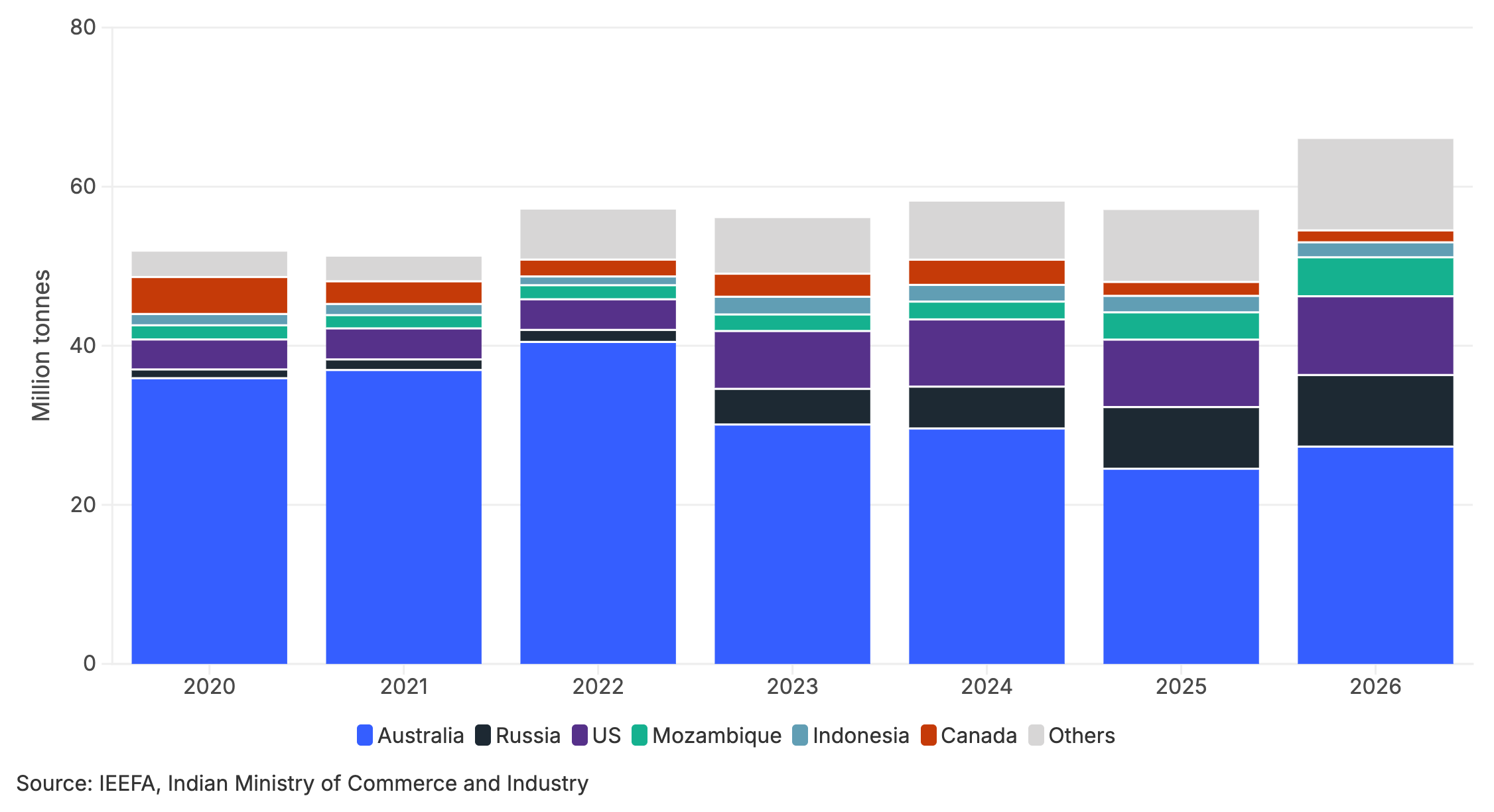
Source: Indian Ministry of Commerce and Industry, IEEFA.
These developments point to a significant risk that long-term Indian demand will fall short of expectations. IEEFA believes the outlook for Australian met coal is not as positive as BHP suggests.
While IEEFA’s analysis raises questions about the viability of BHP’s decarbonisation strategy, it also highlights alternative pathways that offer more promise. Direct reduced iron (DRI)-based steelmaking has emerged as the most promising technology for steelmaking emissions reductions. A mature technology used at commercial scale globally, DRI reduces iron ore using gas or green hydrogen, eliminating the need for coal-consuming blast furnaces. However, solutions need to be developed that allow the use of BHP’s lower-grade supply in DRI-based steelmaking. BHP is involved in this development but seems more focused on CCUS
In IEEFA’s view, BHP should prioritise efforts to develop DRI technology that is compatible with its blast furnace-grade ore. The handover to a new CEO is an opportunity for BHP to take a more realistic approach to these trends.

Related Content