Cost of coal plant emergency orders already more than $300 million
Key Findings
Ratepayers face at least $300 million in extra costs because of a series of U.S. Department of Energy orders to keep coal- and oil-fired power plants open.
More than 20 orders have been used to prevent the retirement of aging, uneconomic coal units, including some that are currently inoperable.
All of the coal burned at the agency’s behest accounts for less than 1% of the 350 million tons of coal used across the U.S. to produce electricity during the same period, and nearly all of it has been used at a single Michigan plant.
In January 2026 alone, U.S. coal consumption fell by more than 6 million tons from the previous year—twice as much as all the coal used under the emergency orders.
Measures have done little to help the coal industry
A year into the administration’s effort to prevent the closure of coal-fired power plants using emergency orders, an IEEFA analysis has found that ratepayers are already facing at least $300 million in extra costs through mid-May.
These costs are rising by more than $30 million per month, and could soar much higher if extensive repairs are made at some units. At the same time, coal mining has barely benefited: The total amount of coal used by the plants under the emergency orders amounted to less than 1% of the coal used by all U.S. plants to produce power in the same period.
The extraordinary approach used by the Department of Energy (DOE) has been to issue more than 20 emergency orders under section 202(c) of the Federal Power Act. The act is intended to ensure “electricity generation and transmission during critical situations like war or energy shortages.” However, as wielded by Energy Secretary Chris Wright, a former oil and gas industry executive, the 90-day orders have been used almost exclusively to prevent the retirement of aging, uneconomic coal units—some of them currently inoperable—by the electric utilities that own them. Yet the plant owners, state regulators, and power grid operators all refute the DOE’s characterizations of power emergencies, citing years-long planning to provide replacement power and the cost and unreliability of the units being closed.
The costs are rising in many ways.
The first plant hit with the emergency orders was J.H. Campbell in Michigan, a three-unit, 1,331-megawatt (MW) facility owned by Consumers Energy. Originally scheduled to close at the end of May 2025, Consumers says it has cost at least $185 million to keep it open for the 10 months through March 31—and that figure could rise as much as $90 million more by the time the current emergency order expires on Aug. 16. Executives have said they expect the orders to continue for the duration of the Trump administration, and the costs will keep growing as a result.
Many of the units covered by the orders have generated power only rarely, but they continue to incur expenses for maintenance and repair, fuel storage, pollution-control supplies, employee retention, property taxes, and higher legal and corporate costs involved with complying with the federal orders. For example, TransAlta, the owner of the Centralia plant in Washington, said these fixed costs totaled $19.9 million, or $6.2 million a month, for the first three-month emergency order that ended March 16. Through mid-May, IEEFA estimates those costs have risen to $33.1 million, two months into a second emergency order that runs through June 14. So far, it appears the plant has not run at all since December, which is a good thing for consumers: TransAlta says generating electricity at the plant will initially cost $83.44 a megawatt-hour (MWh) before rising to $113.49. That’s far higher than the $27.60/MWh wholesale average price in the Northwest in the first quarter, according to the Energy Information Administration (EIA).
For utilities, the retirement of any power plant is an economic decision designed to save the company and ratepayers money as they shift electricity generation to more efficient, more cost-effective, and more reliable sources of power. Such decisions are driven by long-term planning processes supervised by state regulators that have jurisdiction over utilities that provide power to customers.
As a coal plant ages, it needs increasingly frequent and expensive repairs. Companies usually choose to save money for themselves and ratepayers by putting off maintenance as a planned closure date approaches, knowing the unit will no longer be needed. But the DOE’s emergency orders have upended long-term planning, forcing utilities to make at least some of those expensive repairs to get the affected facilities back into service. Worse, the money spent is usually not enough to substantially improve reliability or efficiency, and the plants are unlikely to continue operating once the emergency orders are lifted. In other words, the orders are resulting in extremely high short-term costs with little long-term benefit for ratepayers.
CenterPoint Energy’s F.B. Culley coal plant in Indiana is a good example. DOE issued an emergency order on Dec. 23, 2025, to prevent the retirement of the plant’s 90-MW Unit 2, which began commercial operation in 1966. In response, CenterPoint wrote to the Department of Energy in February that the unit was so unreliable that it was only fully available to run for five of the first 48 days under the emergency order—and it was not asked to run during those five days by MISO, the grid operator. The company said it would cost between $16.5 million and $20.5 million and take at least four weeks of downtime for maintenance to prevent “an increasing risk of catastrophic mechanical failure.” Asking the DOE to not issue another emergency order, CenterPoint wrote: “Extending the life of Unit 2 is neither practical nor financially responsible, underscoring the need for a more prudent and economically sound path forward.” Ignoring the request, the DOE issued a new order anyway, covering March 24 through June 21. The order required the company and MISO “to take all measures necessary to ensure that Unit 2 at the F.B. Culley Generating Station in Warrick County, Ind. is available to operate.”
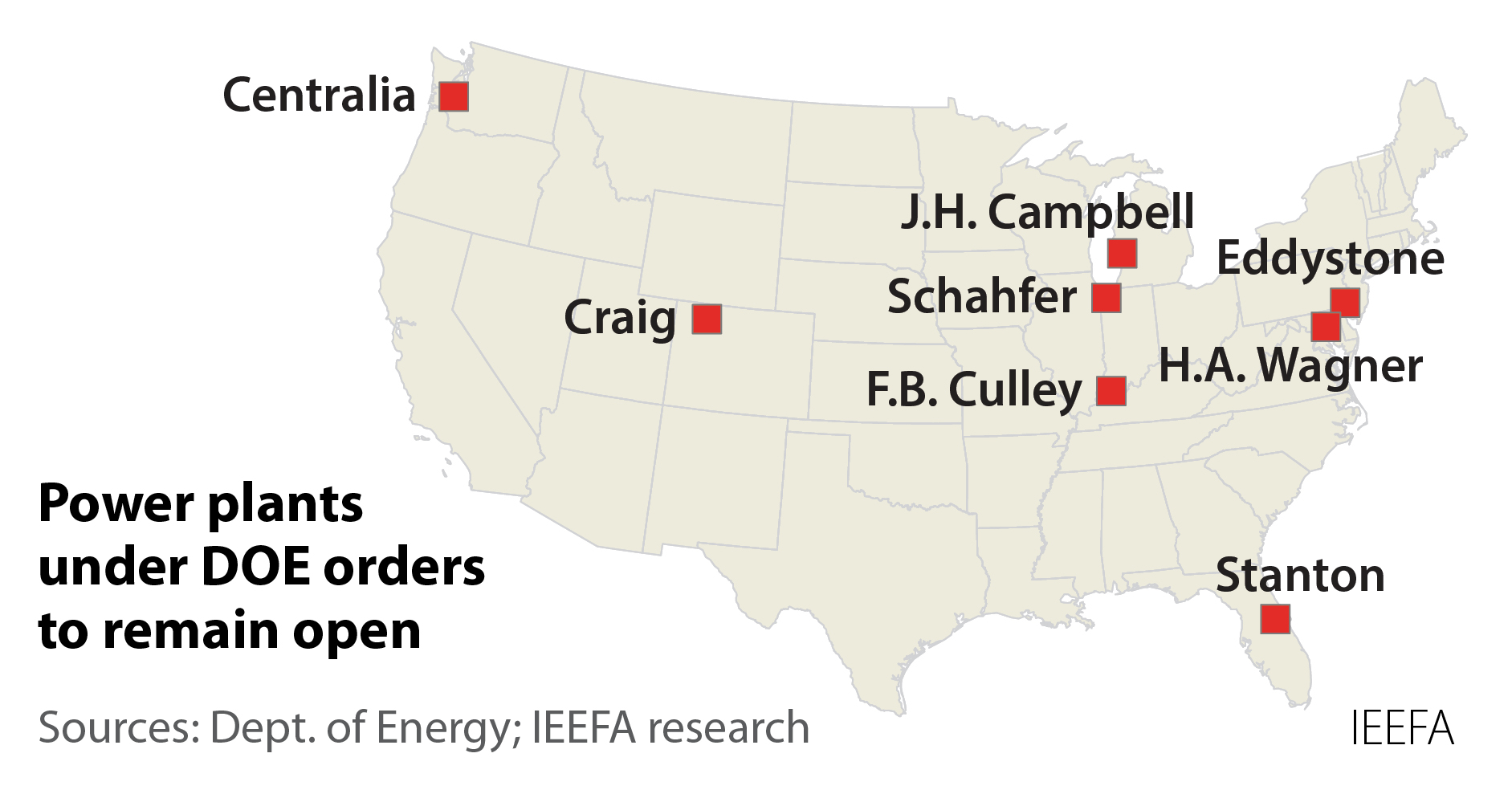
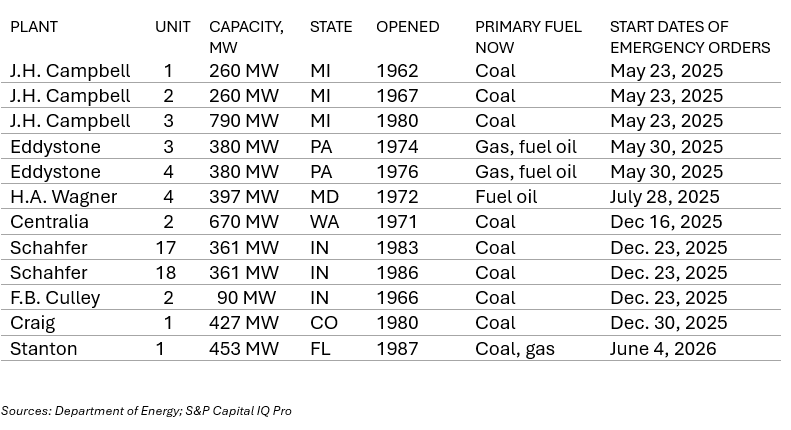
As of June 5, the energy department had issued 22 emergency orders for eight different power plants, requiring 12 individual generating units to stay open. The latest, announced June 4, was for the 453-MW Unit 1 at the Stanton coal plant in Orange County, Fla. The owners, led by the Orlando Utilities Commission, had planned on putting the unit into cold shutdown at the end of May. Not all of these units burn coal, as shown in Table 1:
Table 1: Generation units covered by Department of Energy emergency orders to remain operational (Orders currently in effect)
The operating problems with Cully Unit 2 are not unique among this group, which might be surprising for a set of plants ordered to stay open to “ensure grid reliability” during “critical situations ... like energy shortages.”
The Northern Indiana Public Service Co. (NIPSCO) had planned to close the Schahfer plant by the end of 2025. Unit 18 had not run since early July 2025, more than five months prior to the Dec. 23 emergency order—and still had not run through at least March 31, 2026, according to the most recent data available.
A similar story is unfolding at the Craig plant in Colorado. The 45-year-old Unit 1 was slated for retirement by the end of December by its owners, including Tri-State Generation and Transmission (the plant operator), the Salt River Project, PacifiCorp, and the Platte River Power Authority. The last full day the unit ran was Dec. 16; the emergency order to stay open was issued on Dec. 30. In January, Tri-State and Platte River requested a rehearing on the DOE’s order, saying that it “requires the operation of an uneconomic resource and disrupts ordinary and orderly planning, development and investment in generation resources.” The utilities protested that “Craig Unit 1 is not necessary for ensuring reliability, and that “it is our members that ultimately are going to pay for the cost of this order.” In addition to costing more than $1 million a month to operate, Tri-State was forced to spend money to repair an issue that otherwise would not have been needed so close to the closure date. Through March 31, Craig 1 had not run again.
The emergency orders are costing consumers daily and have not measurably improved system reliability. But have they helped the coal industry, clearly one of the main objectives of the policy? The surprising answer is very little, and the orders have underscored just how uneconomic coal-fired generation is today.
With most units sitting idle most of the time, either unable to operate because of mechanical problems or unable to compete economically in competitive electricity markets, it means they are simply not burning coal. Just one plant, J.H. Campbell, accounted for 93% of the 3.03 million tons of coal used under the orders between June 2025 and March 2026.
Three million tons may seem like a lot, but it is just 0.86% of the 350 million tons of coal used across the U.S. to produce electricity during the same period. It’s also small compared with changes in coal consumption driven by factors like weather, fuel prices, and competition from cheaper sources like wind and solar. In January 2026 alone, U.S. coal consumption fell by more than 6 million tons compared to January 2025—twice as much as all the coal used under the emergency orders.
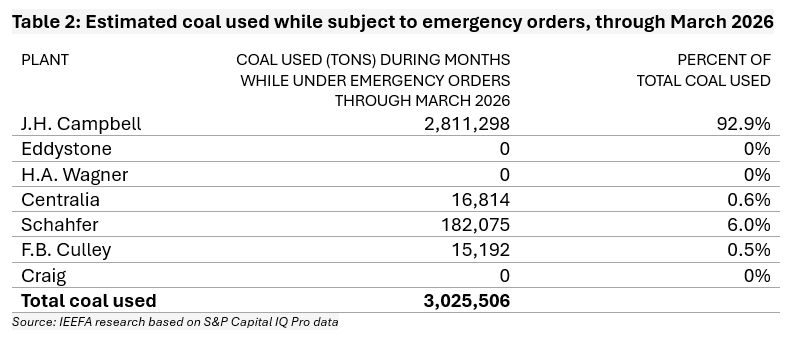
Given the operational problems facing many of the targeted plants, it is hardly surprising that aside from the Campbell plant, very little coal has been used due to the emergency orders. For a policy touted as a lifeline for the coal industry, though, the approach is baffling.
Although the cost of the administration’s emergency orders has not yet shown up on electric bills, utilities are spending real money to comply with them, and the financial damage is adding up quickly. Electricity consumers are already facing more than $300 million in unnecessary charges with little power generation to show for it, and there is no end in sight.
Related Research