
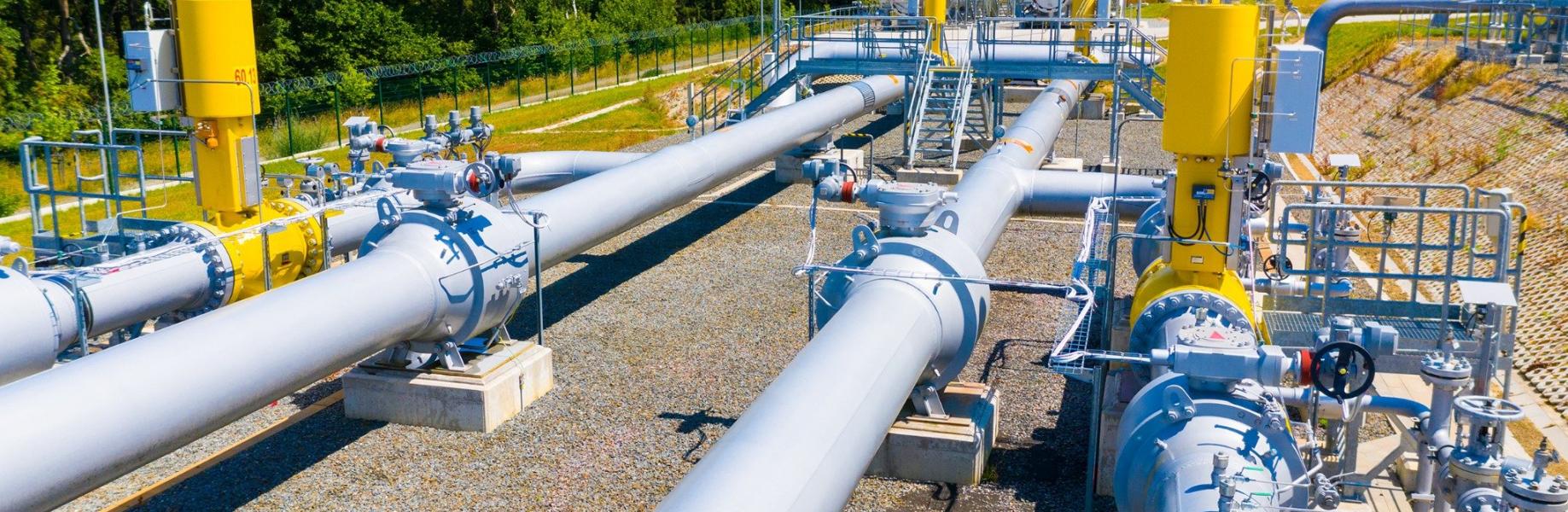
Rethinking Germany's hydrogen-led transition / Chapter 2
The fiscal wager behind Germany's hydrogen-led transition
Key findings
The regulated cost base of Germany’s planned hydrogen network exceeds €50 billion, far higher than the often-cited €19.8 billion construction cost.
The financing model for the core network assumes near-full utilisation by 2040. Under a plausible limited-demand scenario, at least €34.7 billion in unrecovered costs would fall to the state by 2055.
Raising pipeline tariff caps in response to low utilisation is not a viable solution. The increases required to recover costs would suppress demand faster than they raise revenue.
As hydrogen demand lags, policy is expanding to protect pipeline utilisation. A shift to blue hydrogen would deepen Germany’s gas dependency, expand infrastructure exposure and risk open-ended demand subsidies tied to uncertain hydrogen prices.
Energy transitions are not just technological projects. They are financial bets on how quickly new markets will develop, with clear consequences for who pays when expectations fall short. Those consequences are rarely visible in headline investment figures or policy announcements. Instead, they emerge from the financial engineering that enables infrastructure to be built ahead of demand.
How is Germany financing its hydrogen network?
Germany is financing its hydrogen network using a regulated cost-recovery model. This means network operators build the infrastructure and recover their costs over time through fees charged to users. But hydrogen is not yet an established market, and early demand is expected to be low. The fees required to cover costs would be too high to support uptake.
To address this, fees are capped and shortfalls are deferred into a state-backed credit facility known as the amortisation account. This allows infrastructure to be built ahead of demand, with repayment pushed into the future when the market is more mature.
If hydrogen demand grows quickly, this model works as intended: The pipeline fills, revenues grow and public backstops remain theoretical. If it does not, deferred costs remain unpaid and shift onto the public balance sheet. If the amortisation account is not settled by 2055, at least 76% of any outstanding balance falls to the state, meaning taxpayers rather than users carry the burden.
This wager is unusually large in Germany, where national transition planning puts low-carbon hydrogen at the centre of industry, power and infrastructure. Under a rapid hydrogen ramp-up, costs can be recovered from users over time. Under weaker uptake, the same financing mechanisms shift risk onto the public balance sheet. Total system costs might not grow significantly, but who foots the bill can change markedly.
This type of financial engineering is common to the energy transition, where it helps mobilise private capital before markets are fully formed. It has worked well for wind and solar, where end demand is effectively guaranteed and long-term cost trajectories are not only predictable but largely favourable. Hydrogen inherits the same financial design but without these stabilising features. Higher upfront costs, uncertain demand and unresolved competitiveness issues significantly increase downside risk borne by the state.
A cautionary fiscal tale: LNG and Deutsche Energy Terminal
Germany’s recent liquefied natural gas (LNG) expansion provides a concrete illustration of how this architecture behaves when infrastructure is built ahead of demand that never arrives. Germany commissioned LNG terminals rapidly under emergency conditions, backed by fixed payment obligations, state guarantees and expectations of private capacity bookings.
From a policy perspective, these investments were intended to function as an insurance mechanism, ensuring Germany retained physical access to global gas markets in the event of further supply disruptions. Even so, Germany’s LNG terminal utilisation has remained structurally weak, averaging just 36.3% in 2025. Two floating storage regasification units have already been redeployed, including one at Mukran where not a molecule of LNG was commercially regasified before its relocation. State-owned LNG terminal operator Deutsche Energy Terminal (DET) was established to absorb operator losses from Germany’s emergency LNG terminals and is backed by up to €4.1 billion in state guarantees for this purpose. Independent analysis compiling official data suggests that total public exposure could reach €17 billion or more once extended contracts, fixed works and compensation mechanisms are fully accounted for.1
The episode illustrates a broader dynamic. When infrastructure is built ahead of demand, contingent liabilities can migrate onto the public balance sheet. Over time, fixed costs, guarantees and loss-compensation mechanisms can eclipse one-off construction costs, if utilisation disappoints. This same risk-shifting logic now underpins Germany’s planned hydrogen core network but without the justification of an acute energy crisis and at far larger fiscal scale.
The amortisation account: Socialising utilisation risk
Large-scale hydrogen deployment faces a sequencing problem. Producers will not invest without transport infrastructure, industrial users delay conversion without supply certainty, and transmission system operators (TSOs) cannot finance a multi-billion-euro network without credible demand.
Germany’s policy response to this impasse is the amortisation account, Europe’s largest regulated credit facility for hydrogen infrastructure. It allows the hydrogen network to be pre‑financed through a substantial credit facility from state-owned bank KfW while constraining transport tariffs to a politically and commercially acceptable level. Because early utilisation of the hydrogen network is expected to be low and the fees collected from users are capped, revenues collected will initially fall short of repaying TSOs’ allowed costs. The amortisation account absorbs these shortfalls, accumulating a credit balance that attracts financing charges.
Cost recovery depends on optimistic demand
It is a legal requirement that the amortisation account be fully cleared by 2055. In setting the tariff framework, Germany’s Federal Network Agency (BNetzA) therefore works backwards from this constraint, balancing eventual cost recovery against marketability during the ramp-up phase. Setting fees too high risks suppressing uptake and undermining revenues, while setting them too low could ultimately be insufficient to recover accumulated balances if throughput disappoints. The resulting transport fee cap of €25 per kilowatt of booked capacity per year (kWh/h/a) reflects this tradeoff.
Modelling from research institute Fraunhofer underpins this calibration, deriving the tariff caps required to clear the amortisation account by 2055 under different booking trajectories, as shown in Table 3. The most ambitious scenario considered, O45-Strom, reflects a normative climate-aligned pathway to 2045 in which hydrogen plays a substantial cross-sector role, including in heating and firm power generation. By 2040, this pathway embeds roughly 30 gigawatts (GW) of hydrogen turbines and a further 11GW of hydrogen-fired combined heat and power capacity. For context, that eclipses Germany’s entire gas-fired power fleet today.
The central Reference case follows nearer-term policy realities but assumes that from the mid-2030s onward, hydrogen uptake converges toward the O45-Strom trajectory. Fraunhofer acknowledges that “long-term optimism is required for the functioning of the core network financing”. In other words, its tariff calibrations require hydrogen to achieve sustained structural relevance within Germany’s energy system.
Against this backdrop, BNetzA’s decision to apply a uniform €25/kWh/h/a cap is therefore consistent with strong throughput assumptions, implying a pipeline network that is fully utilised before 2041.
In effect, this structure allows private capital to be mobilised on the expectation that costs will ultimately be recovered either from network users over time or, if utilisation falls short, through public backstops. By design, this concentrates early utilisation risk within the amortisation account, deferring the clearance of accumulated balances until after the ramp-up period. The scale of this risk depends on the total cost of the network.
How a “€19.8 billion” hydrogen network costs over €50 billion
As Germany socialises the utilisation risk of its hydrogen network, the scale of the exposure matters. Here, public debate around the hydrogen core network typically understates its true cost by focussing on two headline figures: the estimated €19.8 billion capex cost and the €24 billion amortisation account credit line. Both materially understate the true exposure.
Fraunhofer modelling for BNetzA shows that even under the most optimistic assumptions, the regulated cost base approaches €50 billion. Recent reporting also suggests costs are already rising, with network operators projecting that procurement and project revisions will add a further €5 billion to the final bill. The sizeable gap between the headline construction cost and the full regulated cost base reflects standard features of regulated network economics:
- Financing and timing overheads. Building ahead of confirmed demand while repaying by 2055 means decades of interest and administrative costs.
- Unrecovered book values on repurposed lines. Existing regulated assets carry legacy value that must also be recovered through hydrogen tariffs.
- Operating expenditure. Maintenance costs that persist, largely irrespective of utilisation (including compressor energy, maintenance and inspection).
Alongside capital expenditure, these define the full cost base that the amortisation account must ultimately recover.
How much will Germany's hydrogen network cost?
Germany’s hydrogen network is often described as a €19.8 billion project, but that figure reflects construction costs only. Once financing, repurposed assets and operational costs are included, the total exceeds €50 billion under current plans.
The regulator expects user fees to recover these costs over time. But if hydrogen demand and pipeline usage fall short, tens of billions of euros could remain outstanding over the long term, with most of the burden falling on the state.
Amortisation account balances under alternative uptake paths
The framework described above will clear the amortisation account by 2055 under optimistic long-term assumptions about hydrogen uptake. These assumptions sit uneasily with recent assessments by the German Federal Court of Auditors, which has warned that the national hydrogen strategy has fallen behind plan, posing material risks to public finances.
To test the sensitivity of public exposure to utilisation, IEEFA models two illustrative booking trajectories while holding the transport tariff fixed at the adopted €25/kWh/h/a cap.2 In a gradual uptake case, utilisation rises steadily and reaches 75% by 2050, broadly consistent with sustained cross-sector hydrogen adoption but taking longer to materialise. In a limited hydrogen demand scenario, bookings peak at around 20% of network capacity by 2037 before stagnating thereafter. This second scenario broadly reflects IEEFA's sectorally adjusted demand analysis. Excluding liquid derivatives imports (which bypass pipeline infrastructure) and assuming demand is limited in sectors amenable to electrification, pipeline-relevant hydrogen demand would be substantially smaller than headline forecasts suggest.3 Both cases compare allowed revenues with the regulated cost base. Any shortfall accumulates in the amortisation account and accrues financing charges (see Table 4).
Figure 4 shows how delayed utilisation is not self-correcting. Once revenue shortfalls are deferred into the amortisation account, subsequent improvements in throughput are insufficient to unwind accumulated balances. Under limited uptake, the balance continues to grow with little prospect of reversal.
Limited scope for tariff hikes under weak uptake
The IEEFA modelled balance trajectories above naturally raise the question of whether higher transport fees could recover costs under weaker hydrogen uptake. In theory, adjusting tariffs is the primary lever available to the regulator if utilisation disappoints. In practice, however, the scope for hikes is tightly constrained.
Fraunhofer identifies ramp-up fees in the region of €35/kWh/h/a as “no longer marketable”.4 This threshold reflects more than political discomfort. It marks the point at which higher network charges undermine hydrogen demand itself. At this level, fee increases are expected to rapidly erode rather than expand the revenue base, as users defer conversion decisions, reduce bookings or exit the market altogether.
Applying this constraint to our alternative uptake paths highlights the limits to tariff adjustment as a corrective tool. Clearing the amortisation account by 2055 under the gradual pathway requires a transport fee of around €34/kWh/h/a, fractionally short of Fraunhofer’s unmarketable threshold. If regulators were to maintain a €25/kWh/h/a cap in the early years while utilisation ultimately disappointed, balances would accumulate rapidly. Correcting course later would then require substantially higher fees to unwind those balances, exceeding the levels implied by the eventual uptake path. Fraunhofer’s modelling illustrates how even a modest two-year delay to the network’s utilisation trajectory raises the cap required to clear the amortisation account by 2055 from €25.9 to €29.6/kWh/h/a. In our gradual case, this would certainly mean breaching marketability thresholds.
Under a limited hydrogen uptake scenario, the constraint becomes binding immediately. The fee required to clear the accumulated balance would exceed €100/kWh/h/a, far beyond any level compatible with sustained market participation (see Figure 5).
Under less optimistic hydrogen uptake scenarios, tariff adjustment therefore ceases to function as a viable recovery mechanism. Rather than restoring balance, higher fees would further suppress demand, reinforcing the utilisation shortfalls they are intended to correct for. The implication is not that tariffs cannot be raised, but that their effectiveness is sharply bounded once uptake falls below a critical threshold.
From financing bridge to fiscal liability
Taken together, the preceding analysis implies a structural shift in the role of the amortisation account under weaker hydrogen uptake. Where utilisation follows modelled trajectories that now appear overly optimistic, the amortisation account functions as intended — a temporary financing bridge that smooths early losses and is repaid gradually by users as demand matures. Where uptake is materially slower or falls short, that logic breaks down. Fraunhofer acknowledges this dynamic, noting that “without a substantial long-term role for hydrogen in the German energy system, the core network would be oversized and robust financing would be hardly possible”.
If balances accumulate under weaker-than-planned uptake and tariff adjustment is constrained (as political and economic realities suggest), the amortisation account automatically hardens into a long-dated fiscal exposure. Under existing backstop arrangements, at least 76% of any residual balance would be borne by the state, a share that could rise further as additional losses are absorbed to preserve network solvency. Under a limited demand scenario, the German state would become liable for at least €34.7 billion of unrecovered funds by 2055 (equivalent to 76% of a €45.7 billion total amortisation account balance).
This outcome would not reflect a failure to deploy policy levers but the exhaustion of viable options within the framework’s design constraints. With utilisation weak and pricing flexibility limited, deferred recovery locks utilisation risk onto the public balance sheet by default.
The integrated and compounding fiscal exposure
The hydrogen core network and the amortisation account represent the largest and most concentrated source of public exposure under weaker hydrogen uptake in Germany. They are not, however, the only channel through which utilisation risk is transferred onto the public balance sheet.
Germany has in effect created two parallel insurance systems to manage energy security during its hydrogen transition — a planned capacity
mechanism in the power sector and a sustained public commitment to LNG. These sit alongside programme-based hydrogen support such as H2Global, Important Projects of Common European Interest (IPCEI) and early import contracts. Each responds to a specific policy problem, but none has been fully sized against a common hydrogen demand assumption. Use the sections below to explore how each mechanism responds to weaker hydrogen demand:
Hydrogen-ready power capacity
Germany currently plans around 10GW of hydrogen-ready generation capacity to ensure security of supply during the transition. Like other dispatchable assets, such plants may require capacity payments where market revenues are insufficient to cover fixed costs.
Under a rapid uptake scenario, in which hydrogen is deployed at scale across sectors, hydrogen-fired plants are assumed to operate at higher utilisation rates, contributing to firm system supply rather than acting primarily as peaking capacity. In this case, dedicated capacity support phases out quickly, with costs shifting towards operating support mechanisms, ultimately borne by consumers. This assumption is effectively necessary for a rapid rollout to be realised.
Under weaker uptake, low utilisation persists, limiting revenue recovery and extending both the duration and scale of explicit public support required to maintain system readiness. For an assumed 10GW fleet and a central capacity payment assumption of €100,000 per megawatt per year, the difference between rapid and limited hydrogen uptake scenarios corresponds to €4.8 billion in additional public exposure in our modelling. This figure reflects the longer duration of support required under weaker hydrogen uptake, as payments are phased out more slowly over time.

Persistence of LNG as an option
If hydrogen does not scale as anticipated, the political conditions required to retire LNG capacity will be delayed. In the absence of firm low-carbon substitutes, terminals are likely to be retained as strategic security assets.
However, slower hydrogen uptake does not automatically increase LNG terminal utilisation. Additional system demand could instead be met or reduced by electrification, energy efficiency or even pipeline gas, depending on market conditions. Germany's gas demand shows no sign of structural growth. The risk is therefore one of persistence rather than throughput.
In such a case, LNG operator-loss support, charter costs and other fixed obligations would persist, extending the duration of public exposure. The difference between rapid and limited uptake scenarios corresponds to around €5.1 billion in additional public exposure to crisis-era assets.5
Hydrogen support programmes
Programme-based industrial support instruments such as H2Global, IPCEI and early import contracts operate within defined funding envelopes and are treated as fixed exposures in this analysis. Under weaker uptake, their fiscal impact is modelled as extended programme duration rather than automatic escalation of headline commitments. This is a conservative approach to the full fiscal exposure. Total planned public exposure across the three main support programmes amounts to approximately €20 billion.7 As a result, these programmes do not drive the compounding fiscal effects shown in Figures 6 and 7, but equally, they do not offset them.
Taken together with network financing, these mechanisms create a system in which public obligations grow as hydrogen uptake weakens. If the hydrogen economy develops quickly, more costs can be recovered from users and support mechanisms can be phased down. If uptake is slower, network balances remain unpaid, capacity support lasts longer and LNG commitments persist as an insurance mechanism.
Figures 6 and 7 illustrate this dynamic. As uptake assumptions are progressively relaxed across scenarios, public exposure rises, while contributions from consumers fall away. Private capital is largely insulated with loss retention capped by state backstops. The result is a relatively modest increase in total system costs but a significant shift in who ultimately bears them.
Across the scenarios, the total difference between a rapid hydrogen uptake pathway and a limited one amounts to around €45 billion in additional public funding requirements. This increase is driven primarily by residual network financing balances but is reinforced by power market support and prolonged exposure to LNG. For perspective, an additional €45 billion exposure under a limited outcome equates to around €1,000 per German taxpayer.
Policy creep: Defending the hydrogen bet
Earlier sections detail how Germany’s hydrogen strategy ties fiscal risk to uncertain hydrogen demand. Scenario modelling shows that when network usage falls short of expectations, the public share of costs rises materially and that fiscal exposure is accumulated through multiple channels.
Policy architecture drives this ratcheting effect. The amortisation account spreads early losses over time, but in doing so embeds utilisation risk at the very centre of strategy. To encourage utilisation, Germany plans to introduce additional policy layers. Hydrogen-ready power plant support aims to anchor demand in the power sector. Targeted industrial carbon contracts for difference (CCfDs) intend to stimulate real-economy hydrogen use, while programmes such as H2Global attempt to secure supply by bridging price gaps between producers and consumers. Each instrument addresses a specific bottleneck that could hamper utilisation.
Individually these measures address genuine barriers. Taken together, however, they reveal a policy framework that assumes demand will eventually arrive at scale and that progressively expands public exposure to ensure that outcome. Rather than treating demand shortfalls as a signal to resize ambition, policy adapts to preserve utilisation itself. This dynamic can be described as policy creep — the gradual expansion of policy to protect infrastructure commitments that were made under optimistic demand assumptions. Recent developments suggest policy creep is now entering a new phase.
Enter blue hydrogen
As cost realities become clearer, the green hydrogen bubble is deflating in plain sight.7 Roughly 400km of Germany's hydrogen backbone has been completed and pressurised (around 4% of the planned network) but with no suppliers connected and no customers contracted. This is not a commissioning delay but evidence of a structural lack of demand. Policymakers committed to the hydrogen backbone now face a narrowing window before the gap between infrastructure ambition and commercial reality becomes politically untenable. Blue hydrogen's quiet emergence at this moment is no coincidence. After years of political resistance to carbon capture and storage (CCS), the German policy environment has shifted. The effective moratorium on CCS has been removed, and the Hydrogen Acceleration Act passed by the Bundestag in February 2026 explicitly designates blue hydrogen infrastructure as being of “overriding public interest”, a designation absent from previous iterations.
Favourable near-term production costs relative to green hydrogen make blue hydrogen a tempting fallback, one that might encourage pipeline utilisation in the near term.
The cost of rescue
Blue hydrogen does not resolve the infrastructure exposure embedded in the hydrogen strategy, so much as it substantially expands it. Producing hydrogen from natural gas at scale requires reforming capacity, carbon capture systems, and carbon dioxide transport and storage infrastructure. These assets would sit alongside the hydrogen backbone, layering a second infrastructure system on top of the first. Although outside the scope of this chapter, the capital requirements associated with blue hydrogen production and carbon management could plausibly rival those of the hydrogen core network itself.
There is also a strategic contradiction. Hydrogen was framed, in part, as a response to the energy crisis triggered by Russia’s invasion of Ukraine and as a relief from structural dependence on gas supply chains. Blue hydrogen would re-anchor hydrogen production in those same gas markets, meaning supply shocks and price volatility would continue to shape costs. This undermines any relief from gas dependence and increases the likelihood of future public intervention to shield consumers from volatile gas markets.
The trap for policymakers is not stranded infrastructure, but infrastructure that works well enough to justify open-ended and economy-wide demand subsidies. Blue hydrogen does not reduce the likelihood of that outcome — it increases it.
Even setting aside carbon capture rate and technological uncertainties, blue hydrogen remains structurally expensive compared to incumbent fuels without subsidy and cannot compete with direct electrification where that is feasible. This creates a clear policy dilemma and is where policy creep risks becoming a trap. If CCS fails to close the competitiveness gap, policymakers are left with two options: either accept large-scale stranded assets across both hydrogen and carbon capture infrastructure, or intervene to sustain demand.
On recent evidence, and with dual infrastructures to protect, the latter appears more likely. Hydrogen usage quotas and broad-based demand subsidies become the final levers, extending support across large parts of the economy until such a time as hydrogen becomes competitive.
The nightmare scenario for Germany's public finances is not a hydrogen network that fails. It is one that partially succeeds by locking in gas dependency, expanding the infrastructure footprint and driving widespread economic conversion to an energy source that remains structurally uncompetitive. The trap for policymakers is not stranded infrastructure, but infrastructure that works well enough to justify open-ended and economy-wide demand subsidies. Blue hydrogen does not reduce the likelihood of that outcome — it increases it.
Formalising the trap
Recent industry proposals illustrate how such support frameworks could become institutionalised. German energy association BDEW has proposed consolidating the current patchwork of hydrogen support mechanisms into a single legislative framework governing production, infrastructure and demand. Framed as a way to provide regulatory certainty and coordinate value-chain development, such legislation would embed the assumption that hydrogen requires sustained policy support across the entire system for the foreseeable future.
If embedded in law, the policy question would shift. Rather than asking whether hydrogen deployment is economically justified, policymakers would instead focus on how to coordinate the incentives required to sustain it. In practice, this opens the door to intervention across the energy system — including price support mechanisms, sectoral demand incentives, blending mandates and procurement requirements — all aimed at ensuring hydrogen infrastructure operates at scale, regardless of whether hydrogen can ever become economically competitive.
Notes
1 This report assumes operator loss guarantees remain within the initial €4.1 billion state aid guarantee budget.
2 We hold the regulator-implied cost-recovery path from the Fraunhofer Reference scenario and mirror its early-year booking trajectory, while imposing weaker long-run utilisation. Incremental amortisation account financing costs are reintegrated. Applying lower-than-actual cost recovery biases residual balances downward.
3 Germany has sized the pipeline network on the expectation of system-wide hydrogen relevance. IEEFA's sectoral analysis suggests the applications most likely to use the network (hard-to-abate industrial processes) represent a modest share of projected total demand once liquid derivatives imports (which bypass pipelines entirely) and electrifiable processes are stripped out. When that residual pipeline-relevant demand is measured against a network calibrated for central official forecasts, 20% peak utilisation represents an entirely plausible outcome, rather than a worst-case or extreme assumption.
4 The Federal Network Agency notes that, in the “most adverse scenario”, clearing the amortisation account by 2055 would require a €35/kWh/h/a ramp-up fee, which the commissioned expert consultants (Fraunhofer) classify as no longer marketable (“nicht mehr marktgängig ein”). See page 37.
5 LNG scenario endpoints are anchored to official Federal Ministry for Economic Affairs and Climate Action (BMWK) budget figures submitted to the Bundestag budget committee (as compiled by Deutsche Umwelthilfe). The €5.1 billion scenario differential largely reflects persistence risk: Infrastructure liabilities are assumed to run off even under the limited scenario, while DET exposure is capped at the EU-approved state-aid ceiling of €5 billion. Sources: BMWK/Bundestag budget committee, Deutsche Umwelthilfe, European Commission state-aid decision SA.110126.
6This reflects the Climate and Transformation Fund hydrogen allocation, additionally updated for confirmed H2Global commitments. The total envelope remains subject to revision under the new coalition budget, indicating significant expansion is unlikely at present.
7 Green hydrogen is produced from water using renewable energy. Blue hydrogen is produced from natural gas with carbon capture.
Table of contents
2 Germany’s hydrogen strategy — a reset in progress
3 The fiscal wager behind Germany’s hydrogen-led transition